
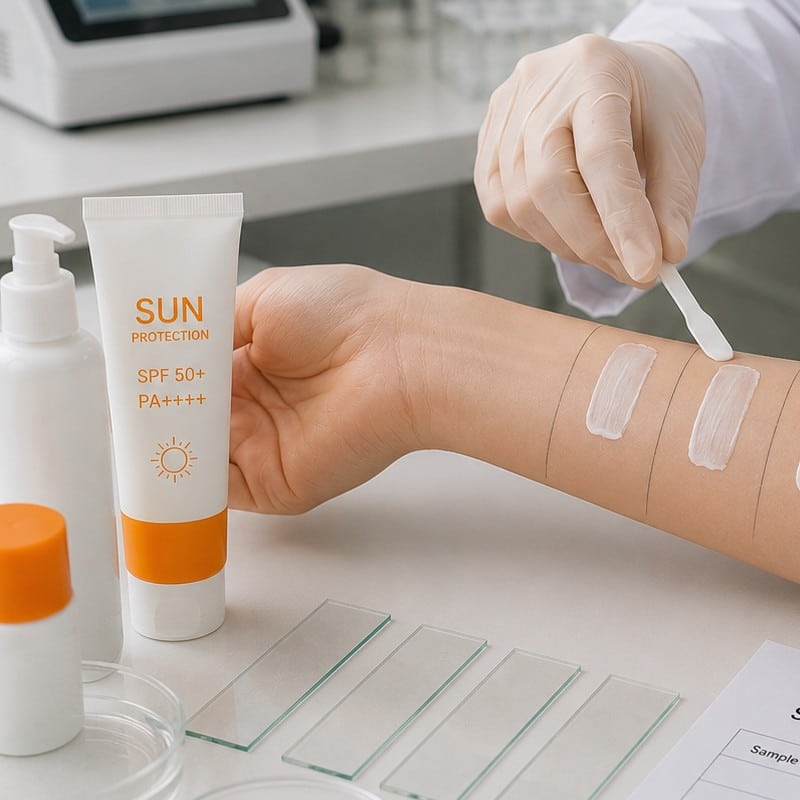
Unlike many cosmetic claims, SPF values cannot be estimated from a formulation or calculated from the concentration of UV filters alone. They must be determined through validated test methods that demonstrate the level of protection provided by the finished product.
Within the European Union, sunscreen products are regulated as cosmetics under Regulation (EC) No. 1223/2009. In addition to complying with the Cosmetics Regulation, manufacturers should follow the European Commission’s Recommendation 2006/647/EC on the efficacy of sunscreen products and the claims made relating to them. This Recommendation establishes principles for substantiating sunscreen claims and has become the accepted reference throughout the European cosmetics industry.
Are SPF Tests Legally Required?
The Cosmetics Regulation does not contain a specific article stating that every sunscreen must undergo an SPF test. However, manufacturers are legally responsible for ensuring that all cosmetic claims are truthful, supported by adequate evidence, and do not mislead consumers.
An SPF value is an efficacy claim. Under Commission Regulation (EU) No. 655/2013, cosmetic claims must be supported by sufficient and verifiable evidence. Since the SPF number communicates a measurable level of protection, appropriate laboratory testing is generally expected to substantiate that claim.
In practice, cosmetic products marketed with SPF claims must have test data demonstrating that the declared protection level is accurate.
What Does SPF Measure?
SPF, or Sun Protection Factor, measures how effectively a sunscreen protects the skin against ultraviolet B (UVB) radiation.
UVB rays are primarily responsible for sunburn and contribute to skin damage and the development of skin cancer. The SPF value indicates the level of protection provided under controlled testing conditions.
A higher SPF generally provides greater protection against UVB radiation, although the increase is not proportional. For example, SPF 50 does not provide twice the protection of SPF 25.
Importantly, SPF does not measure protection against ultraviolet A (UVA) radiation. UVA protection is evaluated separately using dedicated test methods and has its own regulatory expectations.
Which Test Methods Are Used?
European guidance recognizes internationally accepted standardized methods for determining SPF performance.
Traditionally, SPF has been measured through in vivo testing, where the sunscreen is applied to the skin of volunteer participants under carefully controlled laboratory conditions. The product’s ability to delay UV-induced skin reddening is then compared with untreated skin to calculate the SPF value.
In recent years, validated in vitro methods have also become increasingly important. Scientific advances and regulatory efforts to reduce testing involving human volunteers have led to the development of alternative laboratory methods for certain sunscreen evaluations. Depending on the claim and the applicable standards, these methods may be used where they have been appropriately validated.
How Are SPF Claims Classified?
The European Commission recommends simplifying sunscreen claims to make them easier for consumers to understand.
Rather than emphasizing precise SPF numbers alone, sunscreen products are generally classified into four protection categories:
- Low protection
- Medium protection
- High protection
- Very high protection
Each category corresponds to specific SPF ranges. For example, products labeled SPF 50 or SPF 50+ fall within the “very high protection” category.
This approach helps consumers compare products more easily while reducing the risk of misleading marketing.
What About UVA Protection?
European recommendations emphasize that effective sunscreen products should protect against both UVB and UVA radiation.
To support balanced protection, the measured UVA protection factor should be at least one-third of the labeled SPF value. In addition, the product should satisfy the recommended critical wavelength criteria that demonstrate broad-spectrum UV protection.
When these requirements are met, manufacturers may use the UVA logo commonly displayed on sunscreen packaging throughout Europe.
Because UVA testing involves separate procedures and evaluation criteria, it is considered an independent part of sunscreen performance assessment.
Why Can’t SPF Be Calculated from the Formula?
Manufacturers sometimes estimate an expected SPF during formulation by considering the types and concentrations of UV filters used.
However, the actual protection provided by the finished sunscreen depends on many interacting factors, including ingredient distribution, particle size, emulsification, film formation on the skin, product application characteristics, and formulation stability.
Small formulation changes may significantly alter sunscreen performance, even when the UV filters themselves remain unchanged.
For this reason, laboratory testing of the finished product remains essential.
Which Products Need SPF Testing?
Any cosmetic product that claims to provide sun protection should have evidence supporting its SPF claim.
This includes traditional sunscreens as well as products such as facial moisturizers, day creams, foundations, lip balms, BB creams, CC creams, and other cosmetics marketed with SPF values.
Even if sun protection is presented as a secondary benefit, manufacturers are expected to substantiate the declared level of protection.
Ensuring Long-Term Sunscreen Performance
Demonstrating the initial SPF value is only part of the product evaluation.
Manufacturers should also ensure that the sunscreen maintains its performance throughout its intended shelf life. Stability studies help verify that the formulation remains physically and chemically stable and that the UV filters continue to perform as expected under normal storage conditions.
Packaging compatibility may also influence sunscreen performance, particularly where sensitive UV filters could be affected by light, oxygen, or interactions with the packaging material.
Common Reasons Products Fail SPF Testing
Occasionally, sunscreen products do not achieve the expected protection level during laboratory testing.
This may occur because the UV filters are not optimally balanced, the formulation does not create a uniform protective film on the skin, active ingredients become unstable over time, or manufacturing variations affect product consistency.
If testing demonstrates that the measured SPF is lower than the claimed value, manufacturers may need to reformulate the product, adjust the declared SPF claim, or repeat testing after making improvements.


