
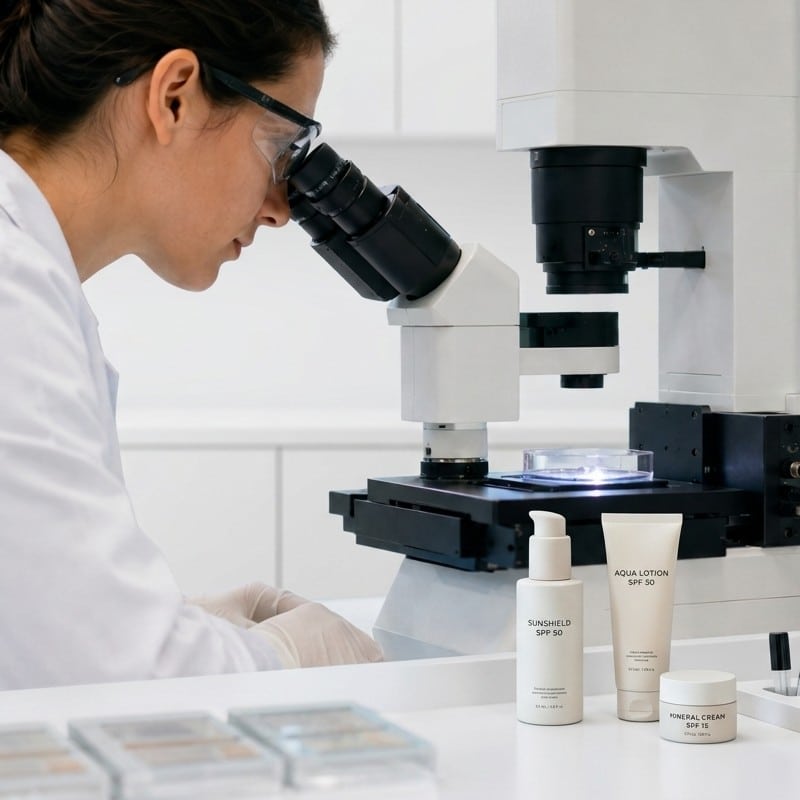
In response to these concerns, the industry, regulators and standardisation bodies have spent years developing alternative approaches capable of delivering reliable SPF measurements while reducing the dependence on human testing. The result was the publication, in late 2024, of two new ISO standards: ISO 23675 for in vitro SPF determination and ISO 23698 for the Hybrid Diffuse Reflectance Spectroscopy (HDRS) method.
Now, in 2026, the discussion is how they are being implemented in practice, how regulators are responding, and whether they are currently sufficient to support photoprotection claims from a regulatory compliance perspective.
ISO 23675: the new in vitro SPF method
ISO 23675 introduces a fully in vitro approach for SPF determination. Unlike traditional in vivo methods, it does not require human volunteers.
The method is based on the application of sunscreen formulations onto specially prepared roughened plates, followed by controlled UV irradiation and spectrophotometric analysis. Using mathematical modelling and spectral measurements, the method estimates the SPF performance of the product.
One of the most important aspects of ISO 23675 is the so-called “Double Plate Method”, developed to improve film formation assessment and better simulate the way sunscreen products behave on human skin. This is particularly important because SPF performance is highly dependent not only on UV filter composition, but also on the uniformity and stability of the film formed after application.
The main advantage of ISO 23675 is clear: it eliminates the need for UV exposure on human subjects while offering high reproducibility and faster turnaround times. For manufacturers, this represents a potentially significant improvement in development efficiency and ethical compliance.
However, the method also has limitations. Certain formulations remain challenging to evaluate in vitro, particularly products containing high concentrations of inorganic filters such as zinc oxide or titanium dioxide, as well as highly pigmented, unconventional or complex textures. Water resistance assessment also remains outside the scope of the standard.
Most importantly, despite the publication of the ISO standard, ISO 23675 has not fully replaced in vivo SPF testing from a regulatory perspective.
ISO 23698 and the HDRS hybrid approach
ISO 23698 introduces a hybrid methodology known as Hybrid Diffuse Reflectance Spectroscopy (HDRS). This approach attempts to bridge the gap between purely in vitro testing and classical in vivo SPF determination.
Unlike ISO 24444, HDRS does not rely on the induction of erythema. Instead, it combines optical measurements taken directly on human skin with in vitro spectral data. The UV exposure involved is significantly lower than in traditional SPF testing and is not intended to produce visible skin damage.
From a scientific perspective, HDRS offers an important advantage: it evaluates sunscreen behaviour directly on skin, allowing better consideration of factors such as film distribution, surface topography and real-life optical interactions. Many experts consider this method particularly promising because it maintains physiological relevance while substantially reducing ethical concerns associated with erythema-based testing.
Several multicentre validation studies performed through the ALT-SPF Consortium demonstrated strong correlation between HDRS results and classical in vivo SPF values. This validation process was instrumental in supporting the publication of ISO 23698.
Nevertheless, HDRS still requires specialised instrumentation and technical expertise, limiting its immediate availability across all testing laboratories.
Industry adoption in 2026
By 2026, both ISO 23675 and ISO 23698 are actively being implemented within the cosmetic industry, particularly in research and development environments.
Many CROs and specialised photoprotection laboratories now offer these methods commercially, especially in Europe. Their use has become increasingly common during early formulation screening, benchmarking exercises and product optimisation phases.
For manufacturers, the advantages are evident. In vitro SPF determination can reduce development timelines, lower testing costs and allow faster iteration during formulation work. HDRS, meanwhile, is increasingly being used as an intermediate validation tool capable of providing physiologically relevant data without relying on erythema induction.
However, industry adoption does not necessarily mean complete regulatory substitution.
Regulatory reality
From a regulatory standpoint, the situation in 2026 remains nuanced.
Within the European Union, there is growing acceptance of alternative SPF methods, especially when scientifically validated and performed according to published ISO standards. Regulatory authorities recognise the importance of reducing human testing where possible and support the development of reliable alternative methodologies.
However, there is still no complete harmonised regulatory replacement of ISO 24444 across all jurisdictions and market situations.
While alternative methods may support product development and technical dossiers, many manufacturers remain cautious regarding exclusive reliance on ISO 23675 for final market claims.
This cautious approach is not necessarily due to doubts about scientific quality. Rather, it reflects the current regulatory landscape, where authorities and companies seek legal certainty and broad international acceptability.
For this reason, many manufacturers currently adopt a combined strategy:
- ISO 23675 during formulation development,
- HDRS for advanced validation,
- and, where required, classical in vivo SPF testing for final regulatory substantiation.
This approach is especially common among companies operating internationally or targeting markets with more conservative regulatory expectations.
A transition rather than a revolution
The publication of ISO 23675 and ISO 23698 does not represent the immediate disappearance of classical in vivo SPF testing. Instead, it marks the beginning of a broader transition within sunscreen evaluation.
The industry is progressively moving from erythema-based biological endpoints toward more instrumental, reproducible and ethically sustainable methodologies. Yet this transition requires time, regulatory harmonisation and continued confidence-building between laboratories, manufacturers and authorities.
For cosmetic manufacturers, the key challenge today is therefore not only scientific performance, but also regulatory strategy: understanding when alternative methods are appropriate, how authorities currently interpret them, and how best to combine available testing approaches in order to support compliant and credible photoprotection claims.
In that sense, 2026 may not yet be the end of classical SPF testing — but it is clearly the beginning of a new regulatory era for sunscreen evaluation.
