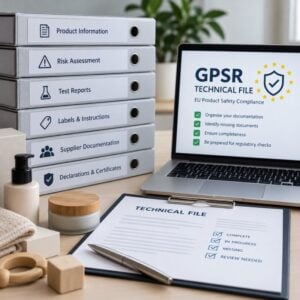
GPSR Beauty Accessories & Personal Care Safety Assessment
From: €150.00
Are you planning to sell consumer products in the European Union? The General Product Safety Regulation (EU) 2023/988 (GPSR) establishes safety requirements for a wide range of non-food consumer products placed on the EU market.
Our GPSR Safety Assessment service helps manufacturers, importers, and brands evaluate product safety and prepare the technical documentation required under Regulation (EU) 2023/988.
- Description
- Additional information
Ensure your beauty accessories and personal care products meet EU product safety requirements.
Selling beauty accessories or personal care products in the European Union? Our GPSR Safety Assessment service helps manufacturers, importers, and brands evaluate product safety and prepare the technical documentation required under Regulation (EU) 2023/988.
From eyelash adhesives and makeup brushes to facial rollers, nail accessories, oral products, tattoo and beauty tools, Certified Cosmetics provides professional product safety assessments tailored to your product’s materials, intended use, and potential risks.
What is a Beauty Accessories & Personal Care GPSR Safety Assessment?
The General Product Safety Regulation (GPSR), Regulation (EU) 2023/988, establishes safety requirements for consumer products placed on the European Union market.
Unlike cosmetic products, which are regulated primarily under Regulation (EC) 1223/2009, many beauty accessories and personal care products fall within the scope of the GPSR.
Manufacturers must evaluate potential product hazards, assess foreseeable risks, and maintain appropriate technical documentation demonstrating product safety.
Our assessment helps identify relevant safety requirements, evaluate available evidence, and determine whether additional testing or documentation is necessary.
What Does Our GPSR Safety Assessment Include?
1. Product Classification & Regulatory Review
We determine which EU product safety requirements apply to your product, including GPSR, REACH, CLP, and other relevant legislation where applicable.
2. Product Risk Assessment
Our specialists evaluate potential hazards associated with normal and reasonably foreseeable product use, including:
- Chemical exposure and restricted substances
- Skin and eye irritation risks
- Allergic reactions and sensitisation
- Sharp edges and mechanical injuries
- Material deterioration and breakage
- Small parts and choking hazards
- Packaging and leakage risks
- Incorrect or foreseeable misuse
The assessment is tailored to the product’s characteristics, intended users, and exposure conditions.
3. Technical Documentation
We prepare or review product safety documentation, which may include:
- Product identification and description
- Intended use and target users
- Material and composition information
- Applicable regulatory requirements
- Hazard identification and risk evaluation
- Existing laboratory test reports
- Relevant safety standards
- Risk mitigation measures
- Safety warnings and instructions
4. Label & Safety Information Review
We review relevant product information to identify missing or inadequate safety details, including manufacturer identification, traceability, instructions, warnings, and applicable chemical hazard labelling.
5. Laboratory Testing Recommendations
Where existing documentation does not adequately demonstrate product safety, we identify additional laboratory testing that may be necessary.
Testing is not automatically required for every GPSR product and is quoted separately.
Product-Specific Safety Considerations
A generic assessment is not sufficient for every beauty accessory. Our specialists focus on the risks associated with your particular product.
Are Laboratory Tests Mandatory?
The GPSR requires products to be safe and supported by an appropriate risk assessment and technical documentation. However, it does not establish a universal laboratory testing requirement for every product.
Testing may be necessary depending on the product’s composition, identified risks, applicable legislation, relevant standards, and available safety evidence.
For example, an eyelash adhesive may require a detailed chemical safety evaluation, while a manual facial roller may primarily require assessment of material safety and mechanical hazards.
Certified Cosmetics evaluates the available documentation and advises whether additional testing is necessary to substantiate product safety.
Documents Required
To begin your assessment, we typically request:
- Product name and description
- Product photographs
- Intended use and target users
- Manufacturer and supplier information
- Material composition or full formulation, as applicable
- Existing SDS, technical data sheets, or material specifications
- Available laboratory test reports
- Product labels, packaging artwork, and instructions
- Information about product variants, where applicable
Additional information may be requested depending on the product category and identified risks.
Start Your GPSR Safety Assessment
Make product safety a priority before entering the EU market.
- Order your assessment
Select the appropriate package and complete your purchase on our website. - Receive secure access
After purchase, you’ll receive login details to our secure portal. - Complete the intake form
Provide your product details and upload available documentation. - Send us your samples
We’ll guide you on exactly what to send to our lab. - Lab testing
Includes stability and compatibility testing (as applicable). - Receive your Technical File
Our safety assessor will prepare your Product Information File (PIF), including Parts I, II, and III.
Additional information
Preservative Efficacy Challenge Test
| Challenge Test | EP/USP 51, ISO 11930, Mixed Culture, Preservative Synergistic Effect, Re-inoculation Protocol, Vegan |
|---|
Stability and Compatibility Test
| Stability Test | Accelerated, Accelerated + Shelf Life Estimation, Thermal Shock, Thermal Shock + Shelf Life Estimation |
|---|
Frequently asked questions
Is a GPSR Safety Assessment mandatory for products sold in the EU?
Manufacturers of consumer products covered by the General Product Safety Regulation (EU) 2023/988 must carry out an internal risk analysis and prepare appropriate technical documentation. The GPSR applies from 13 December 2024. Although an independent third-party assessment is not mandatory for every product, manufacturers must ensure that their products are safe and comply with applicable EU requirements. Our GPSR Safety Assessment service helps businesses evaluate product risks and prepare supporting compliance documentation.
Which products require a GPSR Safety Assessment?
The GPSR applies to a wide range of non-food consumer products, including beauty accessories, personal care accessories, household items, home decorations, fashion accessories, candle accessories and DIY products. Products covered by specific EU legislation may also be subject to certain GPSR provisions where relevant risks or requirements are not addressed by that legislation. We review your product category to determine the applicable regulatory framework and appropriate safety assessment requirements.
Do I need a GPSR certificate to sell my products in the EU?
No. The GPSR does not establish a universal mandatory GPSR certificate. Instead, manufacturers must ensure their products are safe and maintain appropriate technical documentation, including a product risk analysis. Our GPSR Safety Assessment service provides a structured evaluation of product safety and supporting documentation. The resulting assessment is not an official government-issued certificate or guarantee of regulatory approval.
What is included in the GPSR Safety Assessment service?
Our GPSR Safety Assessment service includes a review of applicable regulatory requirements, identification and evaluation of potential product hazards, preparation of a product risk assessment, technical documentation support, and a review of relevant labelling and safety warnings. Where necessary, we also identify additional laboratory testing requirements and recommend corrective actions. The exact scope depends on the product and the documentation provided.
What documents do I need for a GPSR Safety Assessment?
We generally require a detailed product description, product photographs, manufacturer information, material composition, product specifications, intended use and available safety documentation. Depending on the product, additional documents may include Safety Data Sheets (SDS), Certificates of Analysis (CoA), laboratory test reports, applicable standards, instructions for use and existing risk assessments. Our specialists review the submitted information and advise if additional documentation is required.
What is a GPSR product risk assessment?
A GPSR product risk assessment identifies and evaluates potential hazards associated with a consumer product under normal and reasonably foreseeable conditions of use. Depending on the product, this may include physical, mechanical, chemical, electrical, thermal, flammability and hygiene-related hazards. The assessment also considers foreseeable misuse, vulnerable consumers and measures taken to eliminate or reduce identified risks. The results form an important part of the product's technical documentation.
What is included in a GPSR technical file?
A GPSR technical file includes a general product description, essential characteristics relevant to product safety, an analysis of possible risks and information about the measures adopted to eliminate or mitigate those risks. Where appropriate, it also contains applicable standards, product specifications, laboratory test reports, instructions, safety warnings and other supporting evidence. The documentation must be proportionate to the complexity of the product and its identified risks.
Is laboratory testing mandatory for a GPSR Safety Assessment?
Not for every product. The GPSR does not require identical laboratory tests for all consumer products. Testing may be necessary to demonstrate product safety, particularly where potential hazards cannot be adequately evaluated through documentation alone. Certain product categories may also have mandatory testing or conformity assessment requirements under specific EU legislation. We review your product and recommend appropriate laboratory tests where necessary.
Can multiple products be included in one GPSR Safety Assessment?
Yes, in some cases. Products belonging to the same product family with similar materials, construction, intended use and safety characteristics may be assessed together. However, variations that introduce additional hazards or affect product safety must be evaluated individually. We review your product range to determine whether several products can be covered within one assessment or require separate evaluations.
Can you assess products manufactured outside the European Union?
Yes. We can assist with GPSR Safety Assessments for products manufactured outside the European Union, including products imported from China, the United Kingdom, the United States and Turkey. The manufacturer or supplier must provide sufficient technical information, material specifications and supporting safety documentation. Importers must also fulfil their applicable obligations under EU product safety legislation before placing products on the EU market.
Do I need an EU Responsible Person for GPSR compliance?
Products covered by the GPSR must have a responsible economic operator established in the European Union, in accordance with the applicable requirements. Depending on the circumstances, this may be an EU manufacturer, importer, authorised representative or fulfilment service provider. The responsible economic operator performs specified compliance-related tasks and must be identified through the required product or accompanying information. The appropriate arrangement depends on your supply chain and business activities.
Does a GPSR Safety Assessment require CE marking?
No. The GPSR itself does not introduce a general CE marking requirement. CE marking is required only for products covered by specific EU legislation that mandates it, such as certain electrical equipment, toys and machinery. Products covered solely by the GPSR should not carry CE marking unless another applicable EU regulation or directive requires it. Our regulatory review helps identify whether CE marking or additional conformity assessment procedures apply to your product.
Do I need GPSR compliance to sell on Amazon, Etsy or other online marketplaces?
Yes. Consumer products offered for sale to customers in the EU must comply with applicable product safety legislation, regardless of whether they are sold through Amazon, Etsy, another online marketplace or your own webshop. Online product listings must also display certain product identification, manufacturer and responsible economic operator information, together with relevant warnings or safety information as required by the GPSR. Marketplaces may request supporting technical documentation or compliance evidence.
How long must GPSR technical documentation be retained?
Under the GPSR, manufacturers must retain technical documentation for 10 years after the product has been placed on the market and make it available to market surveillance authorities upon request. Importers also have obligations concerning the availability of technical documentation. Additional record-retention requirements may apply under product-specific EU legislation. Maintaining complete and organised documentation is important for demonstrating continued compliance.
What happens if I change my product design, materials or components?
Changes to a product's materials, construction, components, intended use or other safety-related characteristics should be reviewed to determine whether the existing GPSR Safety Assessment remains valid. Significant modifications may introduce new hazards or change the level of risk. Depending on the modification, an updated risk assessment, additional laboratory testing or revised technical documentation may be required before the modified product is placed on the market.
How long does a GPSR Safety Assessment take?
The processing time depends on the complexity of the product, the completeness of the submitted documentation and whether additional information or laboratory testing is required. Products with complete technical documentation can generally be assessed more efficiently than products requiring extensive investigation or testing. We can provide an estimated processing time after reviewing your product information and determining the scope of the assessment.
Is a GPSR Safety Assessment enough to legally sell my product in the EU?
Not necessarily. A GPSR Safety Assessment and supporting technical documentation are important parts of product safety compliance, but additional obligations may apply. These include product traceability, compliant labelling, appropriate safety instructions, responsible economic operator requirements and post-market safety responsibilities. Depending on the product, additional EU legislation, testing or conformity assessment procedures may also be required. Our service helps identify the relevant requirements and documentation needed to support compliance.
Can Certified Cosmetics also help with product labelling and additional safety testing?
Yes. Certified Cosmetics provides regulatory support for consumer products, including GPSR Safety Assessments, technical documentation preparation, product labelling reviews and guidance on additional laboratory testing. Where further testing or compliance services are necessary, we can help identify the appropriate requirements and next steps. Our goal is to support manufacturers, importers and retailers in preparing their consumer products for the European market.