
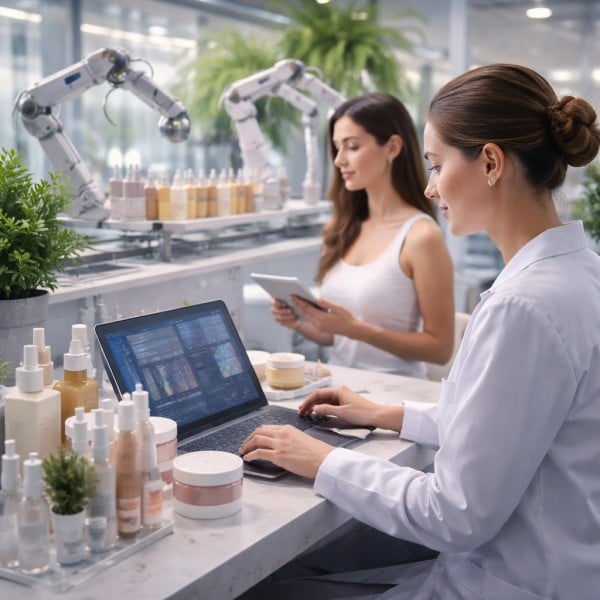
The beauty industry has entered a technology-driven competition. Companies lacking their own data capabilities and computing resources risk losing independence, with AI now deeply involved in formulation, manufacturing, and consumer experiences. Processing power is no longer a minor factor. GPUs-key to large-scale data operations-are at the forefront. Both states and private groups compete fiercely to secure thes vital components and build high-capacity AI facilities.
the Race for AI Muscle in Cosmetics
Artificial intelligence shapes every stage of the cosmetic product journey, from research to retail. Running AI at enterprise scale demands robust computing resources that only high-speed chips can offer.

South Korea’s Strategic GPU Partnership
In a notable move, Nvidia granted South Korea early shipments of its Blackwell GB300 chips, alongside priority to Vera Rubin series GPUs.By joining forces with leading cosmetic giants, South Korea pursues the creation of expansive AI-driven manufacturing plants, targeting a cache of nearly 260,000 GPUs for its projects.
Advances in Beauty Devices
Forward-thinking cosmetic brands use AI to mine large data sets for detailed product customization and have started embedding AI directly into new gadgets. At industry trade shows, Amorepacific debuted its skin sensors, while AI-powered mirrors also drew attention. These devices collect fresh data streams, enabling ongoing improvements in both tailored products and innovation pipelines.
Personalization on the Nvidia platform
Azita Martin, who leads retail and CPG at Nvidia, told Personal Care Insights that brands increasingly tap into Nvidia’s technology stack to handle large-scale personalization. Their goal: turn lengthy R&D pipelines into rapid, consumer-ready recommendations. For beauty, speed and precision in personalization have become critical objectives.
The Value of Quality Data
Anastasia Georgievskaya,a co-founder of Haut.AI, emphasizes that access to powerful hardware can help, but true progress depends on validated clinical data. Real advancement comes from making decisions grounded in science rather than accelerating processes-raw speed alone does not decide who wins.
AI Factories: Modern Examples
Active investment in GPU resources has fueled South Korea’s AI factory development. In the Pyeongtaek 2 facility run by Cosmax-the world’s top original design manufacturer for beauty-AI-driven production now yields 10.2 units per second. Their color-matching AI cut development stages from five to three and trimmed simulation cycles for R&D.
Kolmar korea introduced an integrated system that enables users to develop product formulas, select packaging, and define color palettes in a half-minute. The result is faster collaboration with manufacturers and a reduced timeline from initial idea to finished product.
Global GPU Supply Struggles
The begining of 2026 has been marked by acute GPU shortages as industries compete for AI power. Georgievskaya reiterates that without deep, credible data and industry knowledge, extra hardware does not produce better results. Rushing with more GPUs,without a robust data strategy,only amplifies noise.
From Infrastructure to Brand Distinction
According to Nvidia, once the technological base is locked in, brands differentiate themselves by crafting unique applications. Integrating robotics and AI,modern factories deliver both speed and adaptability. Standout beauty firms refine open-source AI with private research and proprietary formulas, building systems competitors cannot copy. This focus on data integration across different channels is central to setting themselves apart.
Digital Advisors: The Beauty Genius Example
L’Oréal worked with Nvidia to launch Beauty Genius, a tool that leverages generative AI and augmented reality. Consumers receive tailored product advice, category overviews, real-time skin analysis, and precise routine suggestions from over 750 L’Oréal Paris products. the digital advisor draws on a century of scientific research and modern computer vision, improving the match between products and individual needs.
Direct-to-Consumer AI Interaction
Haut.AI rolled out Skin.Chat, giving brands a way to drive AI-powered conversations on their websites. these platforms guide clients to products that match their profile, budget, or ingredient demands. Tools like Beauty Genius would not function without strong, brand-owned data sources.
Georgievskaya highlights a new consumer standard: personalization must feel real and effective, not generic. Influence marketing alone will not persuade today’s buyers. By using frist-party data, brands can track which product needs remain unmet, using that knowledge to adjust product offerings. This instant feedback loop supports smarter development and marketing planning.
The Future of Wearable Diagnostic Devices
at CES 2026, Amorepacific introduced Skinsight, a wearable system for real-time monitoring of skin health. The patch uses Bluetooth to sync with its AI software, tracking metrics such as firmness, temperature, hydration, and light exposure through daily life.
AI examines these data points to pinpoint skin-aging drivers and forecast wrinkles. It tailors recommendations for daily care routines and validates product results with live data rather of relying only on user surveys or limited clinical testing. This marks a shift toward continuous efficacy monitoring.
Toward Fully Personalized Beauty Solutions
Industry leaders predict that AI diagnostics and real-time sensors will soon move from novelty to expectation. Current progress in sensor miniaturization, processor chips, and software is giving rise to a new standard: highly customized care for every user. Digital diagnostic tools are likely to become mainstays as interest in tracking wellness and beauty data grows.
Competitive edge in beauty now grows from advances in technology. The race for better AI systems and deeper data insights is reshaping the industry’s future.
