

New EU anti-greenwashing rules are set to change how beauty and personal care companies talk about sustainability. From September 27, national laws implementing the new consumer protection directive will apply across all EU member states. The rules introduce stricter requirements for environmental claims and clearer expectations around evidence and verification. For the beauty industry, this means sustainability claims will need to be more specific, transparent, and supported by credible evidence.
What the new EU rules mean for beauty brands
The new directive introduces stricter guidelines for environmental claims made about consumer products. Directive (EU) 2024/825 bans generic environmental claims that are not backed by sound evidence.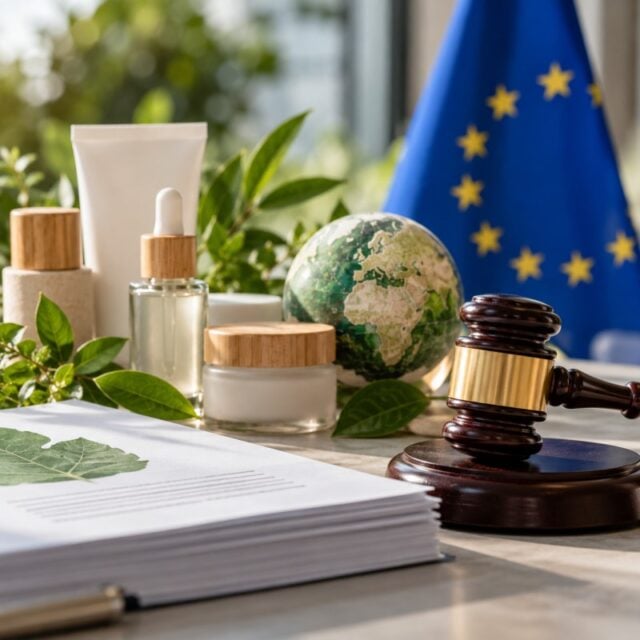
This matters for cosmetics and personal care products, where sustainability can involve many different parts of the value chain. Ingredients, formulation, packaging, manufacturing, and distribution can all involve environmental considerations.
Once the rules take effect, sustainability labels will need to be based on third-party verified certification systems. Environmental benefit claims will face closer scrutiny, while broad sustainability statements will need stronger evidence and credibility.
The directive entered into force on March 26, 2024. Enforcement and penalties across the EU begin on September 27.
Broad claims will need stronger evidence
One of the clearest changes concerns general environmental statements. Claims such as “green,” “eco-friendly,” and “climate-friendly” will no longer be allowed without sufficient evidence.
Environmental claims must be clear, specific, and substantiated. A company cannot give consumers the impression that an environmental benefit applies to an entire product when it actually relates only to one particular component or aspect.
There is a specific restriction around climate claims too. A product cannot be described as having a neutral, reduced, or positive climate impact when that claim is based only on offsetting greenhouse gas emissions outside the product’s value chain.
The purpose is to help consumers distinguish between genuine environmental performance and marketing language that is difficult to prove. At the same time, credible sustainability communication should remain possible. Clear information can help consumers make more informed choices and support investment in better products.
More attention on data and certification
The new rules could influence how companies approach sustainability across the industry. As businesses become more careful about the environmental claims they make, there could be greater investment in data collection, traceability, environmental assessment, and credible certification.
Certification systems with clear criteria and independent verification may become more valuable. They provide a structured way to demonstrate that defined requirements have actually been met.
The rules should still remain proportionate and practical. Environmental assessment can be complex, particularly for SMEs. Requirements should not create unnecessary duplication where robust evidence or recognized certification already exists.
The wider direction is clear. Sustainability communication is expected to move away from broad headline claims and toward more specific and transparent information.
Climate-related language based on carbon offsetting will need particular care. The directive specifically prohibits claims that a product has a neutral, reduced, or positive climate impact when this is based on offsetting greenhouse gas emissions outside the product’s value chain.
Sustainability could influence product development
The directive could affect more than advertising and packaging. If environmental performance needs to be demonstrated more precisely, companies have a stronger reason to understand the environmental characteristics of their products throughout development and across their supply chains.
For cosmetics, this could mean greater attention to ingredient sourcing, formulation choices, packaging materials, manufacturing processes, and other measurable aspects of environmental performance.
The result could be a closer connection between sustainability information and the way products are developed.
What companies need to review
Companies should begin their compliance process by reviewing the environmental claims they currently use across packaging, websites, advertising, social media, and other consumer-facing communications.
Each claim needs a clearly defined scope and appropriate evidence. If a claim concerns a particular ingredient, packaging component, manufacturing process, or another specific part of a product, that should be communicated precisely. Consumers should not be left to assume that the environmental benefit applies to the entire product.
Future environmental claims will need particular attention. A statement about future environmental performance cannot simply express an ambition.
Such claims must be supported by clear, objective, publicly available, and verifiable commitments. They must include measurable and time-bound targets, a realistic implementation plan, and independent verification.
Independent certification has a bigger role
Independent certification can help companies demonstrate compliance with the new requirements.
A credible certification scheme should have clearly defined and publicly available criteria, require evidence of compliance, and include independent third-party verification.
Certification schemes themselves will need to meet defined transparency and independent-monitoring requirements under the new rules.
Sustainability labels will only be permitted if they are established by a public authority or operated as a certification scheme with independent third-party verification, publicly available criteria, transparent and non-discriminatory access, and monitoring consistent with recognized standards such as ISO 17065.
Self-declared sustainability labels without independent verification will face greater restrictions under the new framework.
Recognized third-party certification should be considered early in the product roadmap rather than sought only after a sustainability claim is already on the market.
The basic approach is straightforward. Companies need to define each sustainability claim, identify the supporting evidence, establish its scope, and make sure the communication accurately reflects what has actually been demonstrated.
The bigger climate picture
The cosmetics industry is already gradually moving from claims-led sustainability toward evidence-led sustainability. The ECGT Directive is expected to encourage and accelerate this broader shift as companies work through the new compliance requirements.
The directive is only one part of a much broader transition. It cannot by itself reduce emissions from the cosmetics industry.
Its main value is improving the quality of information available to consumers and the integrity of sustainability communication. It can help prevent environmental claims from hiding the real impacts of products and encourage companies to substantiate and communicate genuine improvements.
Reliable information matters for both consumers and businesses when environmental considerations influence purchasing and product-development decisions.
Directives such as the ECGT can make sustainability information surrounding products more credible. Meaningful climate progress will still depend on the scale and speed of actual emissions reductions across the economy.
Whether the ECGT Directive will become a global model remains to be seen. Its underlying principle is that environmental communication should be credible, transparent, and verifiable. That principle is relevant beyond the EU, and greater convergence around these ideas could make it easier for consumers and businesses to navigate an increasingly complex sustainability landscape.
