

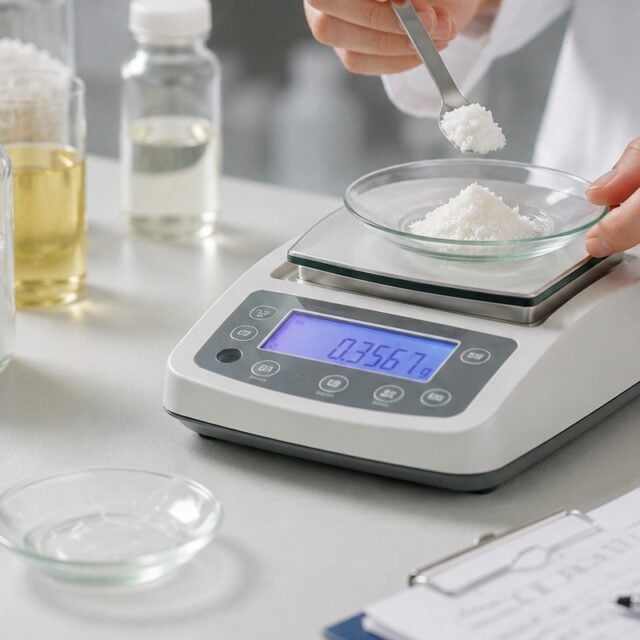
One of the most important aspects of compliance is determining whether ingredient percentages are safe and legally acceptable. This process combines toxicological assessment, exposure calculations, ingredient restrictions, and good formulation practices.
Understanding how these percentages are evaluated helps manufacturers build compliant products and allows consumers to better understand why cosmetic formulas are designed the way they are.
Why Ingredient Percentage Matters
Every cosmetic ingredient has a function, but also a toxicological profile. Water, oils, emulsifiers, preservatives, fragrances, colorants, and active ingredients all contribute differently to both product performance and safety.
An ingredient may be perfectly safe at one concentration and problematic at another. For example, preservatives are often effective only within a specific dosage range, while certain acids or essential oils can become irritating above recommended thresholds.
European legislation therefore focuses not only on which ingredients are used, but also on how much of each ingredient is present in the final formulation.
The concentration of an ingredient can influence:
- Skin irritation potential
- Eye irritation risk
- Sensitization or allergy likelihood
- Systemic exposure through skin absorption
- Product stability and microbiological safety
- Environmental impact in some cases
This is why safety assessment is a mandatory step before a cosmetic product can legally enter the EU market.
Step 1: Identify Regulatory Restrictions
EU regulation includes several annexes listing substances that are:
- Prohibited entirely (Annex II)
- Restricted to certain concentrations (Annex III)
- Allowed only in specific product categories
- Approved as preservatives, UV filters, or colorants (Annexes IV, v and VI)
Before calculating a “safe percentage,” formulators must first verify whether an ingredient is subject to any legal restriction.
For example, some preservatives may only be used up to a maximum concentration, while certain fragrance allergens require labeling above specific thresholds.
Compliance therefore begins with legal verification, not only toxicology.
Step 2: Evaluate Toxicological Data
Once regulatory compliance is confirmed, the next stage is toxicological evaluation.
Safety assessors review available scientific data, including:
- Acute and chronic toxicity
- Skin and eye irritation
- Sensitization potential
- Phototoxicity
- Mutagenicity and carcinogenicity data
- Reproductive toxicity
- Dermal absorption rates
One key reference value is the NOAEL (No Observed Adverse Effect Level), usually derived from toxicological studies.
This value helps determine the level of exposure considered acceptable without adverse effects.
However, cosmetics are not assessed based solely on ingredient hazard. The actual exposure generated by the finished product is equally important.
Step 3: Calculate Consumer Exposure
A crucial principle in cosmetic safety is that risk depends on exposure.
To estimate exposure, safety assessors consider:
- Amount of product applied
- Frequency of application
- Area of skin exposed
- Product type (rinse-off or leave-on)
- Target population
- Dermal absorption percentage
A rinse-off shampoo and a leave-on facial serum containing the same ingredient may have very different safety margins because consumer exposure differs significantly.
The Scientific Committee on Consumer Safety (SCCS) provides guidance documents widely used within the European cosmetics industry to standardize these calculations.
Step 4: Determine the Margin of Safety (MoS)
One of the central calculations in cosmetic safety assessment is the Margin of Safety (MoS), which connects toxicological data with consumer exposure.
Under EU guidance, the Margin of Safety (MoS) must be above a certain threshold, to ensure the ingredient is safe.
If the calculated margin is insufficient, the ingredient percentage may need to be reduced, even if the concentration remains legally permitted under the regulation.
This distinction is important: legal compliance alone does not guarantee product safety.
Special Attention for Fragrances and Essential Oils
Fragrance materials often require particularly careful concentration management because they are among the leading causes of cosmetic sensitization.
Certain fragrance allergens must be declared on product labels when they exceed defined thresholds:
- 0.001% in leave-on products
- 0.01% in rinse-off products
Essential oils can also present additional complexity because they are mixtures of naturally occurring compounds, some of which may themselves be restricted allergens.
A formula containing lavender or citrus oils, for example, may require evaluation of naturally occurring components such as limonene or linalool.
Preservatives: Balancing Safety and Protection
Preservatives illustrate the challenge of formulation balance particularly well.
Using too little preservative can compromise microbiological stability and consumer safety. Using too much may increase irritation risk or violate regulatory limits.
Under EU legislation, only approved preservatives listed in Annex V may be used for preservation purposes, and only within permitted concentration ranges.
Formulators therefore aim to identify the minimum effective concentration capable of passing microbiological challenge testing while maintaining a comfortable safety profile.
The Importance of Finished Product Assessment
Ingredient calculations alone are not sufficient. The final cosmetic product must also be assessed as a whole.
Interactions between ingredients can influence:
- Skin penetration
- Stability
- pH-dependent irritation
- Preservative effectiveness
- Oxidation and degradation
This is why stability, compatibility and microbiological testing remain essential parts of cosmetic compliance.
A theoretically safe formula on paper may still become unsafe if instability alters the product over time.
