
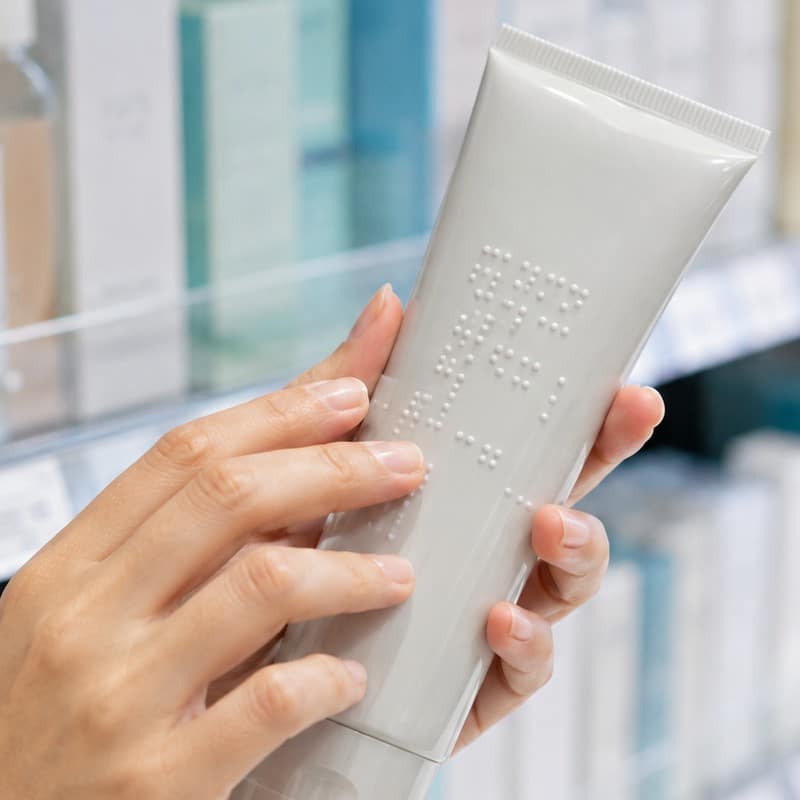
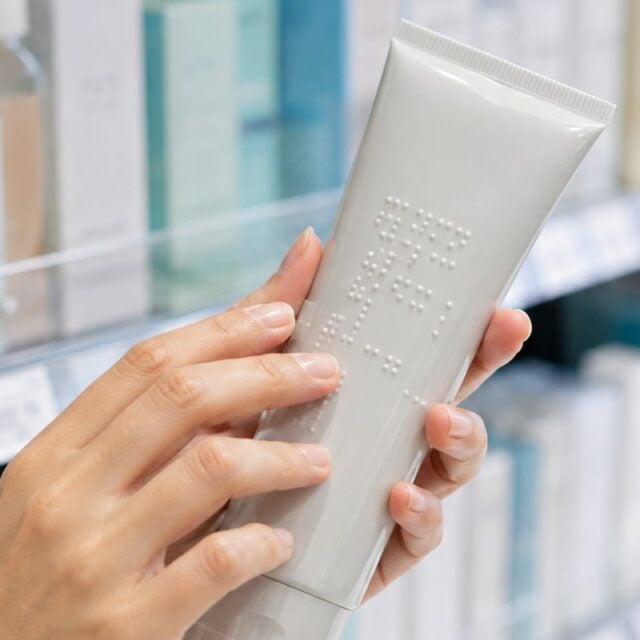
On August 6, 2026, the MFDS published draft Guidelines on Braille Labeling for Cosmetics. The proposal establishes specifications, placement requirements and implementation methods for Braille and QR codes that provide voice or sign-language video information.
The initiative is intended to make essential cosmetic information more accessible to consumers with visual or hearing impairments and to provide manufacturers with clearer technical standards for implementing accessibility features.
The consultation is open until August 31, 2026.
Why is South Korea introducing these guidelines?
South Korea’s Cosmetics Act already provides a legal basis for offering additional information in accessible formats. Under Article 10(3), mandatory cosmetic information displayed on containers or packaging may also be accompanied by Braille, voice conversion, sign-language video conversion codes or similar tools for consumers with disabilities.
Until now, however, there have been no sufficiently detailed and uniform technical standards governing how these features should be produced or where they should appear on packaging.
The new draft guidelines aim to fill that gap by translating the general legal requirement into practical specifications that cosmetic companies and packaging suppliers can follow.
Which products and companies are covered?
The proposed guidelines can be applied to all cosmetics.
They are relevant not only to cosmetic responsible sellers and manufacturers, but also to companies involved in packaging production, Braille printing and the creation of accessible voice or sign-language video QR codes.
This broad scope is important because accessibility labeling will often involve several parties. A cosmetic company may need to coordinate its artwork and packaging specifications with external packaging manufacturers or specialist accessibility service providers.
What would the Braille requirements look like?
Under the proposal, the product name would be the primary information provided in Braille. Where the available space on a container or package is insufficient, manufacturers could use a shortened portion of the product name, provided that it remains sufficient to identify the product.
Other information could also be provided, including an indication that the product is a functional cosmetic, directions for use and other basic information considered useful to visually impaired consumers.
The draft also establishes technical requirements for the physical Braille dots. These include a dot height of approximately 0.4–0.9 mm, a dot diameter of 1.5–1.6 mm and an inter-dot distance of 2.3–2.5 mm. Required spacing between Braille cells would vary depending on the packaging material, while the vertical distance between lines would generally need to be at least 10 mm.
Where the characteristics of the packaging material make the standard dimensions difficult to achieve, the proposed rules would allow a lower dot height of 0.2 mm or more.
The MFDS also recommends using embossed Braille. Depending on the packaging material and design, other approaches such as Braille stickers, tags or transparent embossed Braille may also be used, provided that the method is safe for consumers.
Where should Braille be placed?
The proposed placement rules are designed to make the Braille easy to locate while reducing the risk of damage during manufacturing and handling.
In general, Braille should be positioned toward the upper portion of the main display panel, or toward the upper right where the orientation of the package is clearly distinguishable.
Manufacturers should avoid placing it over seams, cutting lines or other areas that could interfere with the tactile information. The draft recommends keeping the Braille at least 4 mm away from the edge of the packaging and avoiding overlap with conventional printed information.
These requirements could have a practical impact on packaging design. Companies developing new cosmetic packaging may need to reserve sufficient space for accessibility information at the design stage rather than attempting to add it after the artwork has been finalized.
QR codes would provide more extensive accessible information
The second major element of the proposal concerns QR codes that can connect consumers to voice or sign-language video information.
Unlike Braille, which is intended to provide a limited amount of tactile information directly on the package, these codes could provide a much broader set of product details.
The proposed QR code would be square and have a maximum width and height of 18 mm, with 15 mm recommended. Resolution should be at least 300 DPI, and the code should be surrounded by a white border of at least 1 mm.
The border may also include an indication that accessible voice or sign-language information is available.
The code could be applied using methods such as indelible ink, engraving or stamping. To make it easier for visually impaired users to locate, the draft recommends adding a tactile border or raised markings around the code. A four-sided tactile surround is preferred, although at least two adjacent sides would also be acceptable.
What information could be provided through the QR code?
The accessible QR code is intended to provide considerably more information than can normally be communicated through Braille on a small cosmetic package.
Depending on the product, the linked content could include the product name, responsible seller’s name and address, full ingredient list, net contents, batch number, expiry or use-by date, functional cosmetic status, precautions, claimed effects, directions for use and dosage, as well as other information needed for safe and appropriate use.
For sign-language content, the draft states that Korean Sign Language should generally be used in accordance with the relevant legislation. Where a proper name or other term has no corresponding sign, finger spelling may be used.
This means that companies implementing the QR-code approach may need to consider not only packaging design but also the accessibility and accuracy of the digital content to which the code directs consumers.
What should cosmetic companies prepare for?
The draft guidelines are not yet final requirements, but they provide a useful indication of the MFDS’s direction of travel.
Companies operating in South Korea should review their packaging development processes and consider whether sufficient space can be allocated for Braille or accessible QR codes. Coordination between regulatory, packaging, design and digital-content teams may become increasingly important.
Packaging suppliers and specialist accessibility providers should also review the proposed technical specifications, particularly the dimensional requirements for Braille and QR codes.
The consultation remains open until August 31, 2026. Companies that manufacture, market or package cosmetics in South Korea may wish to follow the finalization of the guidelines closely, as the eventual requirements could affect both existing packaging practices and the design of future products.
