
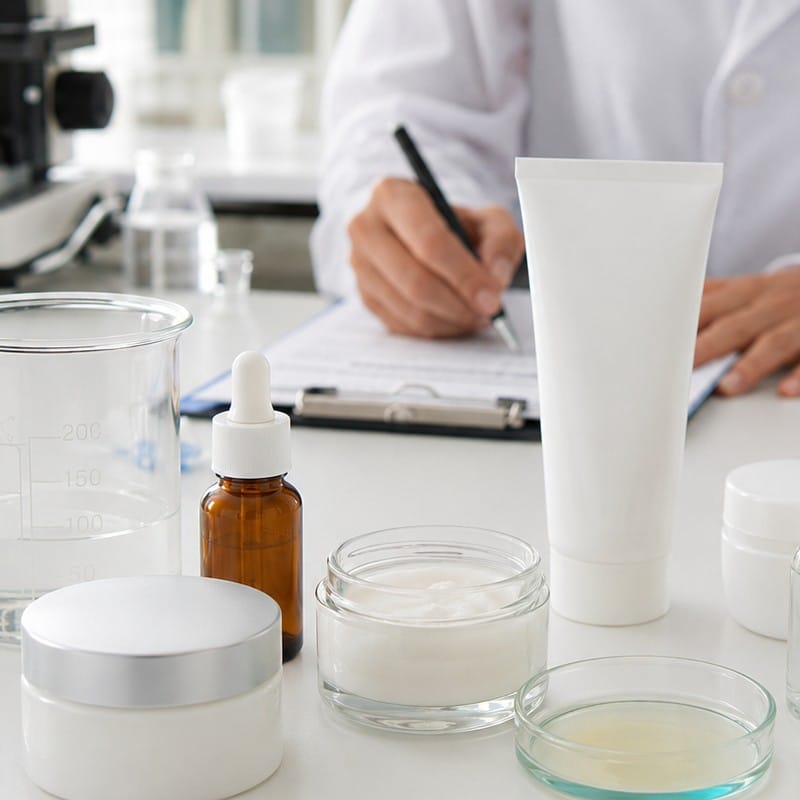
Under Regulation (EC) No 1223/2009, manufacturers are responsible for ensuring that every cosmetic product placed on the European market is safe. However, the Regulation does not prescribe a single testing package for every formulation.
In reality, testing follows a risk-based approach. The required evidence depends on factors including:
- The formulation and ingredients
- The presence or absence of water
- The packaging
- The intended use
- The target consumer
- The claims made for the product
Water-based products usually require the most extensive testing
Products containing water generally present the highest microbiological risk because water supports microbial growth.
Creams, lotions, gels, shampoos, conditioners, liquid soaps and many serums typically require a comprehensive laboratory evaluation. Depending on the formulation, this commonly includes stability testing, microbiological quality testing and preservative efficacy testing.
Packaging compatibility is also frequently assessed, particularly for products intended to remain in contact with their container for long periods.
Because these formulations are often used repeatedly after opening, the effectiveness of the preservation system becomes particularly important.
Anhydrous formulations may require a different approach
Products containing little or no water usually present a much lower microbiological risk.
Examples include facial oils, body oils, lip balms, wax-based products and many oil-based makeup formulations.
Although preservative efficacy testing may not always be necessary, these products still require appropriate laboratory evaluation. Oxidation, colour changes, odour development and packaging compatibility can all affect product quality over time.
The absence of water reduces one type of risk but does not eliminate the need for stability assessment.
Solid products have their own considerations
Solid cosmetics include products such as soaps, shampoo bars and certain cleansing bars.
Their microbiological behaviour differs from that of liquid products, particularly when water activity is naturally low. However, laboratories may still evaluate physical stability, appearance, packaging compatibility and microbiological quality where appropriate.
Products intended to be repeatedly wetted during consumer use should also be assessed according to their specific risk profile.
Emulsions require particular attention
Emulsions are among the most technically demanding cosmetic formulations.
Because they combine water and oil phases, they are susceptible to several types of instability, including phase separation, viscosity changes and emulsion breakdown.
For this reason, creams, lotions and similar products often undergo extensive stability testing to evaluate whether they maintain their intended characteristics throughout their proposed shelf life.
The complexity of emulsions means they generally require more comprehensive stability evaluation than simpler formulations.
Sunscreens require additional testing
Sun protection products represent a special category because they make regulated performance claims.
In addition to the laboratory studies commonly performed for many cosmetic products, sunscreens require specific testing to substantiate claims relating to SPF, UVA protection and, where applicable, water resistance.
These studies follow recognised international methods accepted within the European regulatory framework.
Because the testing supports product claims rather than basic stability or microbiological quality, it forms an additional part of the overall development programme.
Products for sensitive areas
Cosmetics intended for particularly sensitive areas of the body may require additional consideration during safety assessment.
Examples include products intended for the eye area, lips, intimate hygiene or use on babies and young children.
The laboratory testing itself is not necessarily different in every case, but the overall evidence supporting product safety may need to reflect the intended population and conditions of use.
The cosmetic safety assessor ultimately determines whether the available data are sufficient for the specific product.
Products with specific marketing claims
Testing requirements can also change depending on the claims made for the product.
A moisturiser promoted simply as a cosmetic may require a different testing programme from one marketed with claims relating to sensitive skin, dermatological compatibility or specific performance benefits.
Whenever objective claims require scientific substantiation, additional laboratory or instrumental studies may be appropriate to generate supporting evidence.
The more ambitious the claims, the greater the amount of evidence generally required.
Packaging influences testing requirements
The same formulation may require different laboratory evaluation depending on its packaging.
A cream packaged in an airless dispenser experiences different microbiological exposure from the same cream sold in an open jar. Similarly, flexible tubes, glass bottles and plastic containers may interact differently with the formulation.
For this reason, laboratories often consider the packaging alongside the formulation when designing the testing programme.
Testing should always reflect the final product that consumers will purchase.
Building the right testing programme
Different cosmetic products require different laboratory testing strategies because they present different technical and microbiological challenges. Factors such as formulation, water content, packaging, intended use and marketing claims all influence the studies needed to support product safety and quality.
Applying a risk-based approach allows manufacturers to generate appropriate scientific evidence while complying with European cosmetic legislation. Selecting the right testing programme from the beginning not only supports regulatory compliance but also contributes to the development of reliable, high-quality cosmetic products.


