
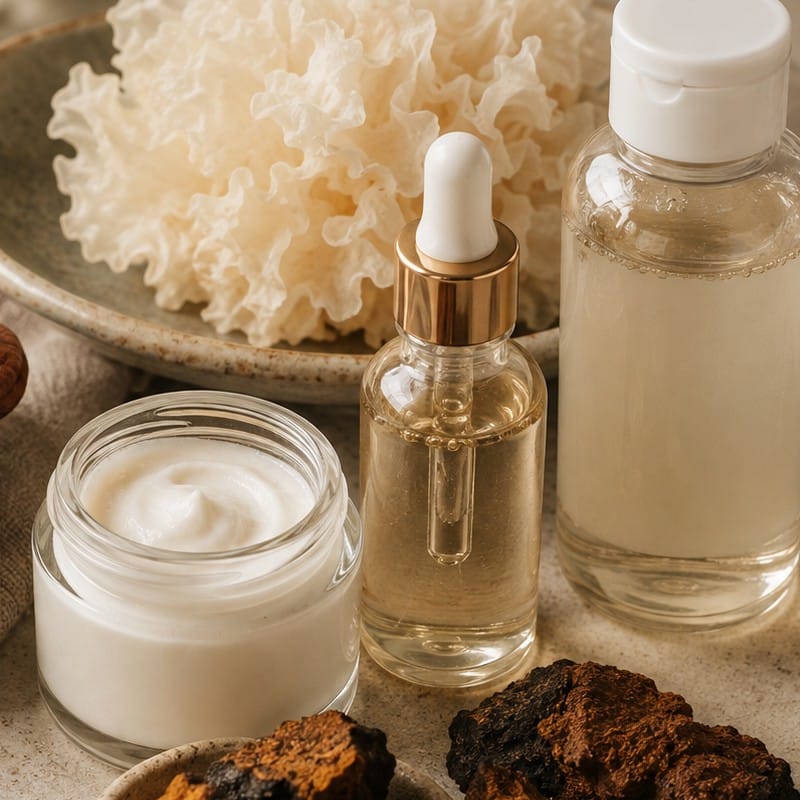
Mushroom Ingredients Redefine Cosmetic Innovation
Mushroom-based ingredients are making a notable impact within the modern cosmetics market. Where these extracts once appeared mainly in herbal remedies or dietary supplements, they are now present in facial serums, moisturizers, masks, cleansers, and edible beauty products.
A mix of factors drives this trend. Cosmetic manufacturers are searching for ingredients with natural or renewable sources that also bring tangible performance benefits.Simultaneously occurring, consumers are more attentive to product origins and are asking for proof of sustainability. Mushroom extracts meet both demands, bridging eco-kind sourcing and active benefits.
Top Trending Fungi in Beauty: Reishi, Chaga, and Tremella
Three mushroom varieties stand out: reishi, chaga, and tremella. Each offers a unique composition. They deliver valuable bioactive compounds such as polysaccharides, beta-glucans, and other molecules that support moisture retention, skin comfort, and the barrier function of the skin.
The market share for these ingredients is rising fast.Innova Market Insights reports a 14% yearly increase in cosmetic launches with mushroom ingredients from July 2021 to June 2026. Most launches are in skin and hair care, with body care seeing the sharpest expansion.
Reishi: Targeting Stressed and Sensitive Skin
Reishi (Ganoderma lucidum) enjoys strong visibility among topical cosmetic actives.
Maruzen Pharmaceuticals recently debuted Ganoderma Extract (B)-BG at in-cosmetics Global 2026 in Paris.Sourced from the mushroomS fruiting body and delivered in a water-butylene glycol blend, this extract addresses rough or reactive skin, particularly for users exposed to psychological stress.
in user trials, a lotion with 2% extract was tested on individuals with a weakened skin barrier and reported stress. Results included reduced transepidermal water loss (TEWL), less flaking, visible enhancement in redness, and lighter dark circles.
Lab studies suggest reishi extracts may modulate key skin functions: influencing cortisol activity within skin cells, boosting hyaluronic acid production, and affecting melanin synthesis enzymes. These effects may support collagen, comfort, and skin tone.
ImDerma Laboratories has taken a distinct approach using extracellular vesicles from reishi. Their ImDermalab ExoReishi comes as a water-soluble powder with trehalose and is recommended between 0.4% and 2% in formulations. Vesicles facilitate cell-to-cell signaling and can carry proteins, RNAs, and sugars. Early studies suggest these vesicles promote fibroblast activity, with ongoing research in wound and scalp benefits.
Finished brands are responding to this momentum. Seed to Skin Tuscany (Italy) features reishi in its Recovery Cream for delicate or challenged skin, describing the compound as a postbiotic rich in triterpenoids and beta-glucans. A 28-day regimen, not exclusive to reishi alone, led to user-reported improvements in dryness, irritation, and itching, along with a 1.9% drop in TEWL.
Tremella: Spotlight on Deep Hydration
Tremella, known as snow mushroom, has become popular because of its exceptional hydration properties.
Its high polysaccharide content enables it to function as a natural humectant-helping the skin to retain water and maintain elasticity. Tremella features in not only face creams but also specialized masks. for example, Mindi Walters Skincare offers an overnight mask with snow mushroom, highlighting its suitability for thin and dehydration-prone neck and décolletage areas.
Tremella’s reach extends to the beauty-from-within market as well. syren Spreads, for instance, uses tremella in a chocolate beauty spread, blending it with gotu kola and bamboo silica for added skin support. The key selling point is the mushroom’s remarkable water-holding ability, which supports both topical and edible beauty solutions.
The diversity of these applications shows that fungi extracts can cross product boundaries-from classic creams and masks to food-based beauty products-depending on their technical roles.
Chaga: Linking Wellness and Skin Health
Chaga takes a different route, gaining ground through its ties to health and nutrition sectors.
Seppic produces Chagadvance, an ingredient made from wild Finnish chaga using a hot-water process. This method preserves active compounds like beta-glucans and polyphenols. The product’s positioning is tied to immune support and the so-called “immune-skin” axis, reflecting deeper consumer interest in the interplay between overall health and skin quality.
For ingredient suppliers and brands, this evolving niche proves the line between supplements and topical cosmetics is less defined than ever. Elements once reserved for nutrition now inform skin formulations, expanding the potential uses of mushroom extracts.
Mushrooms beyond Active Agents: Formulation Tools
Beyond their use as active agents, fungi also offer functional materials for cosmetic textures and stability.
Greenitio has developed mushroom-based chitosan, a polymer that can serve as a thickener, film builder, emulsifier, or stabilizer. These options give formulators enduring alternatives to petrochemical-based components.
Replacing synthetics with natural sources can be complex,especially if high performance and processing reliability are required. Didier Vermeiren, Greenitio’s COO, highlights how most specialty chemicals are the result of decades of petroleum-focused R&D, making the transition to plant or fungi-based versions a technical challenge. The company customizes mushroom chitosan through chemical modification to fit cosmetic needs.
This proprietary process increases performance by two to four times, depending on the application. It avoids organic solvents, produces no chemical waste, and slashes carbon emissions compared to standard manufacturing methods.
Evolving from Buzz Ingredient to Essential Platform
What was once a trend centered on “green” marketing is evolving into a broad category spanning different mushroom species and functions.
Reishi is being studied for skin barrier,relief,and stress-related uses. Tremella stands out for deep moisturization. Chaga is carving a niche at the intersection of wellness and cosmetics. New materials like mushroom chitosan add another layer, providing foundational ingredients for stable, natural formulations.
For cosmetic producers, the trend offers more than just new hype. Future innovation may depend not on the superficial use of mushroom ingredients, but on integrating fungi-derived compounds across texturizers, actives, humectants, and stabilization systems.
As more products tout mushroom benefits, the key challenge will be separating solid evidence from marketing stories. Strong validation, honest ingredient breakdowns, and scientifically proven roles are becoming vital as the mushroom category matures within the beauty market.
