
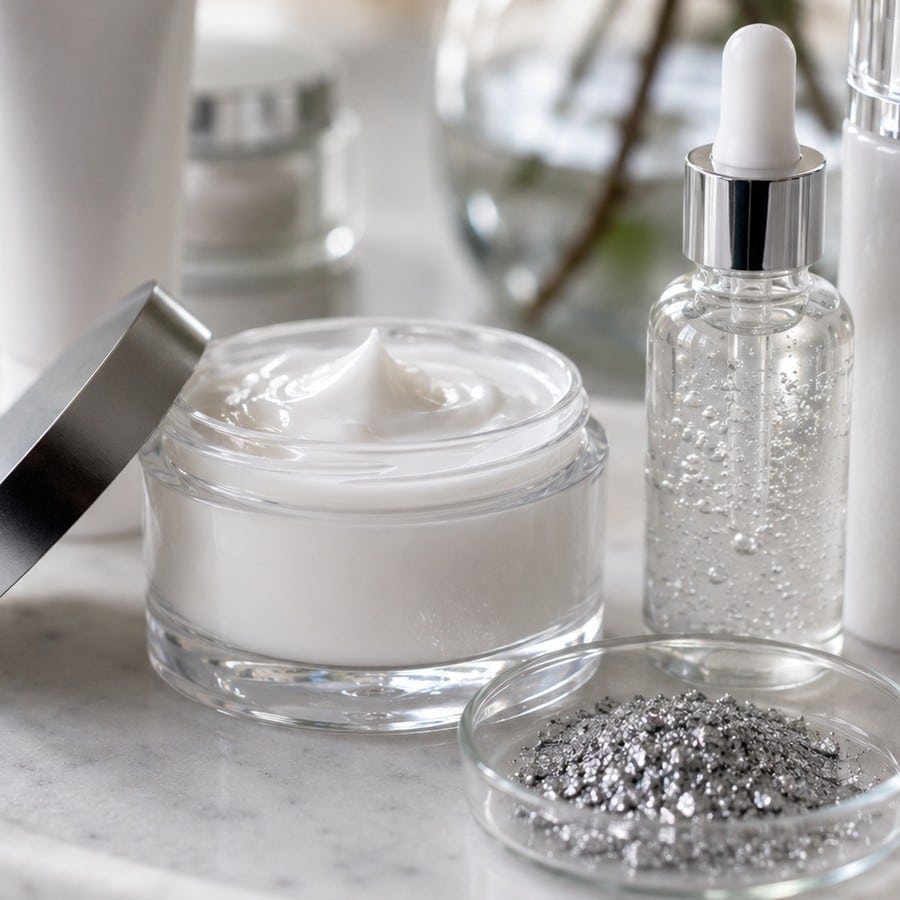
If adopted, the amendment would revise the restrictions currently applicable to silver under both Annex III, which covers restricted substances, and Annex IV, which lists authorised colourants.
Wider range of cosmetic products permitted
The proposal would substantially broaden the cosmetic categories in which micron-sized silver powder may be used.
Under the revised Annex III entry, silver (powder) [100 nm < particle diameter < 1 mm] (CAS No. 7440-22-4; EC No. 231-131-3) would be permitted at the following maximum concentrations:
- Rinse-off products: 0.2%
- Oral care products, except children’s mouthwash: 0.2%
- Children’s mouthwash: 0.05%
- Leave-on products: 0.3%
- Nail products: 0.3%
These limits apply exclusively to silver powder with a porous and sintered particle structure. In addition, the ingredient may not be used in products that could expose consumers’ lungs through inhalation.
Scientific review prompted the regulatory update
The proposal follows new safety data submitted to the European Commission after the adoption of Omnibus Act VIII, which introduced the current restrictions on silver in 2025.
At that time, the ingredient was authorised only in toothpaste and mouthwash, both with a maximum concentration of 0.05%.
An updated dossier, including additional studies on dermal penetration, was subsequently evaluated by the SCCS. Based on this evidence, the Committee issued a revised scientific opinion supporting broader uses of silver powder under specified conditions.
The draft amendment implements those conclusions by extending both the range of authorised cosmetic products and, for several categories, the maximum permitted concentrations.
Changes also proposed for silver as a colourant
The Commission also intends to amend Annex IV of the Cosmetics Regulation, which establishes the list of authorised cosmetic colourants.
Under the proposal, silver (powder) [100 nm < particle diameter < 1 mm] (Colour Index No. 77820) would be authorised as a colourant in:
- Leave-on products: 0.3%
- Nail products: 0.3%
The same technical conditions would apply. Only porous, sintered silver powder would be permitted, and its use would be prohibited in products where inhalation exposure is foreseeable.
This represents a significant expansion compared with the current legislation. Following Omnibus Act VIII, silver powder was authorised as a colourant only in lip products and eye shadows, with a maximum concentration of 0.2%. The proposed amendment would extend its use to all leave-on products and nail products while increasing the concentration limit to 0.3%.
What this means for the cosmetics industry
Although the proposal has not yet been formally adopted, it signals a more flexible regulatory approach to the use of silver powder in cosmetics where safety has been demonstrated.
Manufacturers developing products for the European market may benefit from greater formulation flexibility if the amendment enters into force. However, companies should note that the revised conditions apply only to silver powder with the specified porous and sintered particle structure and remain subject to restrictions intended to prevent inhalation exposure.
According to the draft text, the amendment would take effect on the date of its publication in the Official Journal of the European Union (OJEU). The revised provisions would apply retroactively from 1 May 2026, aligning them with the application date of Omnibus Act VIII.
