
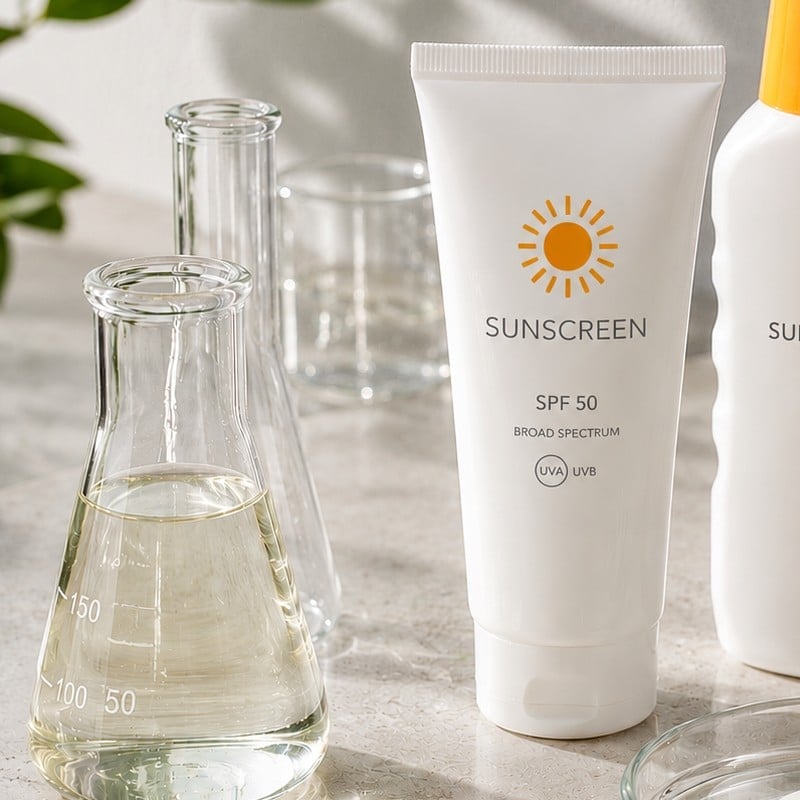
The regulation defines UV filters as substances intended to protect the skin from certain harmful effects of ultraviolet radiation by filtering UV rays.
A key principle of the regulation is that UV filters are subject to a positive list system. This means that only UV filters specifically authorized by the legislation may be used in cosmetic products for a UV-filtering function.
Annex VI: The Positive List of Authorized UV Filters
The list of authorized UV filters is contained in Annex VI of Regulation (EC) No 1223/2009.
Annex VI is not simply a list of ingredient names. For each authorized UV filter, it may establish:
- Maximum permitted concentrations.
- Restrictions on product categories.
- Specific conditions of use.
- Additional labeling requirements.
- Requirements related to nano forms of the substance.
As a result, compliance involves much more than checking whether a substance appears in Annex VI. Manufacturers must verify that the intended use fully complies with all conditions associated with that specific entry.
This approach differs from the regulatory treatment of many other cosmetic ingredients. A UV filter that is not included in Annex VI cannot be legally used as a UV filter in cosmetic products placed on the EU market.
Scientific Assessment Before Authorization
Before a new UV filter can be added to Annex VI, it undergoes a scientific safety evaluation.
The primary scientific body involved in this process is the Scientific Committee on Consumer Safety (SCCS). The SCCS reviews toxicological data, exposure assessments, and other relevant information to determine whether a substance can be considered safe under defined conditions of use.
The evaluation may lead to recommendations regarding:
- Maximum concentrations.
- Permitted product types.
- Restrictions for certain populations.
- Requirements for nano forms.
- Additional warnings or conditions.
The European Commission may subsequently amend Annex VI to reflect the scientific conclusions.
This means that the regulatory status of UV filters can evolve over time as new scientific evidence becomes available.
Compliance Is Not Static
One of the most important aspects of UV filter compliance is understanding that authorization is not permanent.
Several UV filters have been reassessed in recent years following new scientific reviews. In some cases, the SCCS concluded that previously authorized concentrations should be reduced. In others, new restrictions or labeling requirements were introduced.
Manufacturers should therefore avoid relying solely on historical formulations or outdated regulatory databases. Regulatory monitoring is a critical part of compliance management, particularly for sunscreen products and other formulations containing UV filters.
A formulation that was compliant several years ago may require reformulation or updated documentation to remain compliant today.
The Importance of Nano Forms
Nanomaterials receive particular regulatory attention under the European Cosmetics Regulation.
Some UV filters are authorized both in conventional and nano forms, while others are authorized only under specific conditions. The nano form of an ingredient may have its own regulatory entry, concentration limits, purity requirements, or labeling obligations.
Manufacturers using nano UV filters must carefully verify that the exact form of the ingredient matches the conditions described in the relevant Annex VI entry.
In addition, cosmetic products containing nanomaterials may be subject to specific notification requirements before being placed on the market.
