
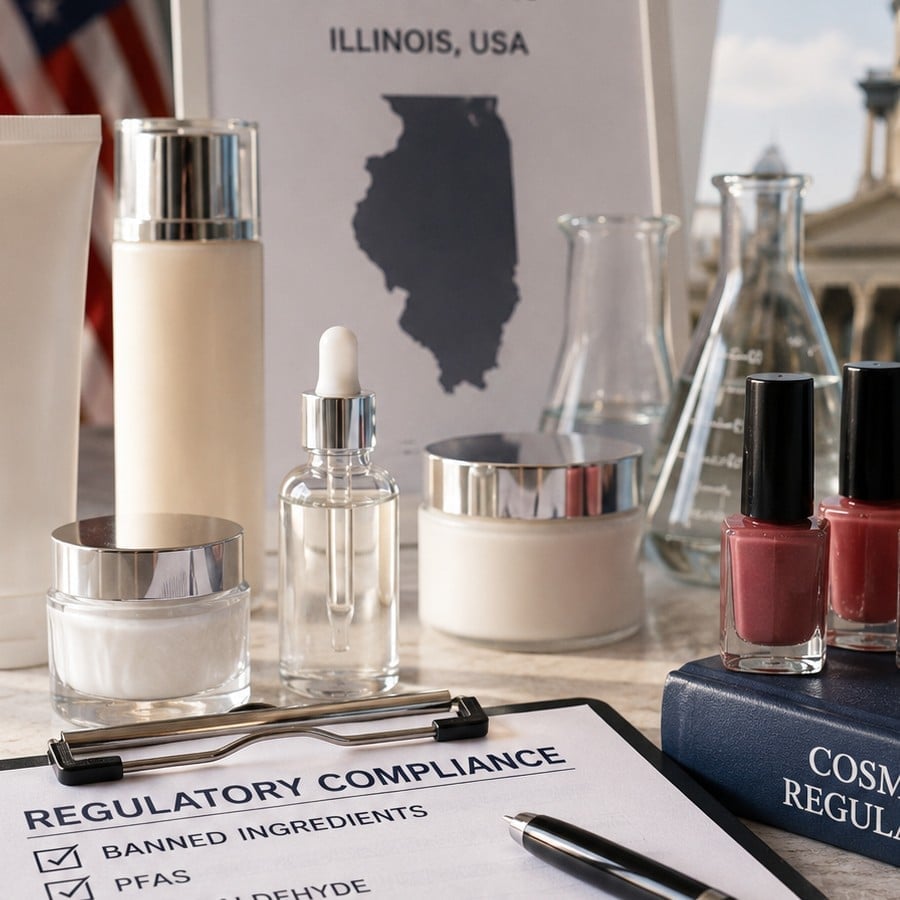
The Chemicals in Cosmetic Products Act (House Bill 3409) introduces restrictions on 24 ingredients, including certain PFAS compounds, formaldehyde, mercury and several other substances associated with potential health risks. The law will apply from 1 July 2028, giving manufacturers time to review formulations and implement any necessary changes before the requirements become enforceable.
Broad restrictions on chemicals of concern
The new legislation targets two categories of ingredients commonly scrutinised by regulators.
The first group includes 11 substances that have long been subject to health and safety concerns, such as formaldehyde and formaldehyde-releasing agents, mercury, triclosan, selected parabens, ortho-phthalates and lead above specified concentration limits.
The second group covers 13 per- and polyfluoroalkyl substances (PFAS), often referred to as “forever chemicals” because of their persistence in the environment and their tendency to accumulate over time. These substances have historically been used in certain cosmetic formulations to improve properties such as water resistance and product durability.
Wide range of cosmetic products covered
The Illinois law applies across the cosmetics sector rather than targeting individual product categories.
Products potentially affected include decorative cosmetics, hair colourants, nail products, soaps, moisturisers, fragrances, sunscreens and other personal care products sold within the state.
The legislation also includes a limited exemption for unavoidable trace contamination. Manufacturers will not be considered in violation if the presence of a restricted substance results solely from incidental contamination, such as migration from packaging materials or unavoidable manufacturing processes, provided they can demonstrate that the ingredient was not intentionally added.
Part of a broader regulatory trend in the United States
Illinois becomes one of a growing number of U.S. states adopting stricter cosmetic ingredient legislation. Similar measures have already been introduced in jurisdictions including California and New York, reflecting increasing state-level action on chemicals considered to present risks to human health or the environment.
The move also brings Illinois’ regulatory approach closer to that of the European Union, where many of the affected substances are already prohibited or subject to stringent restrictions under the EU Cosmetics Regulation.
Although the legislation will not take effect until mid-2028, manufacturers should begin assessing their product portfolios well in advance of the implementation date.
Companies selling cosmetics in Illinois should review ingredient lists, identify formulations containing the newly prohibited substances and evaluate reformulation strategies where necessary. Businesses operating across multiple U.S. states may also wish to consider harmonising formulations to accommodate the growing number of state-specific chemical restrictions.
As state-level cosmetic regulation continues to expand, proactive compliance planning will help manufacturers reduce future regulatory risks while maintaining uninterrupted market access.
