
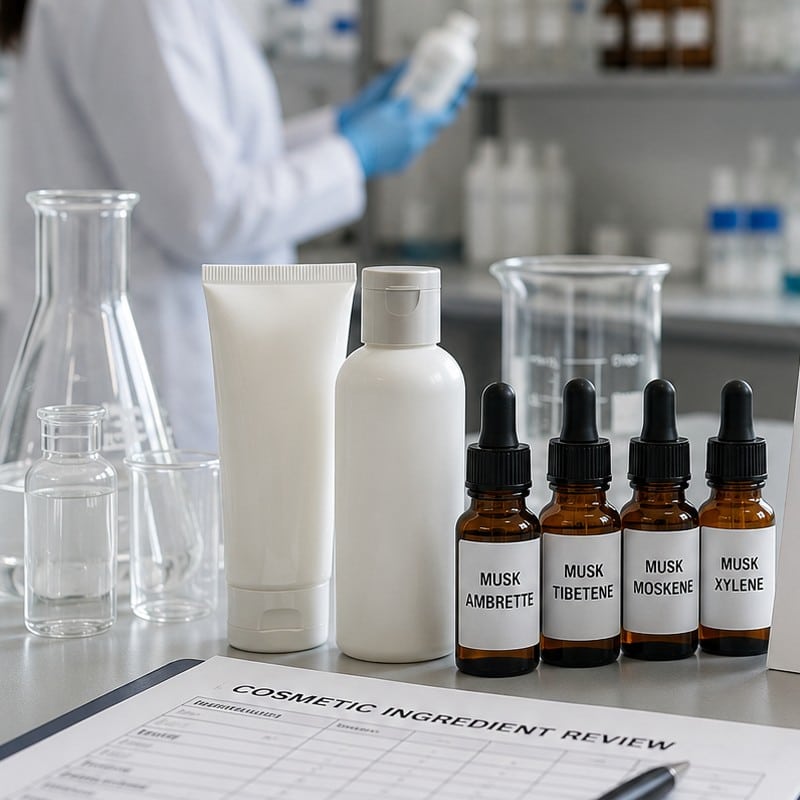
California has progressively strengthened its cosmetics legislation over recent years through several laws targeting substances considered to present potential risks to human health or the environment. The Musk Reduction Act builds on these earlier measures by extending the list of ingredients that cannot be intentionally added to cosmetic products sold within the state.
Synthetic Musks Face New Restrictions
One of the main objectives of the legislation is the reduction of certain synthetic musk ingredients commonly used in fragrance formulations.
Four nitro musks will be completely prohibited when intentionally added to cosmetic products:
- Musk ambrette
- Musk tibetene
- Musk moskene
- Musk xylene
In addition, musk ketone will remain permitted only below specific concentration limits that depend on the product category. Products exceeding these limits may no longer be marketed in California after the legislation takes effect.
Additional Ingredients Included
The Musk Reduction Act is not limited to fragrance ingredients. The law also adds several other intentionally added substances to California’s list of prohibited cosmetic ingredients, including compounds such as lily aldehyde, acetaldehyde, cyclotetrasiloxane (D4), styrene, vinyl acetate and certain boron-containing substances. These restrictions become applicable from 1 January 2027.
The legislation introduces separate requirements for cosmetic vaginal suppositories containing boric acid.
From January 2027, these products must display specific warning statements on their packaging. A further provision establishes that, beginning in 2035, cosmetic vaginal suppositories containing boric acid will no longer be permitted unless they are regulated as drug products by the U.S. Food and Drug Administration (FDA).
What Cosmetic Companies Should Do Now
Although the requirements do not become enforceable until 2027, manufacturers should already be assessing products intended for the California market.
Compliance activities may include:
- Reviewing ingredient lists for affected substances.
- Verifying fragrance compositions supplied by fragrance manufacturers.
- Reformulating products where necessary.
- Updating technical documentation and product specifications.
- Confirming that any unavoidable trace levels comply with the legislation.
Because reformulation, stability testing and packaging updates can require many months, early preparation may help companies avoid supply disruptions once the law becomes applicable.
