
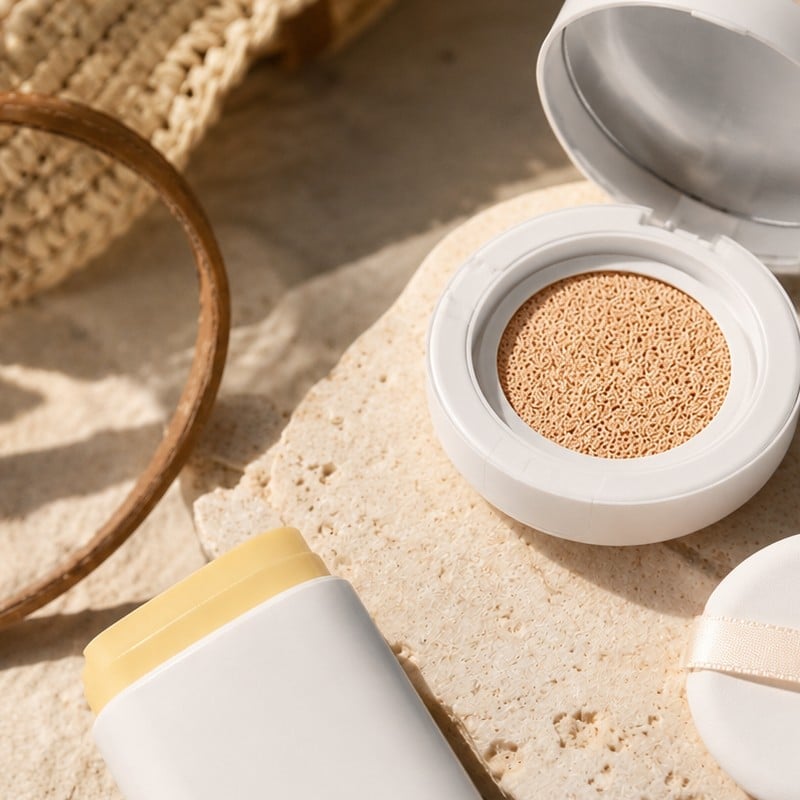
Among the formats attracting growing consumer interest are sunsticks and cushion-based sunscreen products. These alternatives to conventional creams and sprays have been developed to improve portability, simplify reapplication, and better integrate sun protection into daily skincare and make-up routines.
Although their presentation differs from traditional sunscreens, their regulatory obligations remain largely unchanged. Manufacturers and brand owners must ensure that these products comply with the same European requirements governing safety, efficacy, labelling and claims.
How Are Alternative Sunscreen Formats Classified in Europe?
Under European legislation, products intended to protect the skin from ultraviolet radiation are generally considered cosmetic products. This classification applies regardless of whether the product is presented as a cream, fluid, stick, balm or cushion applicator.
As a consequence, these products must comply with the requirements established by Regulation (EC) No. 1223/2009 before being placed on the market. This includes the preparation of a Product Information File (PIF), completion of a cosmetic safety assessment, notification through the Cosmetic Products Notification Portal (CPNP), and compliance with all applicable labelling obligations.
The fact that sunscreen products provide a measurable protective function means that regulators pay particular attention to the evidence supporting their efficacy and the way that protection is communicated to consumers.
Why Product Format Matters from a Regulatory Perspective
While the legal framework does not distinguish between sunscreen formats, the physical design of a product can create specific regulatory and technical challenges.
Solid and semi-solid sticks, for example, are often formulated with waxes, oils and structuring agents that allow direct application to the skin. Cushion-based systems, on the other hand, typically contain fluid formulations housed within a sponge or reservoir that dispenses the product through repeated use.
These differences influence several aspects of product development, including stability, microbiological quality, preservative systems, packaging compatibility and user behaviour. Importantly, they may also affect how consumers apply the product and whether sufficient sunscreen is deposited on the skin to achieve the labelled level of protection.
For this reason, manufacturers should consider not only the formulation itself but also the interaction between packaging, application method and intended use.
Formulation Considerations
As with all sunscreen products marketed in the European Union, UV filters must be selected from the substances authorised under Annex VI of the Cosmetics Regulation and used within the applicable concentration limits.
To achieve broad-spectrum protection, formulations commonly combine filters that provide coverage across both the UVA and UVB ranges. Depending on the target market and product positioning, formulations may also incorporate mineral filters, particularly in products intended for sensitive skin or specific consumer groups.
Beyond UV protection, modern sunscreen products frequently include ingredients associated with skincare benefits, such as moisturising agents, soothing compounds and skin-conditioning ingredients. While these additions may improve the sensory experience, they must not detract from the product’s primary protective function.
The chosen format also influences formulation strategy. Sticks generally require robust structural integrity and resistance to temperature fluctuations, whereas cushion systems must maintain stability and microbiological quality throughout repeated use.
Efficacy Testing
Claims relating to sun protection cannot be based solely on formulation design or theoretical calculations. Manufacturers must generate evidence demonstrating that the product provides the level of protection communicated to consumers.
In practice, this typically involves testing according to internationally recognised methodologies used throughout the cosmetics industry. SPF determination, UVA protection assessment and, where relevant, water-resistance testing form the foundation of sunscreen substantiation.
The resulting data serve multiple regulatory purposes. They support marketing claims, contribute to the product safety assessment and form part of the documentation maintained within the Product Information File.
As sunscreen formats continue to diversify, ensuring that testing accurately reflects real-world product use becomes increasingly important.
Packaging as a Compliance Consideration
Packaging is often viewed primarily as a marketing tool, but for sunscreen products it also plays a significant compliance role.
Direct-application formats can help reduce contamination risks and improve convenience during use. At the same time, packaging materials must remain compatible with the formulation throughout the product’s shelf life and preserve product quality under foreseeable storage conditions.
For cushion-based systems, microbiological control deserves particular attention due to the repeated interaction between the applicator and the product reservoir.
Sustainability objectives are also influencing packaging development across the cosmetics sector. Refillable systems, recyclable materials and simplified packaging structures are becoming increasingly common, provided that product safety and stability are not compromised.
Labelling Challenges Associated with New Formats
The rise of portable sunscreen formats has highlighted the importance of clear usage instructions.
Consumers may perceive sticks and cushion applicators as more precise or efficient than traditional products, potentially leading to under-application. However, the level of protection indicated on the label can only be achieved when the product is used in sufficient quantity.
Manufacturers should therefore ensure that instructions for use are clear, visible and consistent with the conditions under which efficacy testing was conducted.
In addition to sunscreen-specific information, labels must contain all mandatory cosmetic product information required under European legislation, including ingredient declarations, warnings and identification details.
Global Regulatory Considerations
Companies operating internationally must also account for significant differences between regulatory systems.
One of the most notable examples concerns the United States, where sunscreen products are regulated under a fundamentally different framework. Unlike the European approach, which classifies sunscreens as cosmetic products, the US treats them as over-the-counter drug products.
This distinction affects permitted UV filters, product development pathways, claim substantiation requirements and labelling formats. As a result, a product that is fully compliant for sale within the European Union may require substantial modifications before entering other markets.
For brands pursuing global launches, regulatory strategy should therefore be considered at an early stage of product development.
