
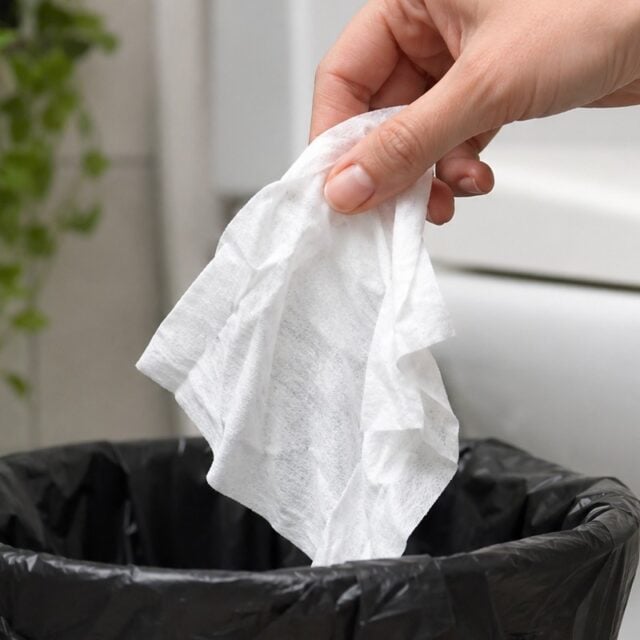
Depending on their construction, wipes may contain synthetic fibres such as polyester or polypropylene. When incorrectly flushed, these materials can contribute to sewer blockages, interfere with wastewater infrastructure and ultimately enter the environment as plastic waste.
At EU level, certain wet wipes containing plastic are already addressed by Directive (EU) 2019/904 on single-use plastics. The Directive introduced measures for specific single-use plastic products, including marking and extended producer responsibility obligations. Commission Implementing Regulation (EU) 2020/2151 establishes harmonised marking specifications for products covered by the relevant marking requirements.
Spain has implemented these marking provisions through Law 7/2022 on waste and contaminated soils for a circular economy. Wet wipes containing plastic that fall within the single-use plastics framework are among the products subject to marking requirements.
However, some European countries are moving further by addressing whether wipes may actually be disposed of through the toilet.
Belgium
Belgium has had a specific framework for products intended to be disposed of through toilets since 2015.
The Belgian Royal Decree of 18 September 2015 establishes conditions related to biodegradability and disintegration. Products intended for disposal through toilets must meet defined criteria and must not interfere with wastewater collection, transport or treatment systems. They also cannot contain non-biodegradable fibres.
This approach is important because it treats “flushable” as more than a marketing expression.
A manufacturer cannot simply decide that a wipe is suitable for toilet disposal based on its intended use. The physical behaviour of the product must support this positioning. Disintegration and the characteristics of the fibres therefore become part of the regulatory assessment.
Products that do not meet the applicable conditions must carry appropriate disposal information.
For companies developing intimate wipes, moist toilet tissue or other personal hygiene products, this means that the wipe substrate itself can be just as relevant to compliance as the liquid formulation applied to it.
Plastic-Free Does Not Automatically Mean Flushable
One of the most important distinctions for manufacturers is the difference between a plastic-free wipe and a flushable wipe.
These concepts are not interchangeable.
Replacing polyester or polypropylene with a cellulose-based material may reduce the use of conventional plastic fibres. However, this does not automatically demonstrate that the finished wipe will disintegrate sufficiently quickly in a sewer system.
Flushability depends on the behaviour of the complete product. Fibre structure, binders, substrate strength and manufacturing technology may all influence how a wipe performs after disposal.
This is why technical standards and performance testing are becoming increasingly relevant.
Industry guidelines developed by EDANA and INDA have historically included assessments related to disintegration and product behaviour in wastewater systems. However, manufacturers must always determine which legal or technical criteria apply in the specific country where the product is sold.
An environmental claim should therefore be supported by evidence appropriate to the claim being made.
Spain
Spain is also developing a more detailed national framework for wet wipes.
In 2025, the Spanish Ministry for the Ecological Transition and the Demographic Challenge published a draft Royal Decree concerning waste from single-use wet wipes and balloons. The proposal is intended to further develop Spain’s extended producer responsibility framework and reduce the environmental impact associated with incorrect disposal.
Importantly, this remains a regulatory proposal and should not be presented as an already adopted Royal Decree.
Under the draft text, wet wipe waste would generally have to be deposited in the residual waste fraction. Disposal through the toilet would be prohibited except for wipes meeting the requirements of the UNE 149002 standard referenced in the proposal.
The draft also addresses extended producer responsibility. Producers could become responsible for costs associated with waste management, awareness measures and the consequences of inappropriate disposal.
This reflects a broader development in European environmental law: responsibility is increasingly moving beyond the moment a product is placed on the market. Regulators are paying greater attention to what happens after use and to the costs generated when disposable products enter waste or wastewater systems incorrectly.
For wet wipe manufacturers, this may affect product design, material selection, disposal instructions and producer responsibility strategies.
Denmark
Wet wipes are only one part of Europe’s growing focus on plastic pollution.
Cosmetic formulations have also been targeted, particularly where solid plastic particles can be released directly into wastewater during normal use.
Denmark introduced a national ban on microplastics in rinse-off cosmetic products through Executive Order No. 655 of 19 May 2020. The measure entered into force on 1 July 2020 and prohibits the import and sale of rinse-off cosmetics containing microplastics within its scope.
Rinse-off products were an obvious regulatory target because ingredients released during washing can enter wastewater systems directly.
The Danish measure was adopted before the EU introduced its wider REACH restriction on intentionally added synthetic polymer microparticles. It therefore provides an example of a Member State taking national action before a broader European framework was fully established.
For cosmetic manufacturers, early national restrictions such as this also demonstrated the direction in which European policy was moving: away from focusing only on visible plastic microbeads and towards a more detailed assessment of synthetic polymer particles used in formulations.
The REACH Microplastics Restriction
The most significant EU-wide development is Commission Regulation (EU) 2023/2055, which amended Annex XVII to REACH and introduced a restriction on synthetic polymer microparticles intentionally added to products.
The restriction is considerably broader than the traditional concept of “microbeads.”
It establishes conditions based on characteristics such as particle size, physical form and polymer properties. As a result, manufacturers need to assess the regulatory status of synthetic polymer ingredients individually rather than relying only on whether an ingredient is marketed as a microplastic.
Cosmetics are specifically addressed through transitional periods. The Regulation provides different timelines depending on the product category and use of the synthetic polymer microparticles. The restriction entered into force in 2023, while several cosmetic applications benefit from longer transition periods to allow reformulation.
For formulators, this creates a significant technical challenge. Synthetic polymers can perform important functions in cosmetics, including texture modification, film formation, sensory improvement and delivery of visual effects.
Replacing them may therefore require more than a simple ingredient substitution.
A reformulated product may need renewed safety assessment, including stability and compatibility testing, microbiological evaluation or claims substantiation depending on the extent of the changes.
National Measures Still Matter Despite EU Harmonisation
The REACH restriction creates an EU-wide framework for intentionally added synthetic polymer microparticles, but it does not remove the importance of national environmental legislation.
Belgium’s flushability framework and Spain’s developing wet wipe waste rules address issues that are not identical to the REACH microplastics restriction.
This distinction is essential for manufacturers.
A cosmetic wipe may comply with Regulation (EC) No 1223/2009 and still be affected by separate legislation concerning single-use plastics, product marking or waste management. Similarly, a formulation may comply with the EU Cosmetics Regulation but require additional review under the REACH restriction on synthetic polymer microparticles.
Compliance can therefore no longer be assessed exclusively from a cosmetic safety perspective.
Product composition, substrate materials, environmental claims, disposal instructions and end-of-life obligations increasingly need to be considered together.
Other European markets are also adopting stricter measures on plastic-containing wet wipes, including bans outside the EU. We have already covered the UK wet wipe restrictions separately.
