

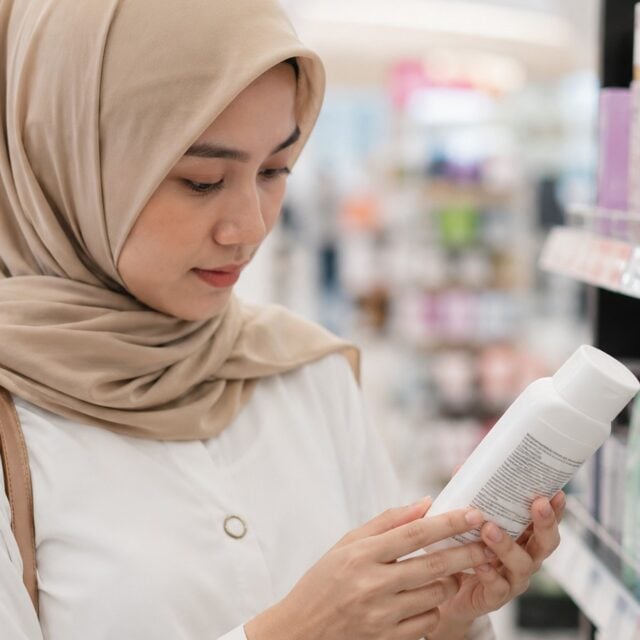
On July 23, 2026, the Indonesian Halal Product Assurance Agency (BPJPH) released Regulation no. 3 of 2026 detailing the format and procedures for non-halal labeling. The new rules have taken effect from the announcement date.
Cosmetic products using non-halal ingredients, or produced through non-compliant processes under Indonesia’s Halal Product Assurance System (SJPH), do not always need halal certification, but do require a conspicuous “NON HALAL” marking on their packaging.
A 12-month grace period applies for items already on shelves when the regulation was introduced, giving businesses until July 23, 2027 to update labeling.
Purpose Behind the “NON HALAL” Label in Indonesia
In recent years, Indonesia has strengthened its halal product standards and brought more categories into this regime. According to Government Regulation No. 42 of 2024, all cosmetics distributed domestically will be subject to mandatory halal certification by October 17, 2026.
Some cosmetics cannot fulfill halal requirements because of their ingredients or methods of manufacture. Such products, even if excluded from halal certification, must still indicate their non-halal status clearly to consumers.
Before the BPJPH regulation, ther was no uniform approach to presenting non-halal information, leading to inconsistent disclosures across products. The latest rules resolve this by providing a standard way for companies to communicate non-halal content.
Defining Non-Halal Cosmetics: Ingredient and Process Criteria
To decide if a cosmetic is non-halal, companies need to examine two main factors: ingredient composition and manufacturing practices.
A cosmetic may be classified as non-halal due to its formula, how it is produced, or both.
Analysis of Ingredient Sources
The regulation outlines specific categories:
– Animal-based components: Any raw materials originating from pigs, dogs, or byproducts of these animals, as well as animal-derived components not prepared under approved slaughter practices, must be treated as non-halal. Leathers not processed through accepted purification and tanning methods also fall into this group.
– Plant-based substances: plant extracts become non-halal when blended with additives or solvents not meeting halal criteria, when intoxicating, or when hazardous to health. For instance, an extract created using a non-halal solvent would require labeling.
– Alcohol and its sources: The rule specifies that alcohol from the khamr sector, beverages containing 0.5% or more alcohol, substances mixed with khamr, and some liquid derivatives linked to the khamr industry must be labeled.
– Chemical, microbial, and biotech origin: Any cosmetic ingredient or additive made through synthesis, fermentation, or genetic engineering involving non-halal materials, including contaminated processing aids, must be disclosed.
– Human-derived inputs: Hair and body parts used as cosmetic ingredients are addressed directly, falling under the non-halal category.
– Impurities (najs): Products tainted by substances regarded as ritually impure, or those polluted by such agents, are included.For brands, compliance means examining not just ingredient lists, but also the source and purity of chemicals, processing aids, solvents, and additives at every step.
Production and Handling: Beyond the Ingredients
Even if a formula fits halal criteria,the manufacturing process may turn it non-halal. The rules apply if the product comes into contact with prohibited materials at any stage, including production, storage, packaging, shipping, or retail.
Production lines or equipment shared with non-halal items become a concern if they are not properly cleansed according to SJPH methods. Special attention is required for facilities coming into contact with pork or pig derivatives, including wash stations and packaging lines.
This is especially relevant for contract manufacturers or those managing multipurpose sites. Auditing production environments is as vital as checking raw ingredients.
Required Appearance of the “NON HALAL” label
Cosmetics and similar non-food goods must visibly display the “NON HALAL” designation in a prescribed format.
This text is to be written in red uppercase letters, framed by a red rectangle on a white background. If the usual packaging is red, companies may use alternative contrasting colors, but the mark must remain prominent and legible.
Labels can appear on the product itself, its packaging, or another designated location, but for packaged items, the marking must appear on the outermost layer as sold to consumers.
Placement and sizing should guarantee that the notice is easy to find and cannot be hidden by other graphics or easily removed. packaging must be designed so that this warning is not obstructed or degraded through normal handling.
Special Provisions for Bulk Cosmetic Products
For bulk cosmetics or those not packed for direct retail sale, extra documentation comes into play.
The non-halal mark must be featured on the immediate container or another clearly visible surface. Companies must also maintain records justifying the non-halal classification.Supporting evidence may include ingredient lists, process flow diagrams, Certificates of Analysis (CoA), questionnaires, statements, or similar documentation from raw material sources.
Firms are responsible for confirming not only the validity of such certificates but also the credibility of the organizations that issue them.
This requirement targets bulk suppliers and those dealing with unfinished goods,where final retail packaging is not yet available.
Steps for Cosmetic Brands Selling in Indonesia
Two compliance tracks now operate side by side for cosmetics in Indonesia:
• The halal certification mandate starting October 17, 2026.
• Non-halal labeling for products that do not meet halal standards, enforced for all products from July 23, 2027.
Cosmetic businesses should start portfolio reviews well ahead of deadlines. Evaluate all component ingredients, including less visible elements like solvents and processing supports. Scrutinize production workflows and facility protocols for possible cross-contact or contamination with non-halal substances.
Where non-halal status is confirmed, packaging must be redesigned to meet the label’s formatting and placement criteria. Bulk product providers need to compile and verify all necessary documentation to explain non-halal status.
These new measures highlight that market access in Indonesia covers more than formulation and safety. Regulatory risk extends to labeling, manufacturing practices, and record keeping. Adhering to the new standards from product concept through to packaging prevents costly recalls or blocked shipments.Any company planning to manufacture, export, or introduce new cosmetic products to Indonesia must integrate both halal and non-halal labeling requirements into compliance strategies from the outset.
