
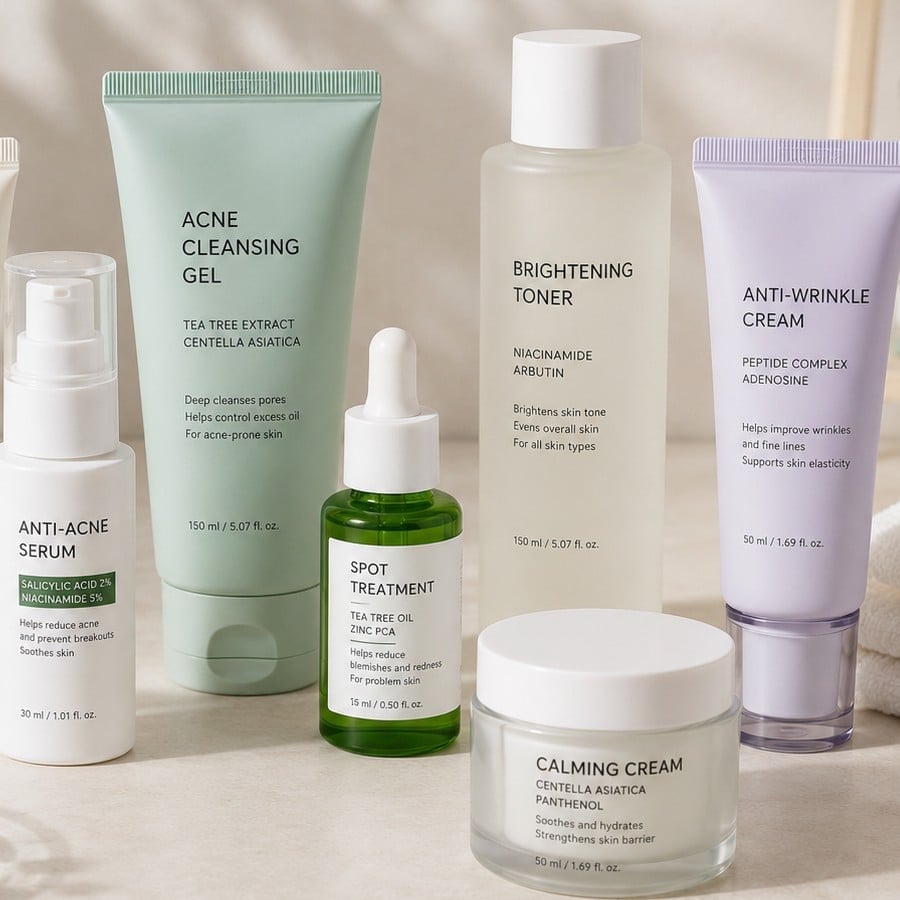
As discussed in our overview of Cosmetic Testing Requirements in South Korea, not every cosmetic requires the same level of testing. Functional cosmetics are the main exception. Manufacturers must provide scientific evidence demonstrating that the product performs as claimed and complies with the requirements established by the Ministry of Food and Drug Safety (MFDS).
What is a functional cosmetic?
Under Korean legislation, a functional cosmetic is a product that claims to provide a specific physiological benefit recognized by the MFDS. Rather than relying solely on marketing language, these claims are regulated and must be supported by appropriate scientific data.
The list of functional cosmetics has expanded over time and currently includes products intended for purposes such as:
- Skin whitening or brightening
- Wrinkle improvement
- UV protection
- Hair colouring and bleaching
- Hair loss symptom relief
- Products that help alleviate acne breakouts
- Products intended to relieve dryness associated with atopic-prone skin
- Products that help reduce the appearance of stretch marks
These categories are specifically defined within the Korean regulatory framework and are evaluated according to dedicated MFDS standards and review procedures.
Why are additional testing requirements necessary?
Unlike general cosmetic claims such as “refreshing,” “hydrating,” or “softening,” functional claims imply that a product produces measurable biological or physiological effects.
Because consumers may rely on these claims when choosing products, the MFDS requires objective evidence demonstrating that the claimed benefit is supported by reliable scientific data.
The goal is not only to protect consumers from misleading advertising but also to ensure consistency between products making similar functional claims.
What evidence does the MFDS require?
The precise documentation depends on the product category, but manufacturers are generally expected to submit information covering three main areas.
Safety data
Every functional cosmetic must demonstrate that it is safe under its intended conditions of use.
Safety information may include ingredient safety assessments, toxicological data, product formulation details, and supporting documentation demonstrating that the product can be used without presenting unacceptable risks to consumers.
Efficacy data
The defining feature of functional cosmetics is the requirement to demonstrate effectiveness.
The MFDS expects evidence showing that the claimed benefit has been objectively verified using appropriate scientific methods. Depending on the product, this may include laboratory studies, instrumental measurements, controlled clinical evaluations, or other validated testing approaches.
The quality of the evidence is often as important as the positive result itself. Testing should be conducted using recognised methodologies capable of producing reproducible and scientifically reliable data.
Standards and test methods
Applicants must also provide documentation describing the product specifications and the analytical methods used to evaluate quality and performance.
These methods help ensure that testing can be reproduced and that products consistently meet their declared specifications throughout production.
Different claims require different testing
One of the most important aspects of Korean cosmetic regulation is that testing is directly linked to the intended claim.
A sunscreen, for example, requires scientific evidence demonstrating its Sun Protection Factor (SPF) and, where applicable, UVA protection performance. Similarly, products claiming wrinkle improvement or skin whitening require efficacy studies specifically designed to measure those outcomes using recognised evaluation criteria.
Rather than applying one universal testing protocol, the MFDS evaluates whether the evidence is appropriate for the specific functional claim being made.
Can existing scientific data be used?
In some situations, manufacturers may rely on previously established evidence instead of conducting entirely new studies.
Korean regulations provide pathways that allow certain functional cosmetics to use recognised ingredients or previously accepted data under defined conditions. However, this depends on whether the formulation, concentration, intended use, and supporting documentation satisfy the applicable MFDS requirements.
Where a product contains novel ingredients or introduces new efficacy claims, additional evidence is typically expected before the product can be marketed.
Clinical testing is not always mandatory
Many manufacturers assume that every functional cosmetic requires a full human clinical trial. In practice, the regulatory approach is more nuanced.
The need for clinical testing depends on factors such as the functional claim, the available scientific evidence, the ingredients used, and whether equivalent data already exist under the relevant MFDS provisions.
For some products, laboratory studies and established scientific data may provide sufficient support. For others, particularly where efficacy cannot be demonstrated through analytical methods alone, well-designed human studies may be necessary.
Because the applicable requirements vary considerably between product categories, manufacturers should evaluate their testing strategy early in product development.
Preparing for MFDS evaluation
Developing a functional cosmetic should involve regulatory planning from the outset rather than treating testing as the final stage before commercialization.
Manufacturers should ensure that product development, formulation design, stability studies, safety assessments, and efficacy testing are aligned with the intended regulatory pathway. Generating evidence retrospectively is often more expensive and may delay market entry if additional testing becomes necessary.
Early coordination between research, quality assurance, regulatory affairs, and testing laboratories can significantly reduce compliance risks.


