
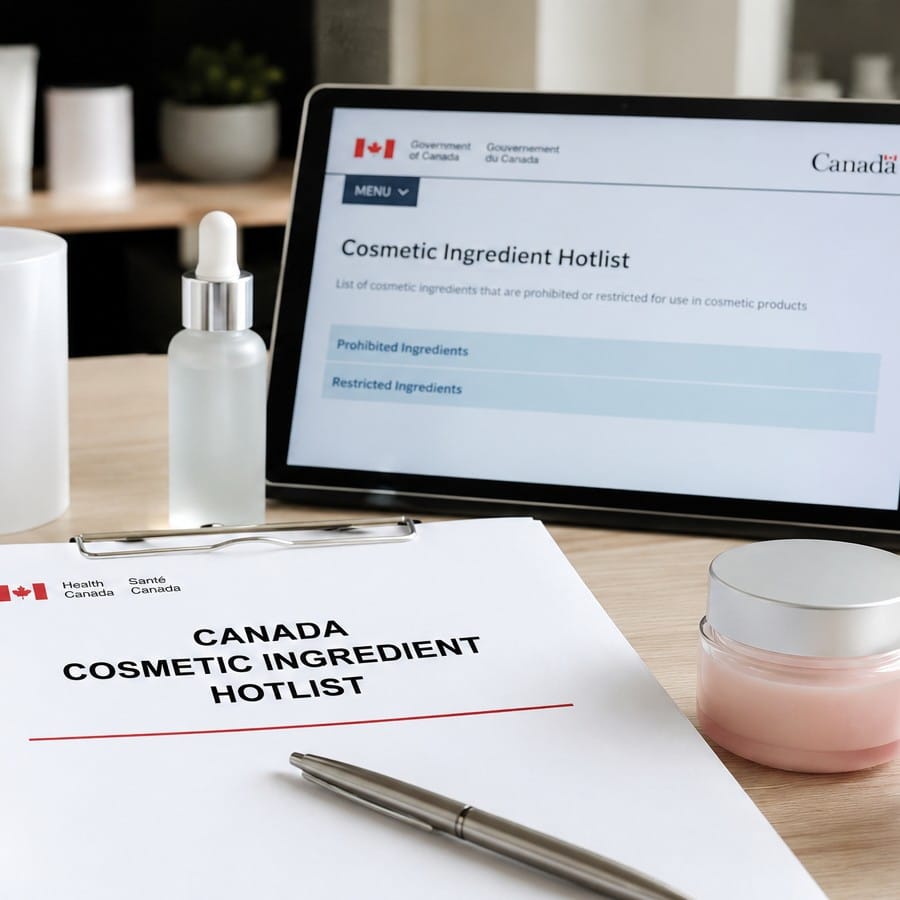
Maintained by Health Canada, the Hotlist is an administrative tool that identifies substances that may make a cosmetic non-compliant with Canadian legislation. Although the Hotlist is not a regulation and does not itself create legal obligations, it helps industry understand how Health Canada assesses ingredient safety and compliance under the Food and Drugs Act and the Cosmetic Regulations.
What Is the Cosmetic Ingredient Hotlist?
The Hotlist contains two categories of substances. The first includes ingredients that Health Canada considers prohibited for use in cosmetics because of potential risks to human health. The second includes ingredients that may be used only under specific conditions, such as concentration limits, product-type restrictions, purity requirements, or mandatory warning statements.
The Hotlist is based on scientific evidence and safety assessments. As new information becomes available, Health Canada may revise existing entries or add new substances. For this reason, compliance should be viewed as an ongoing process rather than a one-time review.
Why Does It Matter for Manufacturers?
The Hotlist plays an important role during product development and regulatory assessment. Before marketing a cosmetic product in Canada, companies should verify that all ingredients are consistent with current Hotlist requirements and other applicable legal obligations.
This is particularly important for businesses operating internationally. An ingredient that is permitted in one jurisdiction may be restricted or prohibited in Canada, making market-specific regulatory reviews essential. Early assessment can help avoid delays, reformulation costs, and compliance challenges later in the product lifecycle.
A Dynamic Regulatory Tool
One of the distinctive features of the Hotlist is its flexibility. Because it is an administrative tool rather than a regulation, Health Canada can update it more quickly than would typically be possible through a formal regulatory amendment process. This allows the department to respond efficiently to emerging scientific evidence and evolving safety concerns.
Manufacturers should therefore monitor updates regularly and assess whether formulation changes, labeling revisions, or additional safety evaluations may be necessary.
Looking Ahead
The Cosmetic Ingredient Hotlist remains a cornerstone of cosmetic oversight in Canada. However, it is only one part of a broader regulatory framework that includes the Food and Drugs Act, the Cosmetic Regulations, and ongoing modernization initiatives affecting cosmetic compliance.
For manufacturers, understanding and monitoring the Hotlist is not only a regulatory responsibility but also an important element of product stewardship and market access. Keeping pace with regulatory developments can help companies reduce compliance risks and ensure that products continue to meet Canadian safety expectations throughout their lifecycle.
