
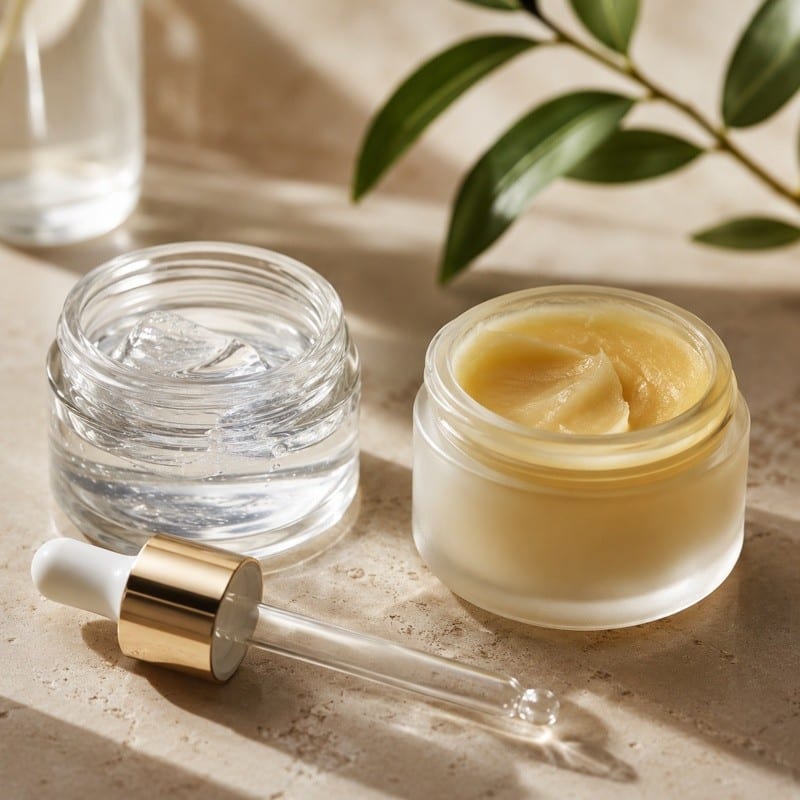
Although the Regulation does not create separate legal categories for “water-based” and “anhydrous” cosmetics, the presence or absence of water significantly affects how products are preserved, tested, assessed and documented from a compliance perspective.
Understanding these differences is essential for formulators, manufacturers and brand owners developing products for the European market.
What is considered a water-based cosmetic?
A water-based cosmetic contains water as a significant component of the formulation. This includes emulsions, gels, shampoos, toners, lotions, masks and many skincare products.
Water plays several functional roles in cosmetics: it acts as a solvent, contributes to texture and sensory performance, and supports ingredient dispersion. However, it also creates an environment where microorganisms can grow.
From a regulatory and safety standpoint, this microbiological risk is one of the most important characteristics of water-containing products.
What is an anhydrous cosmetic?
An anhydrous cosmetic is formulated without water. Typical examples include oil serums, balms, wax-based sticks, certain powders and some solid cosmetics.
Because free water is absent, microbial growth is generally much less likely. This can reduce the need for conventional preservative systems and may influence product stability strategies. However, “anhydrous” does not mean “regulation-free” or automatically safer.
These products remain fully subject to the requirements of EU cosmetic legislation, including safety assessment, stability evaluation, Good Manufacturing Practices and accurate product information.
Contamination risk
For water-based formulations, microbiological quality becomes a critical element of compliance. Manufacturers are expected to demonstrate that the product is adequately protected against contamination during both manufacturing and consumer use.
This generally involves:
- microbiological testing,
- preservative efficacy or “challenge” testing,
- contamination risk assessment,
- and evaluation of packaging compatibility.
Guidance from the European Commission and standards such as ISO 11930 are commonly used to support preservative efficacy assessments.
Anhydrous products may present a lower microbiological risk profile, but this does not eliminate the obligation to assess contamination hazards. For example, products exposed repeatedly to water during use — such as bathroom balms or jar-packaged products used with wet fingers — may still require preservation strategies or additional testing.
Water-based products typically require preservatives to maintain safety throughout shelf life and use. In the EU, preservatives are specifically regulated under Annex V of Regulation 1223/2009, which lists substances allowed for preservative use together with their concentration limits and conditions.
Anhydrous products often rely on formulation architecture rather than conventional preservatives. Oils, waxes and low water activity can help limit microbial proliferation. However, oxidation becomes a more significant concern in these systems, particularly in formulations rich in unsaturated oils or natural extracts.
As a result, antioxidants and packaging protection may become more important than antimicrobial preservation.
Stability considerations
Water-based and anhydrous formulations generally fail in different ways.
In emulsions and aqueous systems, formulators often monitor:
- emulsion instability,
- viscosity drift,
- colour changes,
- and preservative degradation.
In anhydrous systems, concerns are more frequently related to:
- oxidation,
- rancidity,
- crystallisation,
- phase separation in oils,
- and temperature sensitivity.
Under EU requirements, the Product Information File (PIF) must contain evidence supporting the product’s stability and compatibility with packaging. The Regulation does not prescribe a single testing method, but manufacturers must be able to justify the product’s shelf life and Period After Opening (PAO), where applicable.
Packaging interaction
Packaging plays a regulatory and safety role that is sometimes underestimated.
Water-based products may interact differently with packaging materials due to pH, solvent content or preservative systems. Migration, corrosion and compatibility issues can affect safety and stability.
Anhydrous formulations can also present challenges, especially with essential oils, volatile compounds or lipid-rich systems that may interact with plastics, elastomers or adhesives.
European safety assessors typically expect packaging compatibility to be considered as part of the overall safety evaluation.
Safety assessment obligations
Every cosmetic product marketed in the EU must undergo a cosmetic safety assessment performed by a qualified safety assessor, as required under Article 10 of Regulation 1223/2009.
The formulation type directly influences the assessment process.
For water-based products, the assessor generally places stronger emphasis on:
- microbiological specifications,
- preservative systems,
- manufacturing hygiene,
- and contamination risk.
For anhydrous products, the assessment may focus more heavily on:
- oxidation stability,
- ingredient purity,
- exposure scenarios,
- and packaging interaction.
Importantly, neither formulation type benefits from simplified regulatory obligations. The level of evidence required must always be appropriate to the product’s risk profile.
Formulation type does not reduce compliance responsibilities
One common misconception in the industry is that anhydrous cosmetics are easier to regulate because they are less microbiologically sensitive. In practice, they simply present different regulatory considerations.
Water-based products require strong microbiological control strategies, while anhydrous products often demand closer attention to oxidation, packaging interaction and claim substantiation.
In both cases, compliance under the European framework depends on the same core principles:
- product safety
- adequate evidence
- proper manufacturing practices
- transparent labelling
- scientifically supported claims
Understanding how formulation structure influences regulatory expectations helps manufacturers build products that are not only innovative, but also robust, compliant and trustworthy within the European cosmetic market.
