
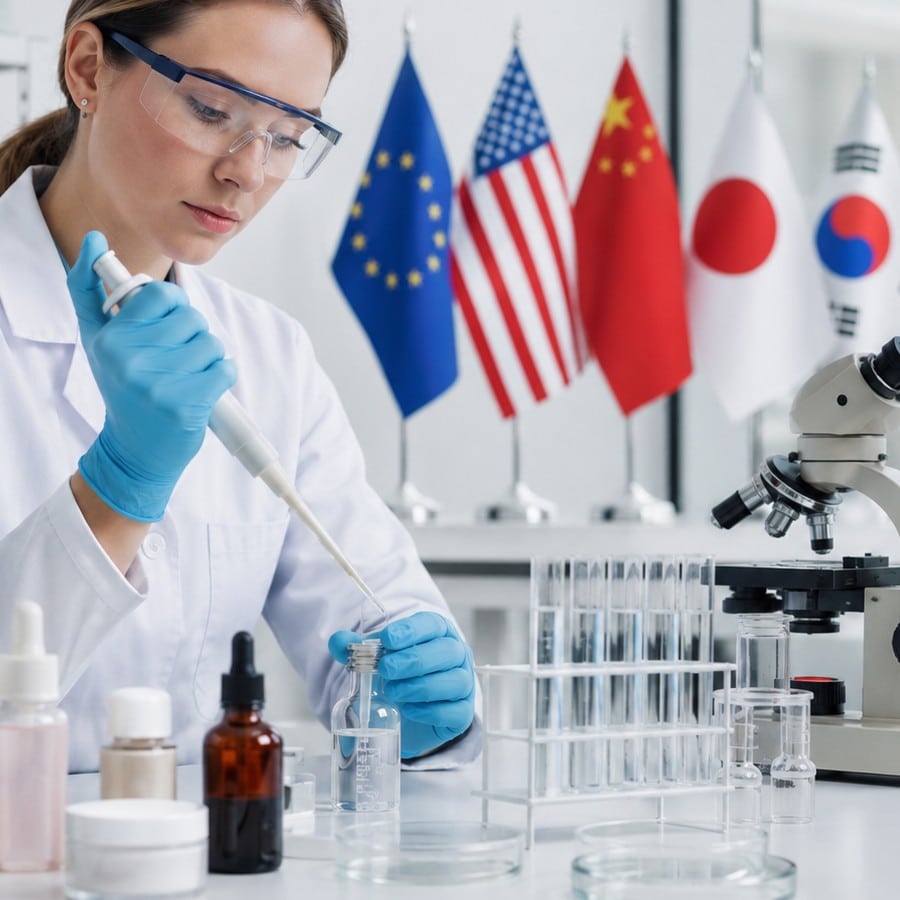

Because each region applies and regulatory requirdifferent testing standards ements, preparing a cosmetic product for international laboratory testing requires careful planning from the earliest stages of development.
Compliance Starts During Formulation
One of the biggest mistakes manufacturers make is leaving regulatory considerations until the product is already finished. In reality, global compliance should begin during formulation design.
Ingredient restrictions vary significantly between countries. Certain preservatives, UV filters, colorants, or active ingredients allowed in one market may be restricted or prohibited in another. The EEA, for example, applies particularly strict ingredient rules under Regulation (EC) No 1223/2009, while China, Japan, and South Korea maintain their own regulatory frameworks and ingredient classifications.
For this reason, manufacturers should evaluate formulations against all target markets before beginning laboratory testing. Early regulatory review helps avoid costly reformulations later in the process.
Products making functional claims — such as anti-wrinkle, whitening, or UV protection — may also require additional testing and stricter regulatory procedures, especially in China and South Korea.
Preparing the Product Before Testing
Proper preparation before sending samples to the laboratory can prevent delays, repeated studies, and unnecessary costs.
Manufacturers should first define the markets where the product will be sold, since testing requirements vary depending on the region and the type of cosmetic claims involved. Once markets are identified, the formulation should be finalized before testing begins. Even small changes in fragrance, preservatives, packaging, or active ingredients may affect stability, microbiological performance, or compatibility results.
It is also important to test samples that accurately represent the final commercial product. Ideally, laboratory samples should come from pilot or semi-industrial batches using the same manufacturing conditions and packaging intended for commercialization.
Before starting laboratory studies, companies should organize key technical information, including:
- INCI ingredient lists
- Packaging specifications
- Manufacturing procedures
- Preservative system details
- Target shelf life and markets
Good preparation helps laboratories design more efficient testing protocols and reduces the risk of repeating studies later in development.
Defining an International Testing Strategy
International cosmetic testing goes beyond basic product analysis. Authorities increasingly expect manufacturers to demonstrate that products remain safe and effective throughout their shelf life and under normal consumer use conditions.
Most cosmetic products require several core laboratory studies, including:
- Microbiological testing
- Stability studies
- Packaging compatibility testing
- Preservative efficacy testing (challenge tests)
These tests help verify product safety, formulation stability, and preservative performance over time.
Although these testing categories are widely accepted internationally, regulatory expectations differ from one region to another.
- The EEA requires extensive documentation within the Product Information File (PIF).
- China may require testing through authorized local laboratories, particularly for special cosmetics.
- The United States applies a more flexible system, although manufacturers remain legally responsible for proving product safety under FDA and MoCRA requirements.
Because of these differences, companies benefit from developing testing programs that can support multiple markets simultaneously.
Managing Animal Testing Requirements
Animal testing remains one of the most complex aspects of global cosmetic compliance.
The EEA fully prohibits animal testing for cosmetic products and ingredients, requiring companies to rely on alternative methods and existing scientific data. South Korea and Japan increasingly follow similar approaches, while the United States generally favors non-animal testing methods through industry practice.
China has introduced reforms reducing mandatory animal testing for many imported general cosmetics, although requirements may still apply in certain situations, particularly for special cosmetics.
For manufacturers operating globally, understanding these differences is essential when designing testing strategies and maintaining cruelty-free positioning.
Preparing for Global Expansion
International cosmetic testing is no longer just a technical requirement — it is part of a broader regulatory strategy. Companies that integrate compliance planning early in product development are generally better prepared to reduce delays, avoid reformulations, and expand into multiple markets more efficiently.
As cosmetic regulations continue to evolve worldwide, manufacturers increasingly benefit from flexible testing programs, organized technical documentation, and internationally aligned development processes.


