

However, it is important to clarify from the outset: this document is a non-binding technical proposal. It is intended to support future EU legislation and may be adapted or modified before any final rules are adopted.
Why the EU is pushing for a single label system
Recycling labels currently vary widely across Europe. Different countries—and sometimes regions—use their own symbols, colours and instructions.
For cosmetics brands, this creates:
- The need to adapt packaging artwork market by market
- Increased compliance complexity
- Higher operational costs
For consumers, the lack of consistency leads to confusion and incorrect disposal, ultimately affecting recycling performance.
The EU’s objective is to address this fragmentation by moving toward a common, harmonised system across Member States.
The core idea: a clearer, more intuitive approach
The JRC proposal suggests a system designed to improve understanding and sorting behaviour through three main principles.
Material-based communication
Labels would primarily indicate the material composition of packaging (e.g. plastic, glass, paper), in line with the requirements of the Packaging and Packaging Waste Regulation (PPWR).
Rather than relying on country-specific disposal instructions, the system aims to provide a consistent basis for sorting across the EU.
Matching labels between packaging and bins
A central concept is the “matching principle”:
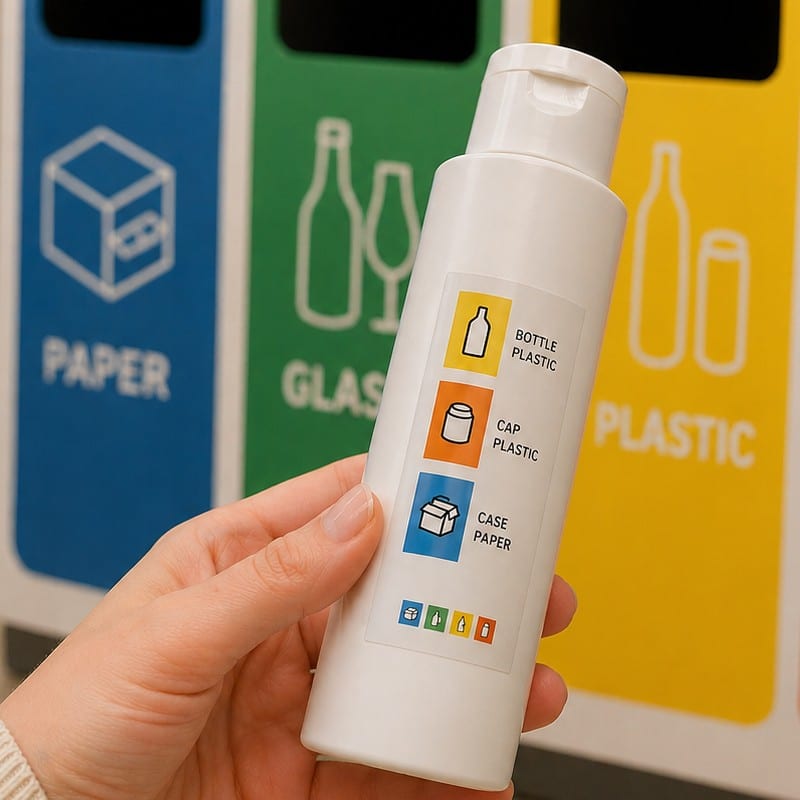
- The same label appears on the packaging
- The same label appears on the corresponding waste container
This allows consumers to visually match the two, simplifying the decision-making process and reducing sorting errors.
Simple, visual design
The proposed labels combine:
- Pictograms
- Colour coding
- Minimal or no text
- Accessibility features
The intention is to create a language-neutral and easy-to-recognise system that works across all EU markets.
Timeline
The harmonised labelling system is part of the broader Packaging and Packaging Waste Regulation (PPWR) framework.
Key milestones include:
- February 2025 → PPWR enters into force
- By 12 August 2026 → The European Commission is expected to adopt implementing acts defining the detailed specifications of the labelling system
After these technical rules are defined, additional timelines for implementation and mandatory use will be set.
At this stage, no exact date has been established in the proposal for when harmonised labels will become compulsory. Implementation is expected to be phased and progressive, depending on the final legal acts.
What it means for the cosmetics industry
Cosmetic packaging presents specific challenges that the proposal explicitly acknowledges, including:
- Multi-component formats (e.g. bottle, pump, cap)
- Mixed materials
- Limited space for labelling
The proposed system introduces approaches to address these issues, such as:
- Guidance for multi-component packaging labelling
- Flexible positioning of labels
- The possibility of complementary digital information (e.g. QR codes)
This could significantly impact how packaging is designed and how information is communicated to consumers.
A step toward a more circular packaging system
The proposed harmonised labelling system is part of a broader EU effort to improve recycling and support the transition to a circular economy.
For consumers, it aims to provide clearer guidance.
For regulators, it offers the potential to improve sorting performance.
For manufacturers, it could ultimately reduce fragmentation—once fully implemented.
For the cosmetics industry, the direction is clear:
greater harmonisation is coming, even if the final details are still being defined.
