
lastic pollution has been a global concern for many years. Most people imagine bottles or plastic bags floating in oceans, yet there is another issue that is much smaller and harder to see.
What are microplastics in cosmetics?
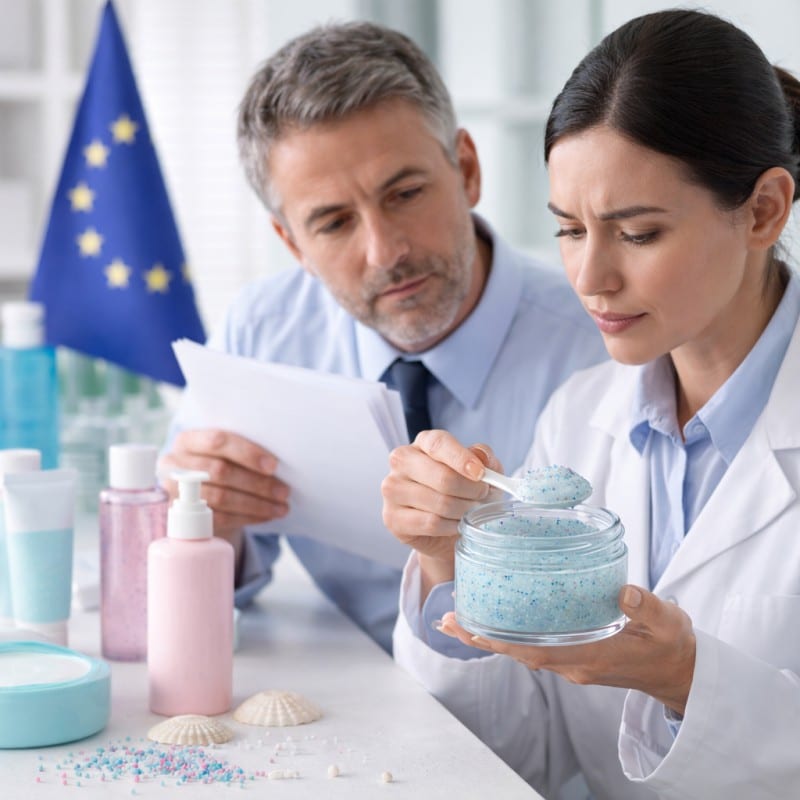
Microplastics are very small plastic particles that can be intentionally added to personal care and cosmetic products. They are commonly used in rinse-off cosmetics for exfoliating or cleansing actions, such as scrubs. These particles appear in many different products used every day.
The plastics most often used in cosmetics include polyethylene and polypropylene. These ingredients can appear in products for both men and women, including soaps, creams, gels, and toothpaste.
Why microplastics are used in cosmetics
Manufacturers have used microplastics in cosmetics for practical reasons. In rinse-off products, they provide exfoliating or cleansing effects. They can also appear in makeup items.
Some cosmetic products containing microplastics have even been marketed as environmentally friendly or natural. The presence of microplastics in those products has raised concerns about misleading claims.
Cosmetics are not considered the main source of microplastics in marine waters. Still, millions of people use these products every day, which means they contribute to pollution in oceans, lakes, and seas. This growing awareness has pushed discussions about reducing their use and limiting their environmental impact.
Current microplastics legislation in the EU
Public debate about plastics in oceans and seas has pushed governments and industry to take action. In 2015, Cosmetics Europe, the European association of the cosmetics industry, asked its members to permanently suspend the use of microplastics in all cosmetics by 2020.
Italy moved quickly on this issue. The country introduced a ban on microplastics in cosmetics, especially in rinse-off cosmetics with exfoliating or cleansing functions, starting January 1, 2020.
Other EU countries introduced similar restrictions. These rules mostly focus on rinse-off cosmetics that contain solid plastic particles smaller than 5 mm.
Some cosmetic products are not covered by these restrictions. Makeup products and natural particles that do not persist in the environment, release chemicals, or affect animal food chains are not subject to these rules.
EU regulatory actions and the REACH framework
The European Commission asked ECHA and its RAC and SEAC committees to prepare a restriction dossier under the REACH regulation for microplastic particles intentionally added to products.
The process involved several steps:
-
Intention to prepare restriction dossier – 17 January 2018
-
Call for evidence – 1 March to 1 May 2018
-
Stakeholder workshop – 30 to 31 May 2018
-
Submission of restriction dossier – 11 January 2019
-
Public consultation of the Annex XV dossier – 20 March 2019 to 20 September 2019
-
RAC opinion – June 2020
-
Draft SEAC opinion – June 2020
-
Consultation on draft SEAC opinion – 1 July to 1 September 2020
-
Combined final opinion submitted to the Commission – February 2021
A draft regulation proposes changes to Annex XVII of Regulation REACH 1907/2006. The rules would limit the manufacturing, sale, and use of certain substances and mixtures. The regulation takes effect on the twentieth day after publication in the Official Journal of the EU.
Under the proposal, products containing microplastics cannot be placed on the market if they contain synthetic polymer microparticles at a concentration equal to or greater than 0.01 percent by weight. This effectively restricts synthetic polymer microparticles used to provide a particular characteristic in products.
Exceptions for cosmetic uses
The RAC opinion issued in 2020 includes certain derogations. One of these exemptions applies to the cosmetic sector. It allows film-forming functions of microplastics in cosmetic products when the particles cease to exist at the point of use.
Determining whether a polymer qualifies for this derogation is not always straightforward. Raw material suppliers must provide cosmetic brands with the necessary information to identify whether a polymer is considered a microplastic and whether the exemption applies.


