
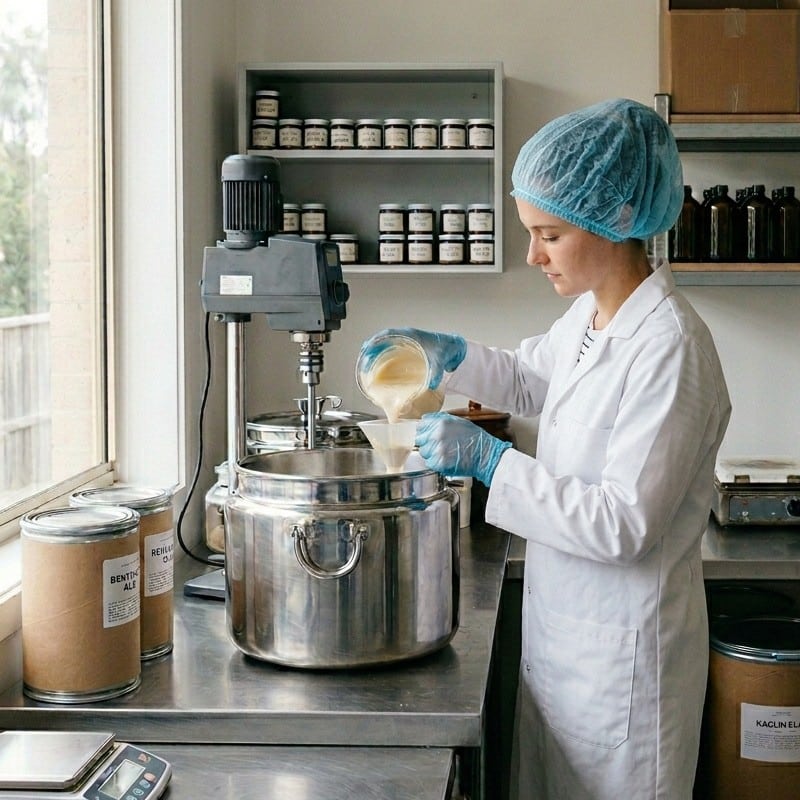
Scaling is not simply about making more product. It involves rethinking formulations, processes, compliance, and business strategy to ensure consistency, safety, and profitability. This article explores the key considerations to help bridge that gap in a structured and realistic way.
Understanding What “Scaling” Really Means
Scaling production is often misunderstood as a purely quantitative step—moving from 1 kg batches to 100 kg batches. In reality, it is a qualitative transformation.
At a commercial level, your product must be:
- Consistent across batches
- Stable over time and under different conditions
- Efficient to produce at scale
A formulation that works perfectly in a small beaker may behave very differently in a larger mixing vessel. Heat distribution, mixing speed, and ingredient dispersion can all change, affecting texture, stability, and performance.
Reformulating for Scale
One of the most common mistakes is assuming that a handmade formula can be directly multiplied without adjustment. In practice, scaling often requires reformulation.
Ingredients may need to be reconsidered based on:
- Availability in larger quantities
- Cost efficiency
- Compatibility with industrial equipment
For example, certain natural ingredients used in artisanal production may vary significantly between suppliers or batches. At a commercial level, this variability can lead to inconsistencies that are unacceptable in the market.
Preservation systems also become more critical. A product that is safe in small batches may face higher contamination risks when produced, stored, and distributed at scale. Robust microbial protection must be validated.
Equipment and Process Design
Handmade production relies heavily on manual control—visual cues, tactile feedback, and small adjustments. Industrial production replaces this with standardized processes.
Choosing the right equipment is essential. This includes mixers, homogenizers, heating systems, and filling lines designed to:
- Maintain uniform mixing
- Control temperature precisely
- Reduce contamination risks
Process parameters such as mixing speed, order of ingredient addition, and cooling rates must be defined and documented. These variables directly affect the final product and must be reproducible.
Scaling up often involves pilot batches. These intermediate-scale tests help identify issues before full production, reducing costly errors.
Quality Control and Stability
At a commercial level, quality cannot rely on intuition. It must be measured, documented, and controlled.
Each batch should be evaluated through defined specifications:
- Appearance, color, and odor
- pH and viscosity
- Microbiological quality
Stability testing becomes a central requirement. Products must be assessed under different conditions—temperature, light, and time—to ensure they remain safe and effective throughout their shelf life.
Without this step, scaling can amplify small issues into major product failures.
Regulatory Compliance
Regulatory compliance is not something that begins at the moment you scale—it applies to cosmetic products from the very start, regardless of whether they are handmade or industrially produced. Even the smallest batch placed on the market must meet legal requirements related to safety, labeling, and claims.
What changes with scaling is not the obligation itself, but its complexity. As production grows, so does the need for structured systems to ensure traceability and control. Larger volumes, multiple batches, and wider distribution make it essential to keep detailed and organized records of formulations, raw materials, and manufacturing conditions.
At a commercial scale, compliance becomes more formalized through documented procedures and adherence to Good Manufacturing Practices (GMP). This includes batch records, supplier documentation, and systems that allow any product to be traced back through its entire production history.
In essence, scaling does not introduce regulatory requirements—it amplifies the need to manage them rigorously and systematically.
Supply Chain and Sourcing
Handmade production often relies on small suppliers or limited quantities. Scaling requires a more robust supply chain.
You need to ensure:
- Reliable sourcing of raw materials
- Consistent quality between batches
- Backup suppliers to mitigate risks
Lead times, storage conditions, and logistics also become more complex. A delay in one ingredient can halt an entire production cycle.
Cost management is equally important. Larger volumes can reduce unit costs, but only if procurement and inventory are handled efficiently.
Economic Considerations
Scaling is an investment. Equipment, testing, compliance, and production setup all require capital.
It is important to evaluate:
- Cost per unit at different production scales
- Break-even points
- Pricing strategy
Producing more does not automatically mean higher profits. Inefficient scaling can increase costs and reduce margins.
A phased approach—gradually increasing production while validating each step—often provides a more sustainable path.
Maintaining Brand Identity
One of the challenges in scaling is preserving what made the product successful in the first place. Handmade products often carry a perception of authenticity and quality.
As production grows, it is important to maintain:
- Product performance
- Sensory experience
- Transparency with customers
Scaling should enhance reliability without compromising the essence of the brand.
Scaling Your Production
Moving from handmade to commercial production is a pivotal step in building a cosmetic business. It requires more than increasing batch size—it demands a structured approach to formulation, process control, quality, and compliance.
By understanding the technical and strategic aspects of scaling, manufacturers can avoid common pitfalls and build a foundation for sustainable growth. The goal is not just to produce more, but to produce better, consistently and safely, at a scale that supports long-term success.


