
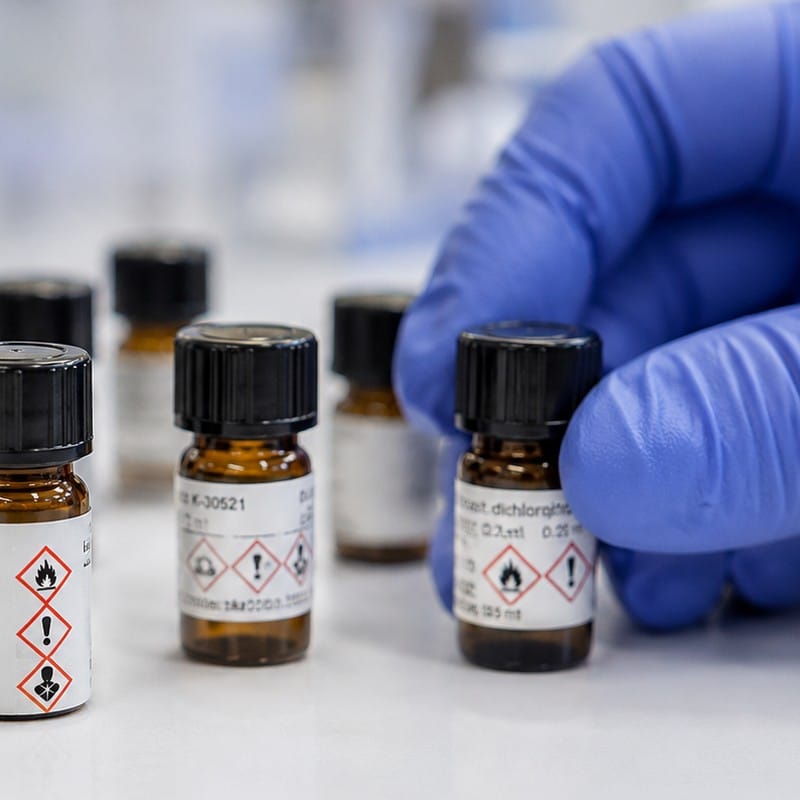

The update is particularly relevant for sectors that routinely handle products in miniature formats, including cosmetics, fragrances, flavourings, laboratory reagents, research materials, and specialty chemicals.
A Practical Response to Packaging Constraints
Under the CLP Regulation, hazardous substances and mixtures must be labelled with a range of information designed to ensure safe handling and use. However, applying all mandatory labelling elements to containers with capacities of only a few millilitres has often proven difficult in practice.
The new regulation acknowledges these physical limitations and introduces specific provisions for containers with a capacity of 10 mL or less. Rather than removing safety requirements, the revised framework seeks to adapt the way information is presented while maintaining an appropriate level of hazard communication.
What the New Rules Clarify
The updated legislation provides greater clarity on the circumstances in which certain labelling elements may be omitted from very small inner containers.
The changes define:
- Which mandatory label components may be excluded from containers of 10 mL or less.
- The conditions that must be met for these exemptions to apply.
- The hazard classes that may be eligible for simplified labelling requirements.
These clarifications are intended to improve regulatory consistency across industries while reducing unnecessary practical difficulties associated with small-format packaging.
The Growing Importance of Outer Packaging
One of the most significant aspects of the revision is the role assigned to outer packaging.
In many cases, simplified labelling on the immediate container will only be permitted when the product is supplied within an external package carrying the complete CLP information. This approach allows critical safety information to remain available to users even when the inner container cannot physically accommodate a full label.
As a result, companies will need to consider labelling as a system distributed across different packaging levels rather than as a requirement limited to the primary container.
This principle is expected to be particularly important for product samples, miniature formats, laboratory kits, single-dose applications, development batches, and other products supplied in very small quantities.
Specific Considerations for Research and Technical Use
The revised provisions also introduce additional flexibility for products intended for research, development, and quality control activities.
Certain substances and mixtures used exclusively in technical environments may benefit from tailored labelling arrangements, provided that all regulatory conditions are satisfied. These provisions recognize that materials used internally within laboratories or industrial facilities often present different supply and exposure scenarios than products placed on the wider market.
For organizations involved in formulation development, analytical testing, or pilot-scale production, the new rules may offer opportunities to streamline labelling practices while remaining compliant with CLP requirements.
What Manufacturers Should Review
Although the new provisions are designed to simplify compliance in specific situations, they will require manufacturers, importers, and downstream users to reassess existing labelling processes.
Companies should evaluate whether their current systems correctly account for the relationship between hazard classification, packaging format, and supply conditions. Particular attention may be needed for label generation software, packaging specifications, artwork approval processes, and regulatory documentation workflows.
The changes also reinforce the need for consistency between information presented on inner containers and that provided on any accompanying outer packaging.
Preparing for Compliance
For businesses operating in the cosmetics and specialty chemicals sectors, the revised CLP requirements represent more than a simple labelling adjustment. They introduce a more nuanced approach to hazard communication that combines flexibility with continued regulatory responsibility.
Organizations that supply products in small-volume formats should review their packaging strategies early to determine whether the new exemptions apply and to ensure that all required information remains accessible throughout the supply chain.
As implementation progresses, regulatory teams will play a key role in ensuring that simplified labelling solutions continue to meet both legal requirements and safety objectives.
