
This article explains what CosIng is, what it can (and cannot) do, and how to use it effectively as part of your compliance workflow.
What Is the CosIng Database?
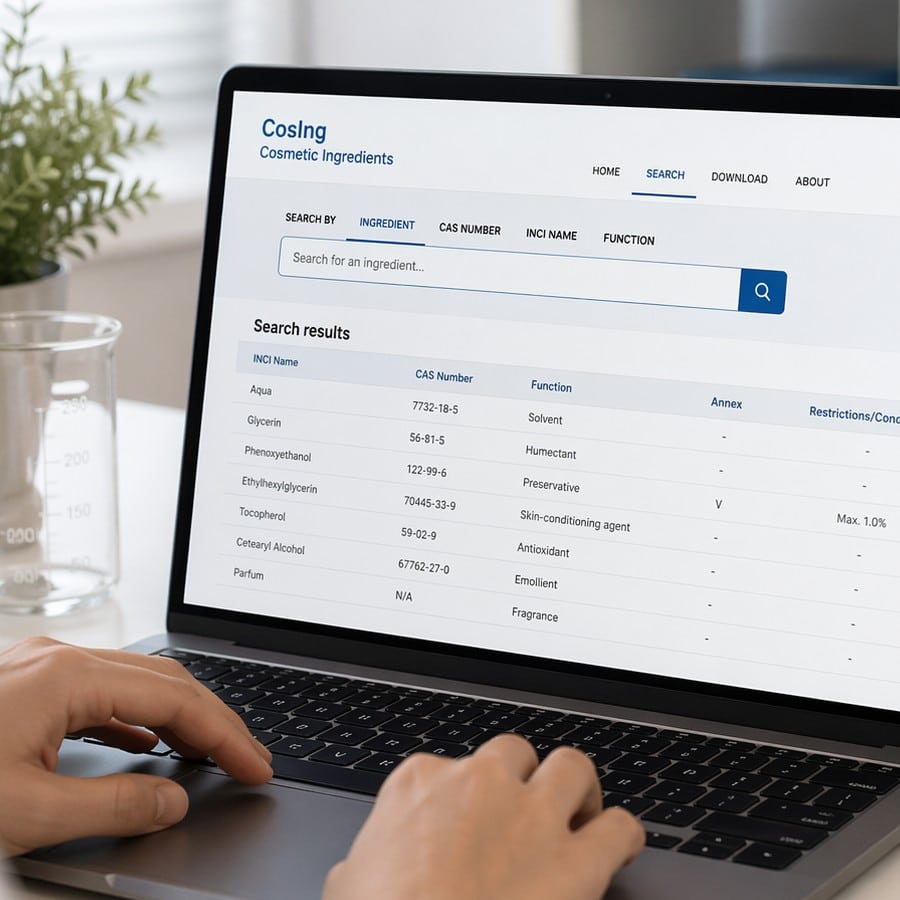
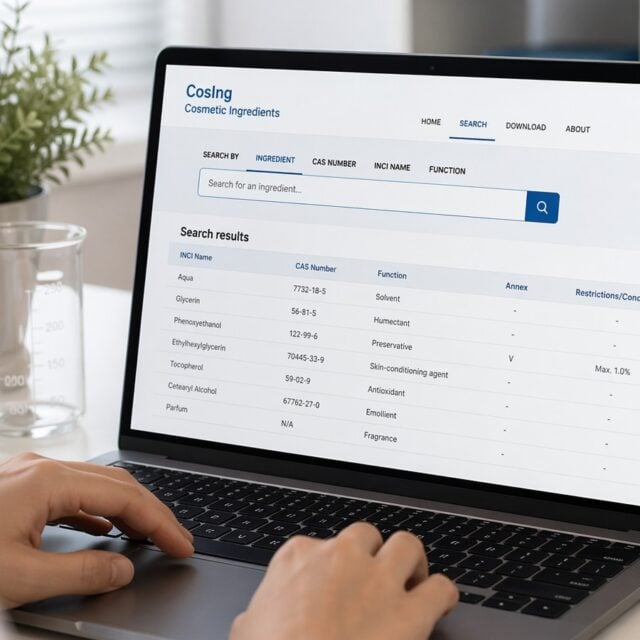
CosIng—short for “Cosmetic Ingredients database”—is an online platform that centralizes information on substances used in cosmetic products. It includes:
- Ingredient names and identifiers (such as INCI and CAS numbers)
- Functions (e.g., preservative, fragrance, emollient)
- References to relevant annexes of Regulation 1223/2009
- Opinions from the Scientific Committee on Consumer Safety (SCCS)
Its main purpose is to provide transparency and facilitate access to regulatory information. However, it is important to understand that CosIng is not legally binding. The regulation itself—and its annexes—remain the official legal reference.
Why CosIng Is Useful for Formulators
When starting a cosmetic business or developing a new formulation, CosIng serves as a first checkpoint to understand whether an ingredient is:
- Prohibited
- Restricted
- Allowed under specific conditions
- Associated with a regulated function (such as UV filters or preservatives)
Instead of manually navigating multiple annexes, CosIng allows you to quickly locate relevant information in one place. This makes it particularly valuable for early-stage formulation and feasibility assessments.
For entrepreneurs entering the cosmetic industry, CosIng is more than a database—it is a learning resource. By exploring ingredient functions, regulatory categories, and scientific opinions, you can gradually build a solid understanding of how cosmetic regulation works in practice.
This knowledge is particularly valuable when designing compliant formulations from the outset, avoiding costly reformulations or regulatory setbacks later.
How to Search for an Ingredient
Using CosIng is relatively straightforward, but precision matters. You can search by:
- INCI name (recommended for cosmetic use)
- CAS number (more precise for chemical identification)
- Chemical name
Each CosIng entry contains structured information that requires careful interpretation.
You will typically find the ingredient’s function, which describes its role in cosmetic products. This does not imply authorization—it simply indicates typical use.
More importantly, CosIng provides references to annexes of Regulation 1223/2009. For example, if an ingredient appears in Annex II, it is prohibited. If it appears in Annex III, restrictions apply.
Additionally, you may see references to SCCS opinions. These documents provide the scientific basis for regulatory decisions and are useful for deeper understanding, especially in borderline cases.
What CosIng Does Not Tell You
Despite its usefulness, CosIng has limitations that must be clearly understood.
First, it is not always fully up to date. Regulatory changes may take time to be reflected in the database, so relying exclusively on CosIng can lead to errors.
Second, it does not replace a full legal or safety assessment. For example, it does not evaluate your specific formulation, exposure conditions, or target population.
Finally, the presence of an ingredient in CosIng does not automatically mean it is allowed for all uses. Context matters—particularly function, concentration, and product type.
Best Practices for Using CosIng in Compliance
To use CosIng effectively, it should be integrated into a broader compliance strategy rather than used in isolation.
Start by identifying your ingredient accurately, ideally with both INCI and CAS numbers. Use CosIng to locate its regulatory status and any associated restrictions. Then, cross-check this information directly with the annexes of Regulation 1223/2009 to confirm accuracy.
It is also advisable to review SCCS opinions when available, especially for ingredients under scrutiny or recent evaluation.
Over time, developing a habit of documenting your searches and conclusions will strengthen your formulation process and make compliance easier to demonstrate.


