
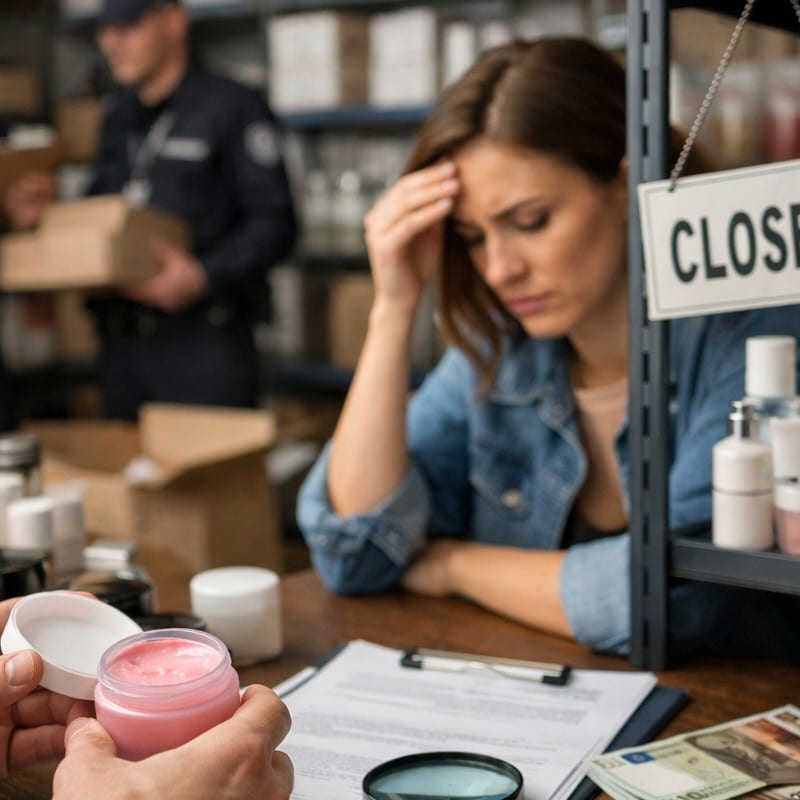
Bringing a cosmetic product to market in the European Union is not just a creative or commercial exercise—it is a regulated activity governed by Regulation (EC) No 1223/2009 on cosmetic products. This framework establishes clear obligations to ensure that all products are safe for human health. When a product does not meet these requirements, it is considered non-compliant, and a range of consequences may follow.
Regulatory framework and compliance obligations
The regulation requires that every cosmetic product placed on the EU market undergo a safety assessment, be properly labeled, and have a complete Product Information File (PIF). In addition, products must be notified through the Cosmetic Products Notification Portal (CPNP) before being sold.
Non-compliance occurs when any of these obligations are not fulfilled. This may include the use of prohibited substances, incorrect or incomplete labeling, lack of safety data, or failure to appoint a Responsible Person within the EU.
Market surveillance and corrective actions
Authorities across EU Member States actively monitor cosmetic products through inspections and testing. When a non-compliant product is identified, regulators can take immediate action to protect consumers.
These actions may involve requiring the company to correct the issue, withdrawing the product from the market, or initiating a full recall. In more serious cases, authorities can prohibit the sale of the product entirely until compliance is ensured.
Legal and financial consequences
Selling non-compliant cosmetics can lead to significant penalties. While enforcement mechanisms vary between Member States, all are required to impose sanctions that are effective and dissuasive.
Fines can be substantial, particularly in cases of repeated non-compliance or negligence. Where there is a serious risk to human health, criminal liability may also apply, exposing responsible parties to further legal consequences.
Responsibility and liability
Under Regulation 1223/2009, each cosmetic product must have a designated Responsible Person. This entity—whether a manufacturer, importer, or third party—is legally accountable for ensuring compliance.
If a non-compliant product causes harm, the Responsible Person may face claims for damages. This includes financial compensation as well as potential reputational harm, which can be especially damaging in a consumer trust-driven industry like cosmetics.
Impact on business operations
Non-compliance does not only result in regulatory penalties; it can also disrupt commercial activities. Retailers, distributors, and online platforms increasingly require proof of compliance before agreeing to sell or list products.
A lack of compliance can therefore limit market access, delay product launches, and weaken business relationships. In competitive markets, these setbacks can have long-term consequences.
Common causes of non-compliance
In many cases, non-compliance is not intentional but results from gaps in knowledge or understanding of regulatory requirements. Common issues include missing or incomplete Product Information Files, inadequate safety assessments, and failure to keep up with changes in ingredient restrictions.
Despite this, regulatory authorities apply the same standards regardless of intent, meaning that even unintentional errors can lead to enforcement actions.
Final considerations
Selling non-compliant cosmetics puts consumers at risk and exposes businesses to legal, financial, and reputational damage. Compliance should therefore be seen as a fundamental part of product development rather than an administrative burden.
For those starting a cosmetics business, integrating regulatory requirements from the outset is essential. Ensuring compliance early on is not only more efficient, but also critical for building a trustworthy and sustainable brand in the European market.


