
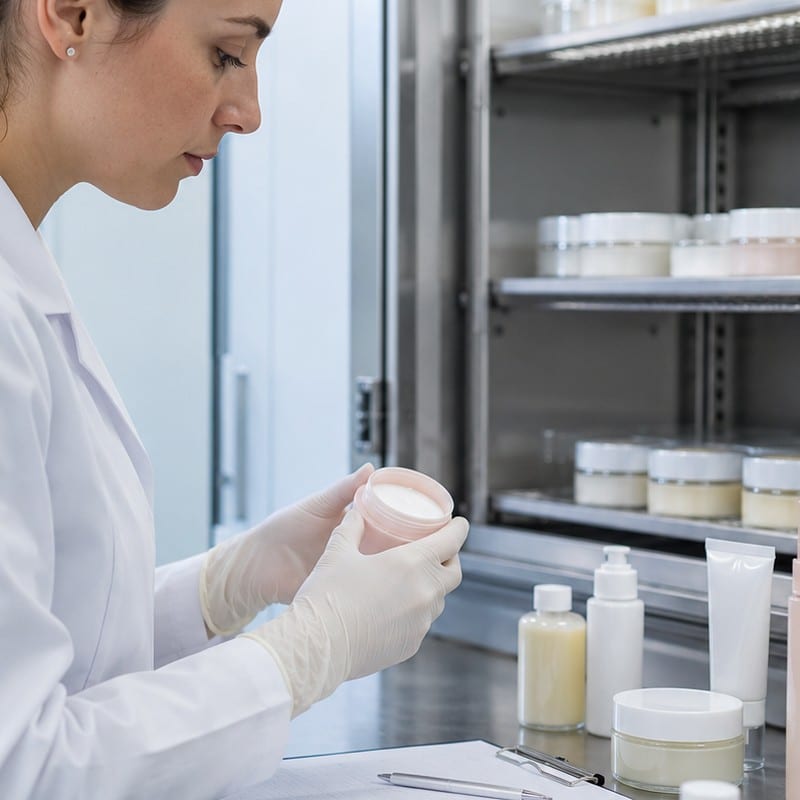

From a regulatory perspective, stability testing is also a fundamental part of cosmetic compliance. Around the world, authorities require companies to demonstrate that products maintain their quality and safety under reasonably foreseeable storage conditions. Although the principles are broadly similar internationally, the exact expectations, documentation requirements, and testing approaches vary significantly between regions.
Understanding these differences is increasingly important for brands operating in global markets.
What Is Cosmetic Stability Testing?
Cosmetic stability testing evaluates how a product maintains its quality, safety, and performance over time under different environmental conditions such as temperature, humidity, and light. These studies are crucial to determine whether a formulation remains stable during storage, transportation, and normal consumer use.
Testing typically assesses physical, chemical, and microbiological stability, as well as packaging compatibility and shelf-life performance. Manufacturers usually combine real-time and accelerated studies to predict long-term product behavior.
European Union: A Strong Documentation Approach
The European Union cosmetic framework is largely governed by Regulation (EC) No 1223/2009. Under this system, stability testing is not described through highly prescriptive protocols, but manufacturers must provide sufficient evidence that the product is safe and stable under normal or reasonably foreseeable conditions.
One of the key requirements is the Product Information File (PIF), which must include data supporting:
- Product stability
- Compatibility between formulation and packaging
- Shelf-life determination
- Preservation system effectiveness
The EU also places strong emphasis on the role of the safety assessor. Stability data contribute directly to the Cosmetic Product Safety Report (CPSR), particularly regarding microbiological quality and storage recommendations.
For products with a minimum durability exceeding 30 months, manufacturers generally indicate a Period After Opening symbol rather than an expiration date.
The European approach is therefore highly evidence-based: companies have flexibility in designing studies, but they must scientifically justify their conclusions.
United States: More Flexibility, Greater Manufacturer Responsibility
Historically, the U.S. regulatory system has been less prescriptive than the EU regarding cosmetic stability testing. Manufacturers are responsible for ensuring product safety and preventing adulteration or misbranding, but specific mandatory stability protocols are limited.
However, industry practice strongly encourages manufacturers to conduct:
- Accelerated and real-time stability studies
- Compatibility testing
- Microbial challenge testing
- Transportation simulations
The Modernization of Cosmetics Regulation Act (MoCRA), introduced in recent years, has increased regulatory expectations around safety substantiation and documentation. While MoCRA does not establish detailed stability protocols, it reinforces the need for scientific evidence supporting product safety.
Compared with the EU, the U.S. framework provides greater operational flexibility but also places significant legal responsibility on manufacturers.
China: More Structured Technical Expectations
China has historically maintained one of the most structured cosmetic regulatory systems, especially for imported products.
Stability testing requirements are often more detailed and procedural than in Western jurisdictions and manufacturers may need to provide:
- Accelerated stability data
- Long-term stability data
- Packaging compatibility studies
- Data supporting claimed shelf life
China also pays close attention to the relationship between formulation, packaging materials, and product integrity. Certain product categories, especially special cosmetics, may face additional technical scrutiny during registration or notification.
In practice, companies entering the Chinese market often adapt their global testing protocols to align with local expectations and documentation formats.
ASEAN Countries: Harmonized but Locally Interpreted
The Association of Southeast Asian Nations (ASEAN) Cosmetic Directive was created to harmonize cosmetic regulations across member states. The framework adopts many principles similar to the European model, including safety assessments and technical documentation requirements.
However, implementation may differ between countries. Regulatory authorities in markets such as Singapore, Thailand, and Indonesia can interpret stability expectations somewhat differently.
Climate is also a major consideration in ASEAN markets. Because many countries experience high temperature and humidity year-round, stability studies frequently incorporate tropical conditions, commonly around 30°C and elevated relative humidity.
This environmental factor can significantly influence packaging selection, preservative systems, and shelf-life claims.
Packaging Compatibility: An Increasing Regulatory Focus
Modern cosmetic formulations often contain highly active ingredients, acids, essential oils, or sensitive natural extracts. These components can interact with packaging materials over time.
As a result, packaging compatibility studies have become increasingly important worldwide. Regulators and safety assessors may expect evidence that:
- The packaging does not contaminate the formulation
- The formulation does not degrade the packaging
- Product performance remains consistent during use
Airless pumps, recyclable plastics, refill systems, and sustainable materials introduce additional variables that manufacturers must evaluate carefully.
This area is becoming particularly important as sustainability initiatives reshape cosmetic packaging globally.
Common Testing Parameters
Despite regional differences, several testing conditions are widely used across the industry.
Accelerated studies commonly expose products to elevated temperatures such as 40°C with controlled humidity over several months. Freeze-thaw cycling may also be used to evaluate resistance to temperature fluctuations during transportation.
Typical parameters monitored include appearance and color, odor, pH, viscosity, weight loss, microbial growth, packaging integrity and ingredient degradation.
Photostability testing can also be important for products exposed to light, particularly formulations containing fragrances, botanical extracts, or UV filters.
The testing strategy usually depends on product type, formulation complexity, packaging design, and intended market.


