
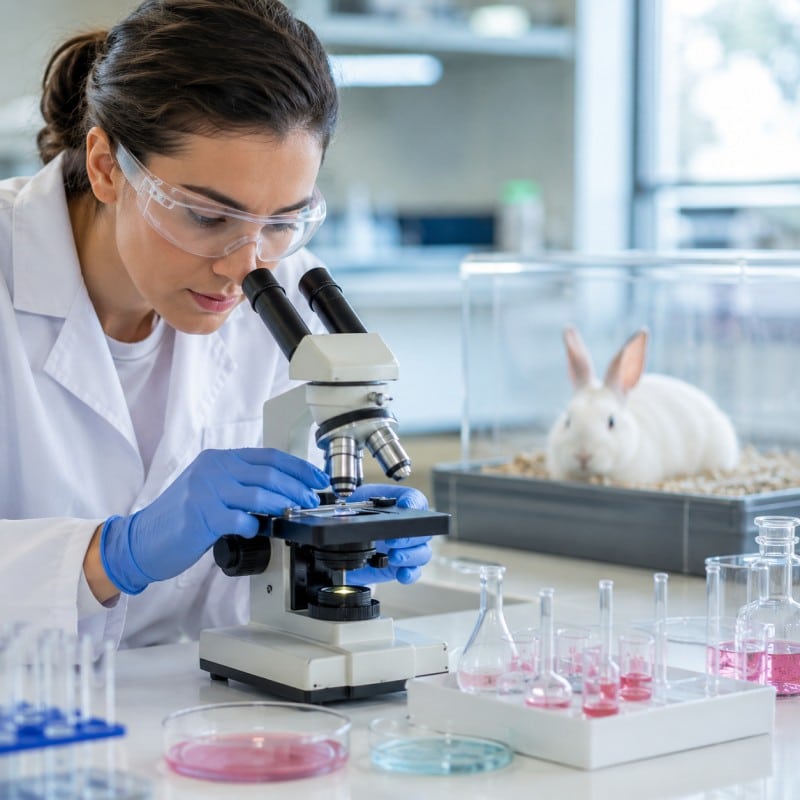
The European cosmetics industry’s move away from animal testing has reached an important point following the European Commission’s release of a roadmap to phase out animal testing in chemical safety assessments. The plan represents the Commission’s first formal commitment to replacing animal testing methods with non-animal science. Its goal is to replace animal tests used for chemicals in cosmetics and other products without lowering safety standards for consumers or the environment. Animal welfare groups have welcomed the announcement, though questions remain about funding, legal commitments, and implementation timelines.
A first official commitment
The new roadmap aims to replace animal testing in chemical safety assessments with alternative scientific methods. According to the company, the publication of the roadmap is an encouraging
There are still concerns. The roadmap itself is not legally binding, which leaves uncertainty about whether all commitments will be fully delivered. Questions remain around funding, regulatory action, and the future revision of the REACH regulation.
The company believes legislative change remains fundamental to achieving long-term progress. Existing changes and ongoing reforms provide reasons for optimism, though the complete removal of animal testing is expected to take longer than ten years in practice.
How the beauty sector helped shape the discussion
The roadmap follows years of campaigning. The company describes it as a direct response to the “Save Cruelty Free Cosmetics — Commit to a Europe Without Animal Testing” European Citizens’ Initiative.
More than 1.2 million verified signatures were submitted to the European Commission in 2023. The initiative brought together nonprofit organizations, policymakers, scientists, and global beauty brands including Dove and The Body Shop. The roadmap is structured around three pillars designed to support the phaseout of animal testing across Europe. The first pillar contains more than 30 recommendations focused on replacing, reducing, or refining animal use in safety assessments for human health and environmental testing. The second pillar focuses on research and innovation. This includes support for scientists and businesses developing New Approach Methodologies, commonly referred to as NAMs.
AI enters the picture
Artificial intelligence forms part of the Commission’s effort to strengthen NAM innovation in Europe.
The company says AI has the potential to improve efficiency, consistency, and depth in chemical safety assessments. It believes AI could help reduce animal testing in personal care even faster and could become an important part of achieving the roadmap’s objectives.
The exact role AI will play is still developing. At this stage, the technology is viewed as promising, but its full impact remains uncertain.
As non-animal testing methods continue to evolve, the beauty industry is increasingly being recognized for helping drive broader adoption of these approaches. Regulators cited the sector’s use of alternative testing methods as a model for other industries late last year.
Non-animal methods are now considered the default approach for skin and eye irritation testing in many cases.
Collaboration remains critical
The third pillar of the roadmap focuses on cooperation between European Union member states, agencies, international regulators, and industries.
The company views industry participation as crucial. It believes businesses will continue to play an important role in shaping both the future of toxicity testing and the legislation governing it.
One example involves adapting standard information requirements under the REACH regulation. Demonstrating that sound regulatory decisions can be made using non-animal methods may help accelerate wider regulatory acceptance.
In the short term, the company wants to eliminate animal use in tests involving skin and eye irritation, corrosion, and skin sensitization.
The complete removal of all toxicity testing on animals remains a longer-term objective. New non-animal methods will need to continue entering routine regulatory use over time.
Remaining concerns
Animal welfare organizations have welcomed the roadmap but continue to highlight several concerns.
The plan does not cover every use of animals in chemical testing. There is no clear commitment regarding who will finance future work, and there is no fixed timeline for legal reform.
Funding uncertainties could slow implementation. Existing animal tests may continue wherever regulators determine that alternative methods are not yet acceptable.
The company notes that the roadmap’s timelines are ambitious, which is viewed positively. At the same time, long-term deadlines for the complete elimination of animal testing are absent.
The organization believes a rolling program of short-term and medium-term targets will be necessary to maintain momentum.
Practical barriers remain. Supplies of materials and equipment can be limited. Additional training may be required. Testing laboratories may face capacity constraints. Smaller businesses may struggle to invest the time and resources needed to adapt regulatory information requirements and avoid animal testing.
The company argues that regulations must continue advancing so there is clarity regarding when and how non-animal methods should be used.
What comes next?
The possibility of replacing animal testing is no longer theoretical. Since the European Union completed its cosmetics testing ban in 2013, non-animal testing methods have become established tools for generating important toxicity data.
The benefits extend beyond cosmetics. Non-animal approaches for skin and eye irritation, corrosion, and skin sensitization are now the default methods required under regulations such as REACH.
The company points to OECD Guideline 497 as an example. Defined approaches for testing skin sensitization are said to predict effects in humans more accurately than the Local Lymph Node Assay mouse test.
Further reforms may arrive through the European Commission’s One Substance One Assessment initiative. The proposal seeks to prevent different European Union bodies from reaching conflicting safety conclusions about the same chemical used across multiple industries.
If implemented, cosmetics companies could face earlier pressure to reformulate ingredients identified as hazardous in other sectors.
The company expects additional benefits from the initiative, including stronger links between European chemicals, medicines, and food standards agencies and the creation of a Common Data Platform for Chemicals managed by the European Chemicals Agency.
Not everyone agrees with the direction of travel. Some members of the cosmetics industry have raised concerns that a hazard-based system could lead to reformulations that disrupt supply chains.
The debate continues, but the roadmap marks the first time the European Commission has formally committed to replacing animal testing in chemical safety assessments with human-relevant non-animal science.
