
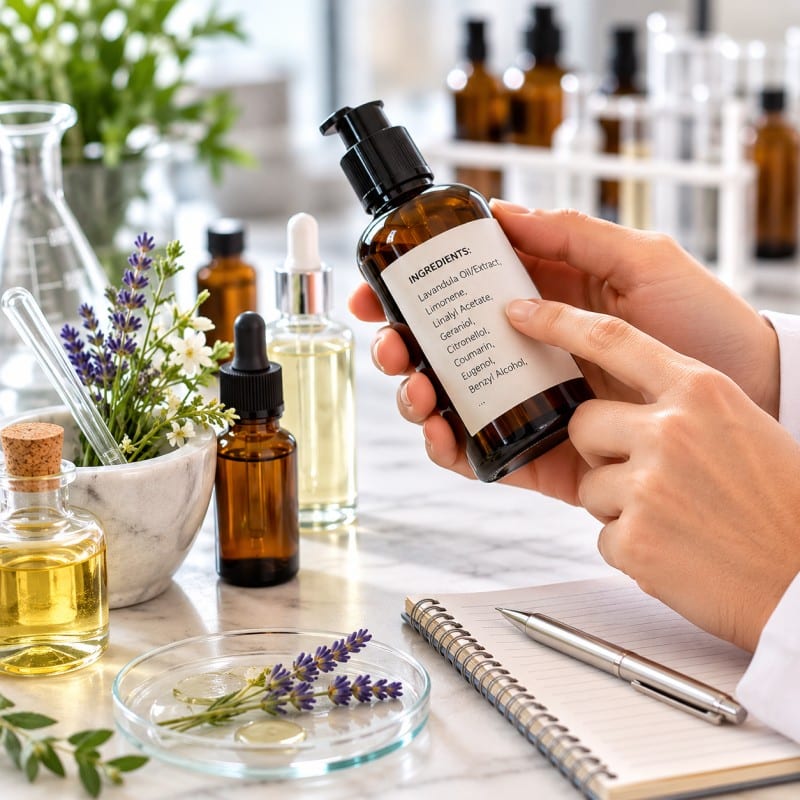
From today, cosmetic products placed on the EU market have to follow new fragrance allergen labeling rules. Commission Regulation (EU) 2023/1545 has now reached the end of its three year transition period, and brands selling products described as “natural beauty” could feel the biggest impact. Cosmetics containing any of the 56 extra fragrance allergens added to Annex III can no longer be placed on the EU market unless each allergen is listed separately in the ingredients when it exceeds 0.001% in leave on products or 0.01% in rinse off products. Products already placed on the market before today can still be sold until July 31, 2028.
Between 1% and 9% of people in the EU are allergic to fragrance allergens, according to the European Commission. The new labeling rules are not limited to perfumes. They apply to skin care, body care, shampoos, conditioners, shower gels, and products that use essential oils or aromatic botanical extracts.
The rules are based on a Scientific Committee on Consumer Safety (SCCS) opinion published in 2012. The SCCS confirmed that the existing 24 fragrance allergens requiring individual labeling were still relevant and identified another 56 substances that had caused allergic reactions in people but did not yet require declaration. The European Commission adopted those changes in July 2023, and the regulation now applies in full.
New products must comply today
The deadline applies to all newly placed cosmetic products. Companies still have a two year sell through period for older stock that was already on the market before today. Those products can remain available through distributors and retailers until July 31, 2028.
Beauty brands selling products in the EU can no longer introduce new batches that do not meet the regulation. That applies to imported products and cosmetics sold online as well.
Essential oils now require individual entries
One of the biggest changes affects formulators working with essential oils. The new Annex III entries cover more than individual fragrance molecules. Added substances include menthol, vanillin, camphor, benzaldehyde, carvone, linalyl acetate, santalol, terpineol, and geranyl acetate. The regulation now gives separate entries to many botanical ingredients too.
Those botanicals include lavender, rose, ylang ylang, bergamot, lemon peel oil, lemongrass, eucalyptus, clove, jasmine, peppermint, spearmint, geranium, patchouli, sandalwood, cedarwood, narcissus, bay laurel, and cassia and Ceylon cinnamon oils.
The 56 newly added substances bring the EU’s list of declarable fragrance allergens to around 80.
Some ingredients must be declared under one required collective name instead of the supplier’s preferred INCI name. This applies where a material has multiple INCI names or several related materials share the same entry.
For instance, the three Cymbopogon oils covered by the regulation all have to appear as “Lemongrass Oil.” Rose oils and extracts, including damask, cabbage, dog, and musk rose, must be listed as “Rose Flower Oil/Extract.” True lavender and lavandin materials must be declared as “Lavandula Oil/Extract.”
Natural and clean positioned products may face extra pressure from these changes. A formula containing three or four essential oils can exceed the declaration threshold for several entries at once. That can lead to a longer ingredient list with more chemical sounding names, something many natural beauty brands have tried to avoid.
More than label changes
Updating ingredient lists is only part of the work. Some of the newly listed entries now include requirements for the quality of raw materials.
Pinene must remain below a peroxide value of 10 mmoles/L, and limonene below 20 mmoles/L. Peroxide value measures how much a material has oxidized. Terpenes become much more allergenic as they age and react with air. Two cosmetic batches with the same ingredient list can still have different sensitizing potential if one has degraded more than the other.
Ingredient suppliers now need to certify these specifications. Beauty brands must keep oxidation under control throughout the product’s full shelf life.
The regulation uses the same approach for prehaptens and prohaptens. These substances can become known allergens after exposure to air or after they are metabolized by the skin. They are treated the same as fragrance allergens and are subject to the same restrictions.
Brands must update their Product Information Files. Cosmetic Product Notification Portal entries must be updated too if the labeling changes affect the notification.
Corrigendum changed a few details
Companies that completed their label updates early may still need another review. The European Commission published a corrigendum in the Official Journal on November 11, 2025. It arrived more than two years after the original regulation and kept the same compliance deadlines.
The corrigendum made three small changes that can affect product labels.
Geranium oil originally covered only Pelargonium graveolens flower oil. It now includes the plant oil and leaf oil as well. Patchouli originally covered only Pogostemon cablin oil. It now includes the leaf oil too.
Brands using either ingredient should check supplier declarations again, since materials that were outside the regulation in 2023 may now fall within its scope.
The final correction involved a name change. One of the rose ketones was listed as Damascone in the original text. The correct compound is Damascenone. Products using the earlier spelling need updated labels.
Canada adopts the same allergen list
Beauty brands operating internationally have another deadline to follow.
Starting tomorrow, cosmetics newly placed on the Canadian market must declare the same 56 additional fragrance allergens using the same concentration thresholds as the EU. Products already on the Canadian market have until April 11, 2027. Health Canada based its fragrance allergen list directly on Annex III of the EU regulation.
Canada is keeping this labeling schedule even after Health Canada relaxed parts of its notification requirements earlier this March.
The 2024 amendments to Canada’s Cosmetic Regulations originally required brands to report the concentration of every fragrance allergen in the Cosmetic Notification Form above the same thresholds used in the EU. Health Canada later made most of those concentration disclosures optional. Mandatory concentration reporting now applies only to allergens restricted under the Cosmetic Ingredient Hotlist. Brands still have to list all allergens in the Cosmetic Notification Form, and the requirement to declare them on product labels has not changed.
Great Britain keeps the previous rules
Great Britain has not adopted the expanded fragrance allergen list used by the EU and Canada. The UK Cosmetics Regulation still follows the previous allergen list. Northern Ireland continues to apply the EU rules.
Brands supplying both markets now have to work with two different ingredient labeling requirements for the same cosmetic formula. The Cosmetic, Toiletry and Perfumery Association in the UK has indicated that alignment could happen later, though no date has been announced.
