Anti-aging claim “up to five years younger” banned by UK regulator
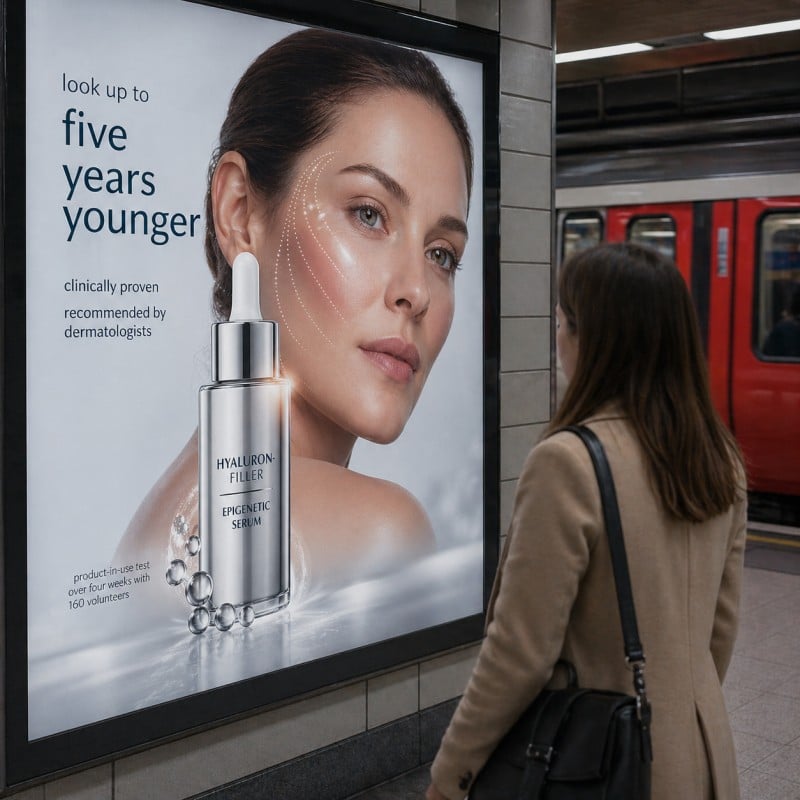
A billboard for a Hyaluron-Filler Epigenetic Serum ended up getting banned after someone filed a complaint with the UK Advertising Standards Authority (ASA). The poster appeared at Balham Underground Station in London, UK, and claimed users could “Look up to five years younger.” That claim was challenged, and the ASA asked for solid proof, which the company behind the product couldn’t really provide. The ad ran in November 2025, and the situation ties into a broader push for brands to back up what they say. People are watching more closely now, so there’s extra pressure to keep things clear and accurate.
What the ad claimed
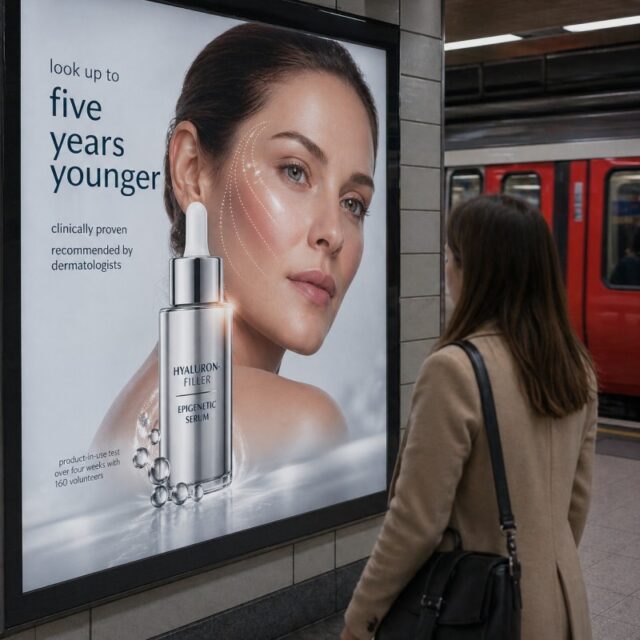
The ad showed a woman’s face with highlighted dots across her cheek, paired with lines like “look up to five years younger,” “clinically proven,” and “recommended by dermatologists.” In small text on the left-hand corner, it said the product had been tested in a “product-in-use test over four weeks with 160 volunteers.”
The ASA didn’t just accept that. It reviewed the study behind the claim and started questioning how it had been carried out.
Why the claim was challenged
The company said “up to five years younger” referred to the maximum possible outcome, not the average result for users. Even with that explanation, the ASA ruled the claim was misleading and not properly supported by evidence.
The regulator pointed out a few issues with the study. It included 160 volunteers but had no control group, and there was no information on how participants were selected. The study was done in a different climate than the UK, so it wasn’t clear if the results would apply locally. After the ruling, the billboard was removed.
Problems with the evidence
Another concern was the use of self-reported data. Participants evaluated their own results, which made the findings subjective rather than based on objective, clinical measurements.
The company submitted three additional unpublished studies, but those didn’t satisfy the ASA either. One peer-reviewed study only looked at the serum’s active ingredient and didn’t test the full product. The company maintained that all its studies followed industry standards, even with the concerns raised.
Final ruling and outcome
The ASA noted that self-assessment is often used in the industry for appearance-based claims. Even so, it emphasized that saying someone looks younger is subjective and doesn’t equal a clinically measured or biological change in age.
In the end, the company was instructed not to use the claim “Look up to five years younger” again in advertising unless strong supporting evidence is provided. It confirmed the poster is no longer prohibited in the UK.