
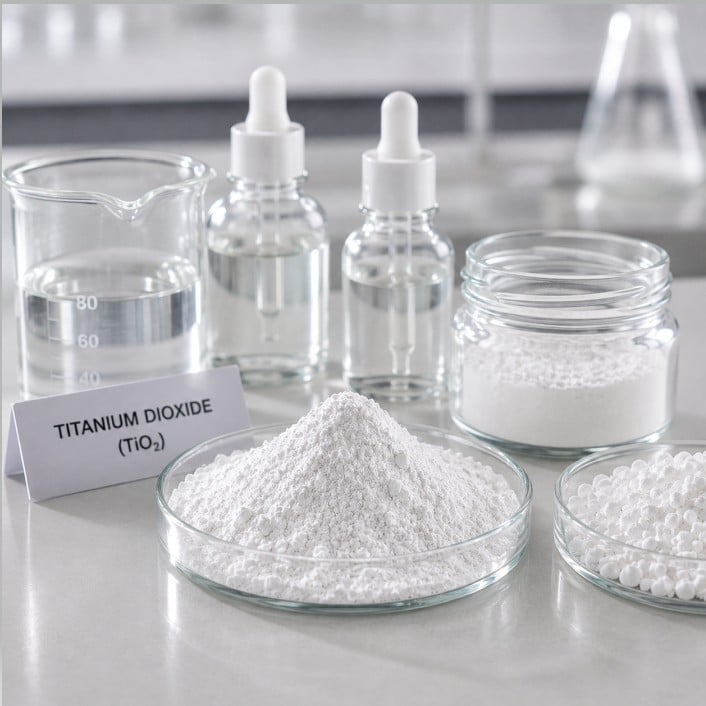
The substances under review are titanium dioxide (TiO₂), an established mineral UV filter already authorised in cosmetics, and Cresyl Methoxycinnamate, a candidate UV filter that is seeking approval for use in the European market.
Cresyl Methoxycinnamate awaits EU approval
Although Cresyl Methoxycinnamate is already used in some cosmetic formulations as a light stabiliser, it is not currently listed as an authorised UV filter under the EU Cosmetics Regulation.
The ingredient has attracted interest because it absorbs ultraviolet radiation primarily within the UVB range while extending into part of the UVA spectrum, making it a potential addition to the range of available sunscreen filters.
An industry dossier was submitted to the European Commission in August 2025 requesting the inclusion of Cresyl Methoxycinnamate in Annex VI of Regulation (EC) No 1223/2009 as a UV filter. The application proposes a maximum concentration of 6% in creams and lotions and 3% in spray products.
The SCCS has been asked by the European Commission to assess the safety of the ingredient under the proposed conditions of use, advise whether the requested concentrations are considered safe and identify any additional scientific concerns that should be taken into account before a regulatory decision is made.
Although a scientific opinion had initially been expected in 2026, the timetable has been extended to allow the submission and evaluation of additional data. The publication of the SCCS opinion has therefore been delayed.
Titanium dioxide undergoes another safety assessment
Titanium dioxide has long been authorised for use in cosmetics as both a white colourant and a mineral UV filter. It is widely used in sunscreens, facial creams, colour cosmetics, lip products and oral care formulations.
The introduction of nano-sized forms of titanium dioxide has improved the transparency of sunscreen formulations while maintaining effective protection against both UVA and UVB radiation, making it one of the most widely used mineral UV filters on the market.
Despite its long history of use, titanium dioxide continues to be the subject of ongoing scientific evaluation.
Why the SCCS is reviewing TiO₂ again
Titanium dioxide has already undergone several scientific assessments within the European Union.
Following its classification as a Category 2 carcinogen by inhalation for certain respirable powder forms under the EU Classification, Labelling and Packaging (CLP) Regulation, the SCCS re-evaluated its use in cosmetics. This resulted in amendments to the EU Cosmetics Regulation, including additional restrictions and conditions of use for certain applications.
The current review stems from a separate assessment carried out by the European Food Safety Authority (EFSA), which concluded that titanium dioxide could no longer be considered safe as a food additive because a potential genotoxic effect could not be excluded. This conclusion related specifically to oral exposure through food and did not automatically apply to dermal exposure from cosmetic products.
Following the EFSA opinion, the European Commission requested that the SCCS assess whether the new scientific evidence had implications for the safety of titanium dioxide when used in cosmetics.
In its final opinion adopted in May 2024, the SCCS concluded that the available evidence did not allow it to exclude a potential genotoxic concern for several grades of titanium dioxide used in oral cosmetic products and requested additional information for a number of material types.
Additional data under evaluation
To address the remaining scientific questions, industry submitted further data in June 2025, including studies covering different nano and pigmentary grades of titanium dioxide.
The SCCS is currently evaluating information on oral mucosal uptake, cellular effects and proposed grouping strategies for assessing the various forms of titanium dioxide used in cosmetic products.
A new SCCS scientific opinion is currently expected by the end of 2026.
What cosmetic manufacturers should monitor
Neither of these scientific reviews results in immediate regulatory changes. However, the conclusions reached by the SCCS could inform future amendments to the EU Cosmetics Regulation if the European Commission determines that regulatory action is necessary.
Manufacturers developing sunscreens or other products containing UV filters should continue monitoring forthcoming SCCS opinions and maintain close communication with raw material suppliers regarding the regulatory status and scientific evaluation of UV filter ingredients.
As the regulatory framework for cosmetic UV filters continues to evolve, early awareness of scientific assessments can help manufacturers anticipate potential formulation changes and minimise future compliance risks.
