
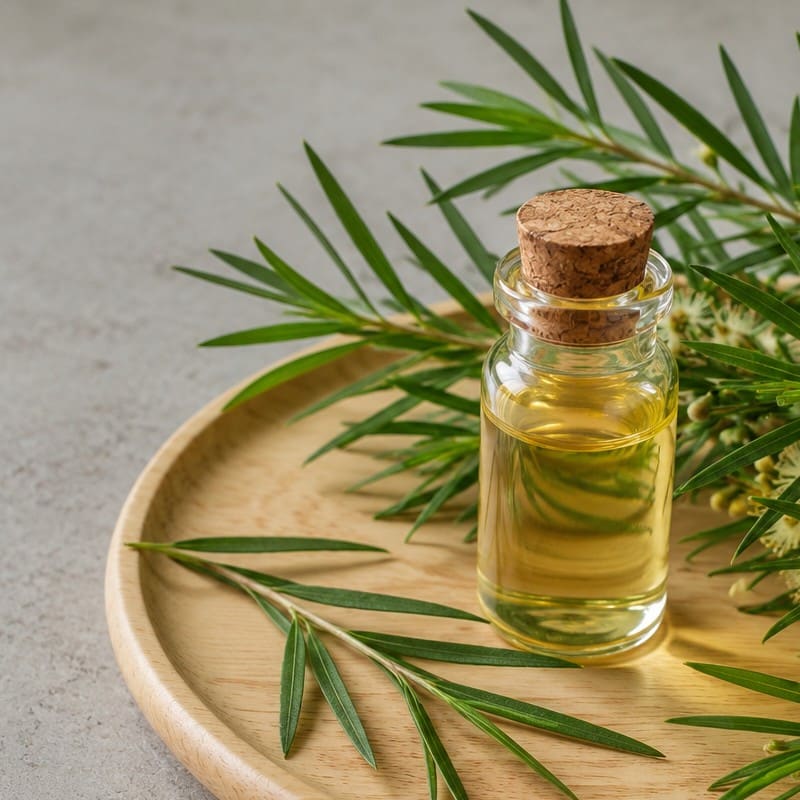

Tea Tree Oil, listed in cosmetics as Melaleuca Alternifolia Leaf Oil, is commonly used in products targeting oily skin, blemishes, dandruff and scalp imbalance thanks to its antimicrobial and anti-seborrheic properties. However, concerns regarding skin sensitisation, oxidation and possible reproductive toxicity classification led the SCCS to conduct a detailed scientific assessment.
Why Was Tea Tree Oil Under Review?
The review is linked to the European regulatory framework for substances classified as CMRs (carcinogenic, mutagenic or toxic for reproduction). Under the EU Cosmetics Regulation, substances classified as CMR are generally prohibited unless strict safety conditions are met and an SCCS assessment supports their use.
Tea Tree Oil attracted regulatory attention because some of its naturally occurring constituents may raise toxicological concerns under the CLP Regulation framework. The SCCS therefore evaluated whether the ingredient could still be considered safe in cosmetic products under controlled conditions.
This case also illustrates a broader trend in EU cosmetics regulation: natural origin does not automatically imply regulatory acceptance or safety. Essential oils are increasingly scrutinised with the same toxicological standards applied to synthetic ingredients.
What Did the SCCS Conclude?
The SCCS concluded that Tea Tree Oil can be considered safe in specific cosmetic product categories and under defined concentration limits. According to the final opinion, the ingredient is considered safe when used:
- up to 2.0% in shampoo,
- up to 1.0% in shower gel,
- up to 1.0% in face wash,
- and up to 0.1% in face cream.
Importantly, these conclusions only apply to the product types evaluated in the dossier submitted to the SCCS. The opinion should not be interpreted as a blanket approval for Tea Tree Oil in all cosmetic applications.
The SCCS also specified that the assessment applies only to dermally applied products intended for adults and excludes aerosol or spray formats because of inhalation exposure concerns.
The Importance of Composition and Stability
One of the most significant aspects of the opinion is the emphasis on ingredient quality and stability.
The SCCS stated that the opinion only applies to Tea Tree Oil that complies with ISO 4730 specifications, which define the acceptable chemical composition of the oil.
This is particularly important because Tea Tree Oil is chemically unstable. Exposure to oxygen, heat or light can alter its composition over time, increasing the formation of oxidation products associated with skin sensitisation. The SCCS therefore highlighted that manufacturers must ensure the stability of the ingredient throughout the finished product’s shelf life.
For formulators, this means that simply sourcing compliant raw material may not be enough. Stability testing, packaging selection and antioxidant strategies may become increasingly relevant for regulatory compliance and safety substantiation.
Sensitisation Remains a Key Concern
Although the SCCS concluded that Tea Tree Oil can be used safely within the proposed limits, the committee also identified it as a moderate skin sensitiser.
This point is especially relevant for leave-on formulations, where exposure duration is higher. The notably lower concentration allowed in face cream (0.1%) compared with rinse-off products reflects this concern.
Manufacturers should therefore carefully evaluate cumulative exposure, intended consumer group and compatibility with other sensitising ingredients in the formulation. From a product development perspective, the opinion reinforces the importance of balancing efficacy claims with tolerability and consumer safety.
Regulatory Impact for Cosmetic Brands
The SCCS opinion itself is not a legal restriction, but it is highly influential. SCCS conclusions are frequently used by the European Commission as the scientific basis for future amendments to the EU Cosmetics Regulation.
As a result, companies using Tea Tree Oil should already begin reviewing formulations, technical documentation and safety assessments in line with the SCCS conclusions.
Beyond Tea Tree Oil itself, the opinion sends an important signal to the wider cosmetics industry. EU regulators are continuing to apply increasingly detailed toxicological scrutiny to complex natural substances, particularly essential oils containing allergenic or potentially hazardous constituents.
This trend is likely to continue in the coming years as more botanical ingredients are reassessed under evolving toxicological and classification frameworks.
For cosmetic manufacturers, the message is clear: natural ingredients require the same level of scientific substantiation, compositional control and regulatory strategy as synthetic ones.
