
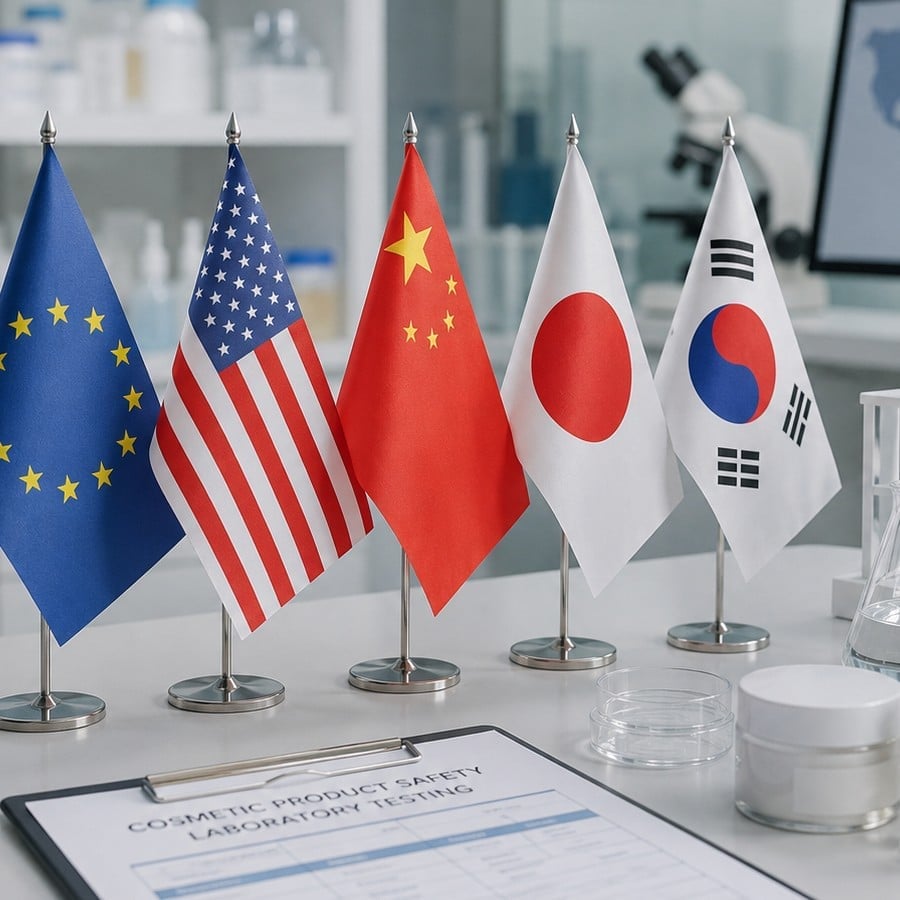
This article provides a comparative overview of laboratory testing requirements in four major regulatory frameworks: the European Economic Area (EEA), the United States, China, Japan, and South Korea. While all jurisdictions share a common goal—ensuring consumer safety—their approaches differ in structure, rigor, and enforcement.
European Economic Area (EEA)
The EEA, governed by the European Commission, enforces one of the most stringent cosmetic regulatory systems in the world under Regulation (EC) No 1223/2009.
A defining feature of the European framework is its strong emphasis on pre-market safety assessment. Before a product can be placed on the market, it must undergo a comprehensive safety evaluation conducted by a qualified assessor. This evaluation relies heavily on toxicological profiles of ingredients, exposure scenarios, and stability data.
Laboratory testing in the EEA typically includes microbiological quality testing, stability and compatibility studies, and preservative efficacy testing (commonly known as challenge tests). Notably, the EEA has implemented a full ban on animal testing for cosmetic products and ingredients, meaning all safety data must rely on alternative methods such as in vitro testing or existing historical data.
Additionally, manufacturers must compile a Product Information File (PIF), which includes detailed laboratory results and must be readily accessible to authorities.
United States
In the United States, cosmetics are regulated by the Food and Drug Administration under the Federal Food, Drug, and Cosmetic Act.
Unlike the EEA, the US system does not require pre-market approval for most cosmetic products (with the exception of color additives). Responsibility for safety rests primarily with the manufacturer. This results in a more flexible—but also less centralized—approach to laboratory testing.
Manufacturers are expected to substantiate the safety of their products, but the law does not prescribe specific testing protocols. In practice, companies conduct microbiological testing, stability studies, and sometimes clinical or dermatological testing depending on product claims.
Recent legislative developments, such as the Modernization of Cosmetics Regulation Act (MoCRA), have increased requirements around safety substantiation and adverse event reporting. However, laboratory testing remains largely guided by industry best practices rather than strict regulatory mandates.
China
China’s cosmetic regulatory framework has undergone significant modernization with the introduction of the Cosmetic Supervision and Administration Regulation (CSAR), overseen by the National Medical Products Administration.
Historically, China was known for mandatory animal testing requirements, particularly for imported cosmetics. While reforms have relaxed these rules for certain categories—especially general cosmetics—animal testing may still be required under specific circumstances, such as for special-use cosmetics or when safety concerns arise.
Laboratory testing in China is highly structured and often must be conducted in authorized local laboratories. Required tests typically include toxicological assessments, microbiological testing, heavy metal analysis, and stability studies.
For many products, especially those classified as “special cosmetics” (e.g., hair dyes, sunscreens), registration dossiers must include extensive laboratory data and sometimes human safety or efficacy testing.
Japan
Japan regulates cosmetics under the Pharmaceutical and Medical Device Act (PMD Act), with oversight from the Ministry of Health, Labour and Welfare.
The Japanese system emphasizes ingredient regulation through positive and negative lists. Manufacturers must ensure that only approved ingredients are used within specified limits. Unlike China, pre-market approval is not generally required for standard cosmetics.
Laboratory testing focuses on ensuring product quality and safety, including stability testing, microbiological controls, and preservative efficacy. While animal testing is not explicitly banned, it is largely discouraged and rarely used in practice due to global industry trends.
Companies must also comply with Good Quality Practice (GQP) and Good Vigilance Practice (GVP), which reinforce internal quality control and post-market surveillance rather than prescriptive testing requirements.
South Korea
South Korea has emerged as a major cosmetics market with a robust regulatory framework managed by the Ministry of Food and Drug Safety.
Similar to Japan, South Korea distinguishes between general cosmetics and functional cosmetics (such as whitening, anti-wrinkle, or UV protection products). Functional cosmetics are subject to stricter requirements, including pre-market approval and more extensive laboratory testing.
Testing requirements typically include stability studies, microbiological testing, and, for functional claims, efficacy data. South Korea also places increasing emphasis on alternative testing methods, aligning with global trends toward reducing animal testing.
Manufacturers must maintain detailed technical documentation and ensure compliance with Korean Good Manufacturing Practices (KGMP), which integrate laboratory testing into broader quality assurance systems.
Key Differences and Strategic Implications
While all five regions require laboratory testing to ensure cosmetic safety, the degree of regulatory control varies significantly. The EEA and China impose more structured and mandatory pre-market requirements, whereas the US, Japan, and South Korea rely more on manufacturer responsibility and post-market oversight—though South Korea applies stricter controls to functional products.
Animal testing policies also differ markedly. The EEA enforces a complete ban, while China maintains conditional requirements. Other regions fall somewhere in between, often influenced by international market expectations.
For manufacturers, this means that a “one-size-fits-all” testing strategy is rarely sufficient. Instead, companies must design adaptable testing programs that can meet the most stringent requirements while remaining efficient and cost-effective.


