
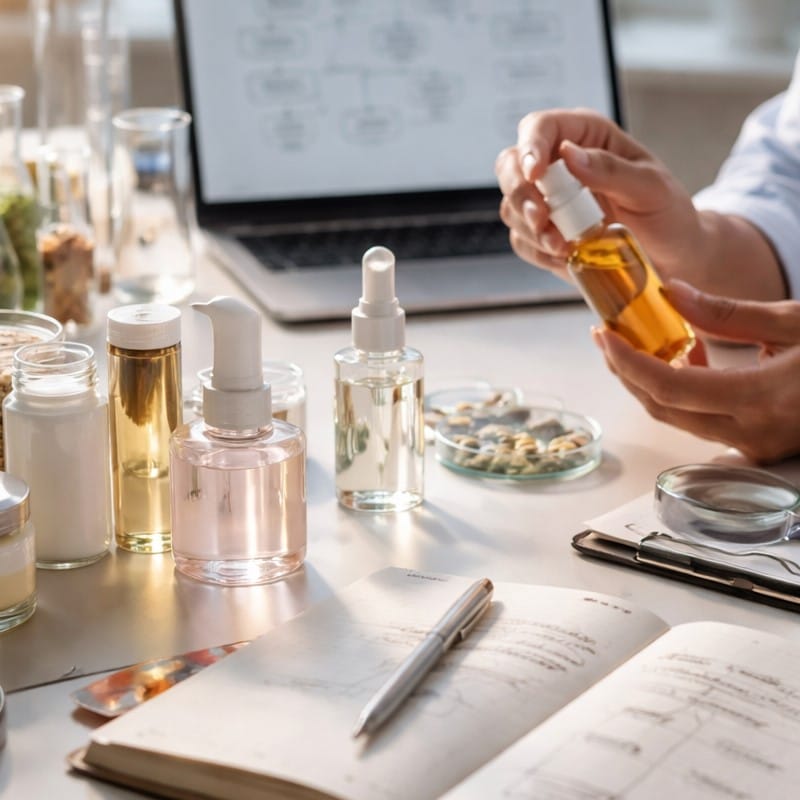

This guide walks you through the key stages—from initial concept to placing your product on the market—explained in a practical and accessible way.
Concept & Product Definition
Every cosmetic product begins with an idea. At this early stage, it is essential to clearly define the nature of the product: what it is, what it is intended to do, and who it is for. Whether the product is a moisturizer, a cleanser, or a fragrance, its intended function determines whether it falls under the definition of a cosmetic.
This distinction is crucial because if a product makes medicinal claims or acts beyond a cosmetic purpose, it may fall under pharmaceutical legislation instead.
Formula Development
Once the concept is established, formulation begins. This involves selecting ingredients and ensuring that each one complies with European regulatory requirements. The formulation must avoid substances prohibited under Annex II of the Regulation and respect the conditions and limits imposed on restricted substances listed in Annex III.
At this stage, safety is not just a future requirement—it is already embedded in formulation decisions.
Safety Assessment and PIF
Before a cosmetic product can be placed on the market, it must undergo a formal safety assessment. This process is carried out by a qualified professional who evaluates the toxicological profile of each ingredient, the expected exposure, and the overall risk to human health.
The outcome of this evaluation is documented in the Cosmetic Product Safety Report (CPSR), which confirms that the product is safe under normal or reasonably foreseeable conditions of use.
The Product Information File is a central element of compliance. It brings together all essential documentation related to the product, including its description, the CPSR, details of the manufacturing process, and evidence supporting any claims made.
This file must be kept accessible to authorities and maintained for ten years after the last batch of the product is placed on the market.
A key regulatory requirement is the designation of a Responsible Person within the European Union. This individual or entity is legally accountable for ensuring that the product complies with all applicable requirements.
The Responsible Person oversees safety, maintains the Product Information File, and ensures that all obligations—such as notification—are properly fulfilled.
Good Manufacturing Practices (GMP)
Manufacturing must follow Good Manufacturing Practices to ensure consistent quality and safety. In the cosmetics industry, this is typically aligned with ISO 22716.
GMP covers not only production itself but also hygiene, documentation, traceability, and quality control. Even small-scale or artisanal producers are expected to apply these principles.
Notification via CPNP
Before a cosmetic product can be marketed, it must be notified through the Cosmetic Products Notification Portal (CPNP). This step involves submitting key information about the product, including its category, the identity of the Responsible Person, and specific details such as the presence of nanomaterials.
It is important to note that this is not an approval process. Rather, it is a declaration that the product complies with the regulatory framework.
Labelling & Claims
Labelling is a critical interface between the product and the consumer. It must include essential information such as the name and address of the Responsible Person, the product’s content, its durability, precautions for use, and the ingredient list in INCI format.
Claims made about the product must be truthful, supported by evidence, and not misleading. This ensures transparency and protects consumer trust.
Market Placement and Post-Market Surveillance
Once all requirements have been fulfilled, the product can be legally placed on the European market. However, compliance does not end at this stage, the manufacturer or Responsible Person must remain vigilant and ensure that the product continues to meet safety standards.
After launch, continuous monitoring becomes essential. This includes collecting feedback from users, tracking any adverse effects, and reporting serious undesirable effects to the appropriate authorities.
This phase ensures that safety is maintained throughout the product’s lifecycle and reinforces confidence in the brand.
From Concept to Commercialisation
Bringing a cosmetic product to market in Europe is not just about creativity—it is about responsibility. Regulation (EC) No 1223/2009 provides a structured framework to ensure that all products are safe, transparent, and trustworthy.
Understanding this timeline helps transform a complex regulatory landscape into a manageable process. With the right preparation, compliance becomes not a barrier—but a foundation for long-term success in the cosmetics industry.


