
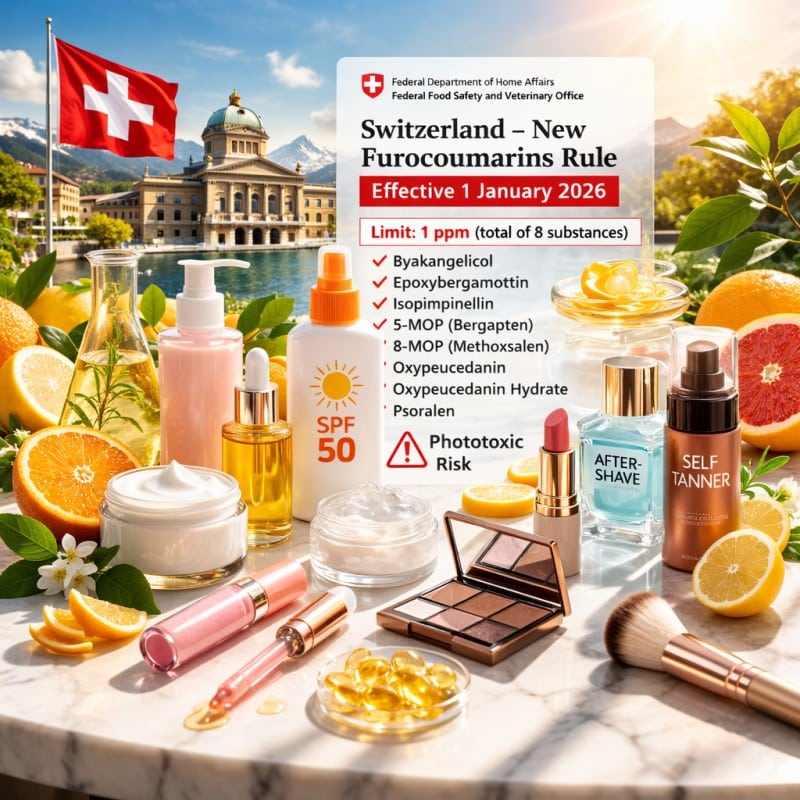
Switzerland has updated its Cosmetics Ordinance, introducing a specific restriction on furocoumarins that takes effect on 1 January 2026. The Federal Department of Home Affairs, through the Federal Food Safety and 
If furocoumarins remain on the skin and are exposed to ultraviolet rays, they can cause phototoxic responses, including irritation, inflammation, or even possible genetic changes from repeated or prolonged exposure.
Due to the high risk of photoreactive effects, Switzerland has set one of the toughest international thresholds for furocoumarins. The measure covers all leave-on cosmetics likely to be worn in sunlight, not only sunscreens or self-tanning products. The rule targets both Swiss-produced and imported goods as these substances are now excluded from the Cassis de Dijon Principle.
Key Points of the New Regulation
- The 1 ppm maximum now applies exclusively to the following eight furocoumarins: byakangelicol (CAS 61046-59-1)
-
Epoxybergamottin (CAS 206978-14-5)
-
Isopimpinellin (CAS 482-27-9)
-
5-Methoxypsoralen (5-MOP, also known as Bergapten; CAS 484-20-8)
-
8-Methoxypsoralen (8-MOP, Methoxsalen; CAS 298-81-7)
-
Oxypeucedanin (CAS 737-52-0)
-
Oxypeucedanin hydrate (CAS 2643-85-8)
-
Psoralen (CAS 66-97-7)
All these substances now fall under the updated cap.
Understanding Furocoumarins and Risks
Furocoumarins are plant-based compounds found in sources such as citrus peels. when absorbed onto skin and exposed to ultraviolet light, they can form bonds with DNA or proteins, producing skin irritation or inflammation. Repeated contact with these agents increases the likelihood of cellular mutations, which might be linked to cancer risk.
Scope: Which Cosmetics Must Comply?
The revision impacts all cosmetic products designed to stay on the skin and perhaps encounter sunlight. This group includes face and body creams, lotions, gels, oils, lip balms, color cosmetics, sunscreen products, and also self-tanners and aftershave balms. Items such as nail polish, hair treatments, toothpaste, deodorants, overnight skin products, rinse-off formulas, and fragrances are not subject to this regulation.
Implementation Timeline
The amended rules will be in force begining 1 January 2026, with no grace period.From that day, non-compliant items cannot be introduced to the market.
Items legally distributed before 31 December 2025 may remain on sale until inventories are exhausted.
Steps for Cosmetic Companies
With furocoumarins now removed from the Cassis de Dijon Principle, the standard applies equally to both domestic and imported cosmetics. Companies selling in Switzerland must analyze all leave-on products for possible sunlight exposure, confirming that the combined concentration of these eight furocoumarins does not exceed 1 ppm. Early assessment and reformulation where needed will help retain market access and avoid enforcement actions.
