
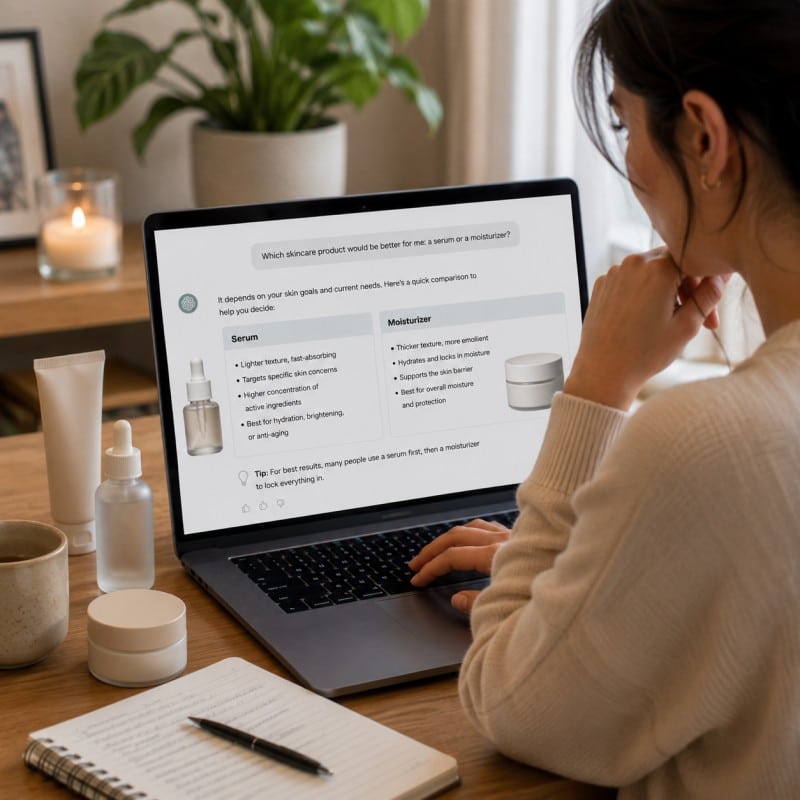
AI tools are changing how people discover beauty products, and a new report suggests that brand websites play only a small role in those recommendations. Most of the sources AI relies on come from outside the brands themselves. Editorial coverage, media mentions, and trusted reference sites carry much more weight. The findings suggest that third-party credibility, rather than brand publishing, is the biggest factor behind AI visibility.
Editorial coverage drives AI beauty recommendations
The report found that beauty brands’ own websites and marketing materials have very little influence on whether AI tools recommend their products. According to the research, 96.1% of all citations used in AI beauty recommendations came from third-party sources, including editorial coverage, media mentions, and trusted reference sites. Brand-owned content accounted for the remaining 3.9%.
The report says AI models are becoming the first place many consumers turn to when researching beauty products. Brands that appear in AI responses gain a strong competitive advantage.
According to the report, AI visibility is no longer driven by publishing more content. Instead, it is built through authority and credibility beyond a brand’s own channels. Trusted third-party sources continue to shape how AI understands and recommends brands, creating a different approach from traditional brand publishing.
The 2026 AI Visibility Index Beauty Report examined how ChatGPT recommends beauty brands to consumers. The research covered 60 major beauty brands across 565 AI citations and 75 consumer prompts spanning cosmetics, hair care, and skin care. Several skincare and hair care brands ranked highest for AI visibility.
Editorial sources have the strongest influence
The report says consumers are adopting AI for product discovery at a rapid pace. ChatGPT had 400 million active weekly users in early 2025, and that number grew to more than 900 million by early 2026.
According to the research, 73% of consumers now use generative AI for product research. The report describes this as a shift in consumer behavior that beauty brands cannot afford to ignore.
Editorial publications accounted for 63.2% of all AI citations. Beauty magazines and editorial websites were the sources referenced most often. The report says earned media has become the primary signal of a brand’s credibility and trustworthiness, regardless of how much content a brand publishes on its own.
The leading beauty brand appeared in 16% of all prompts analyzed and captured 6% of all brand mentions. The report attributes this to broad authority across multiple topic areas rather than dominance in a single category.
The second-ranked brand captured 5% of all brand mentions, while another brand climbed from seventh place last year to third place this year.
The brands in the top five together accounted for 24% of all brands cited by AI tools. According to the report, this suggests that a small group is beginning to separate itself from the rest of the market.
The report adds that brands mentioned heavily in only one topic area are less likely to achieve AI visibility at scale.
Comparison content performs best
The report found that AI models are more likely to cite comparison articles than standard product descriptions. According to the research, AI prefers content that helps consumers compare options and make informed decisions instead of content that simply promotes products.
Among user-generated content sources, Reddit was the platform cited most often. The report says community discussions and peer recommendations play an important role in how AI evaluates trust.
AI becomes the starting point
As generative AI continues to grow, more product discovery begins inside AI tools before consumers visit a brand or retailer’s website.
A marketing executive from an AI beauty technology company previously said consumers are engaging with AI tools earlier in their product discovery journey than they would traditionally engage with a brand or retailer.
The executive said the difference is that this new “front door” is conversational and dynamic rather than navigational. Instead of browsing or searching, users ask AI for guidance.
The analysis found that the questions consumers ask AI tools closely match the factors buyers use when choosing products, including price, features, reliability, service quality, reputation, and trust.
The report says that if a brand is not cited when consumers ask AI which options are the most trusted, most affordable, or best suited to their needs, it is missing an increasingly important stage of product consideration.
The report advises brands to monitor whether they appear in AI conversations and adjust their online engagement strategies before AI visibility becomes a standard industry performance indicator.
