
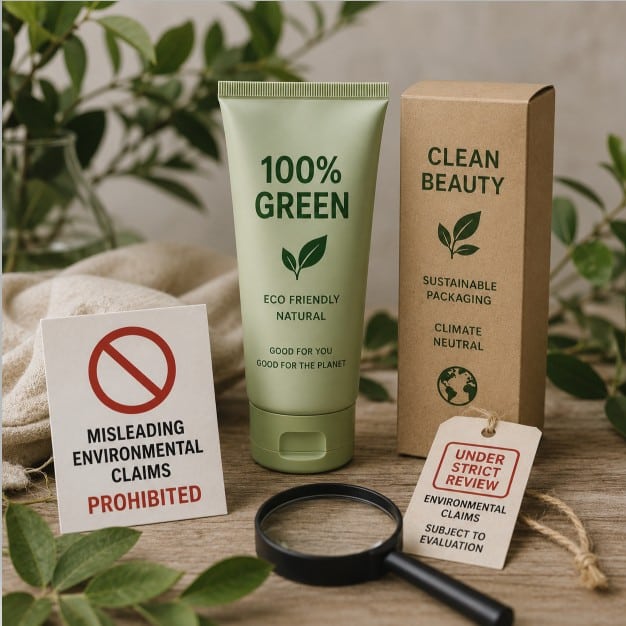

However, the way these claims are communicated is changing across the European Union.
Directive (EU) 2024/825, known as the Empowering Consumers for the Green Transition Directive, introduces new EU rules aimed at protecting consumers from misleading environmental claims and unreliable sustainability information. Member States were required to transpose the Directive into national law, with the new measures applying from 27 September 2026.
Italy has now implemented the Directive through Legislative Decree No. 30 of 20 February 2026. While this is an important regulatory development for companies operating on the Italian market, the underlying requirements originate from EU legislation and are relevant to cosmetic companies throughout the European Union.
For cosmetic manufacturers and brands, environmental claims are therefore becoming an increasingly important compliance issue across the EU.
A New Approach to Greenwashing in the EU
Directive (EU) 2024/825 introduces new rules designed to improve the reliability of sustainability-related information provided to consumers.
The objective is not to prevent companies from communicating environmental improvements. Instead, the legislation targets claims that are vague, exaggerated or presented without sufficient context.
An environmental claim can take many forms. It may be a written statement on a cosmetic label, a symbol on packaging, a product name or a message used in online advertising. Even visual or graphic elements may contribute to an environmental message if they imply that a product, brand or company has a positive or reduced environmental impact.
This broad approach is particularly relevant for cosmetics, where sustainability messages are often incorporated into the overall presentation of a product.
Generic “Green” Claims Face New Restrictions
One of the most important changes concerns broad environmental expressions.
Claims such as “green”, “eco-friendly”, “environmentally friendly” or “ecological” may create a general impression that a product has superior environmental performance. Under the new rules, generic environmental claims are prohibited when the claimed environmental performance cannot be demonstrated in accordance with the requirements of the legislation.
For cosmetic brands, simply adding environmental language to packaging will therefore become increasingly risky.
A more precise statement may provide consumers with clearer information. For example, communicating a specific and substantiated characteristic of the packaging is very different from describing the entire cosmetic product as “green”.
The wording, context and evidence behind the claim will all be important.
One Environmental Benefit Does Not Make the Entire Product Sustainable
Cosmetic products often have complex environmental profiles.
The formula, raw materials, manufacturing process, primary packaging, secondary packaging, transport and disposal can all contribute differently to the environmental impact of a product.
The new rules address situations where a benefit linked to one element is presented as if it applied to the entire product.
For example, an environmental improvement concerning the packaging should not automatically be used to suggest that the complete cosmetic product has a reduced environmental impact.
This distinction is particularly important for cosmetic brands using recycled packaging, refill systems or specific sustainably sourced ingredients.
Claims should clearly identify what the environmental benefit actually relates to.
Sustainability Labels Will Also Be Scrutinised
Logos and environmental labels can strongly influence consumer perception.
Under Directive (EU) 2024/825, sustainability labels may only be displayed when they are based on a certification scheme or established by public authorities.
This is intended to reduce the use of self-created environmental logos that resemble independent certifications.
Cosmetic companies should therefore review environmental symbols and sustainability seals appearing on their products. A green logo designed internally by a brand may create a certification impression even when no independent certification exists.
The visual presentation of environmental information should receive the same regulatory attention as written claims.
Carbon Neutrality Claims Become More Difficult
The Directive also introduces specific restrictions concerning climate-related claims based on greenhouse gas offsetting.
Companies cannot claim that a product has a neutral, reduced or positive environmental impact in terms of greenhouse gas emissions when that claim is based on offsetting emissions.
This has important implications for claims such as “carbon neutral” when they are used at product level.
Cosmetic brands relying on carbon credits or similar offsetting mechanisms should carefully review how climate information is communicated. Purchasing offsets does not automatically justify presenting an individual cosmetic product as climate neutral.
Italy’s Implementation Reflects a Broader EU Change
Italy has transposed Directive (EU) 2024/825 through Legislative Decree No. 30 of 20 February 2026, integrating the new environmental claims requirements into its national consumer protection framework. For companies selling cosmetics in Italy, the new measures will apply from 27 September 2026.
However, these rules are not limited to the Italian market. Directive (EU) 2024/825 is an EU-wide initiative that Member States must incorporate into national law. While national implementation and enforcement may vary, the core restrictions on generic environmental claims, sustainability labels and certain offset-based climate claims originate from the same European legislation.
Cosmetic manufacturers and brands should therefore review environmental communication across labels, packaging, websites and advertising. Claims should clearly identify whether an environmental benefit relates to the entire product or only to a specific element, and companies should ensure that appropriate evidence supports the statements they make.
For businesses selling cosmetics in multiple EU countries, a coordinated European approach to environmental claims may be more practical than reviewing claims market by market. Italy’s implementation is part of a wider regulatory shift that will affect sustainability communication throughout the EU from September 2026.
