
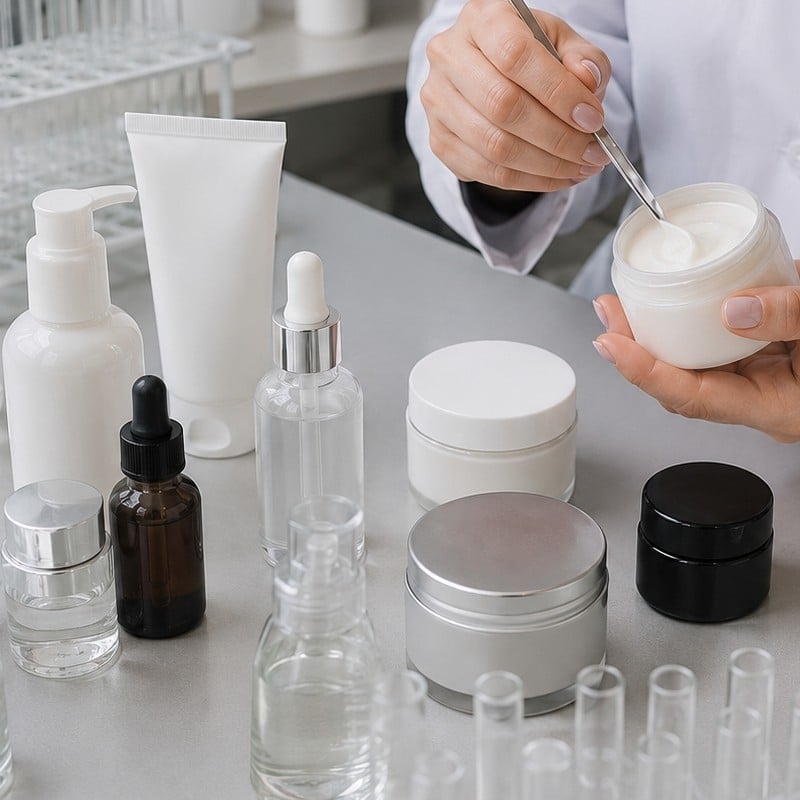
Packaging compatibility testing evaluates how a cosmetic formulation and its packaging interact over time. It helps manufacturers identify potential problems before a product reaches the market and supports the evidence required to demonstrate that the product remains safe and fit for its intended purpose.
What Is Packaging Compatibility Testing?
Packaging compatibility testing is the process of evaluating whether a cosmetic formulation remains stable and safe when stored in its intended container throughout its expected shelf life.
Unlike stability testing, which focuses primarily on the formulation itself, compatibility testing examines the relationship between the product and the packaging material. A formulation that performs perfectly in a laboratory glass container may behave differently when stored in plastic, aluminum, glass with coated closures, airless pumps, tubes, jars, or bottles.
The objective is to confirm that neither the packaging nor the cosmetic product negatively affects the other over time.
Why Is Packaging Compatibility Important?
Cosmetic packaging performs several essential functions. It protects the formulation from contamination, oxygen, moisture, light, and physical damage while allowing consumers to dispense and use the product conveniently.
If the packaging is incompatible with the formulation, various problems may develop during storage or normal use. These issues may affect product quality, consumer safety, or the product’s commercial appearance.
Potential compatibility problems include changes in color, odor, texture, leakage, evaporation, cracking of containers, swelling of plastic components, corrosion of metal packaging, migration of substances between the packaging and the formulation, or failure of dispensing systems such as pumps and sprays.
Identifying these issues before launch reduces the likelihood of customer complaints, product recalls, and unnecessary reformulation.
What Is Evaluated During Testing?
Packaging compatibility studies typically monitor both the cosmetic formulation and the packaging throughout the storage period.
The formulation is examined for changes in appearance, color, odor, pH, viscosity, weight, phase stability, and overall performance.
At the same time, the packaging is inspected for physical or functional changes such as deformation, cracking, discoloration, swelling, corrosion, leakage, loss of seal integrity, or deterioration of labels and printing.
For products with dispensing systems, laboratories may also verify that pumps, droppers, valves, or spray mechanisms continue to operate correctly after prolonged storage.
Migration Between Product and Packaging
One of the most important aspects of compatibility testing is evaluating migration.
Migration occurs when substances move between the packaging material and the cosmetic formulation. Certain ingredients may be absorbed by the packaging, while components of the packaging itself may migrate into the cosmetic product.
This interaction can alter the formulation, reduce the concentration of active ingredients, affect fragrance or color, or introduce unwanted substances into the product.
The likelihood of migration depends on several factors, including the formulation, storage conditions, packaging material, temperature, and the length of storage.
Which Products Need Compatibility Testing?
Packaging compatibility should be considered for virtually every cosmetic product, regardless of its formulation.
However, it becomes particularly important for products containing essential oils, fragrances, solvents, alcohol, acids, vitamins, botanical extracts, or other ingredients known to interact with certain packaging materials.
Water-based emulsions, sunscreens, products containing volatile ingredients, and formulations with high concentrations of active substances also benefit from thorough compatibility evaluation.
Whenever a manufacturer introduces new packaging or changes an existing container, additional compatibility assessment is generally recommended, even if the formulation itself remains unchanged.
What Happens If Compatibility Problems Are Found?
Discovering compatibility issues during development is common and often leads to improvements before commercial production begins.
Manufacturers may decide to change the packaging material, modify internal coatings, improve sealing systems, select a different dispensing mechanism, or reformulate the product to improve long-term stability.
Once these changes have been implemented, additional testing is usually performed to verify that the revised product-package combination performs satisfactorily.
Resolving compatibility problems during development is significantly less expensive than addressing customer complaints or product recalls after launch.
Packaging Compatibility and the Product Information File
Although Regulation (EC) No. 1223/2009 does not require a separate packaging compatibility report, the evidence generated during development contributes to the Product Information File (PIF) and supports the Cosmetic Product Safety Report (CPSR).
Safety assessors consider available information regarding packaging suitability, especially where there is a possibility of interaction between the formulation and the container.
Well-documented compatibility studies therefore strengthen the technical documentation supporting the product before it is placed on the European market.


