
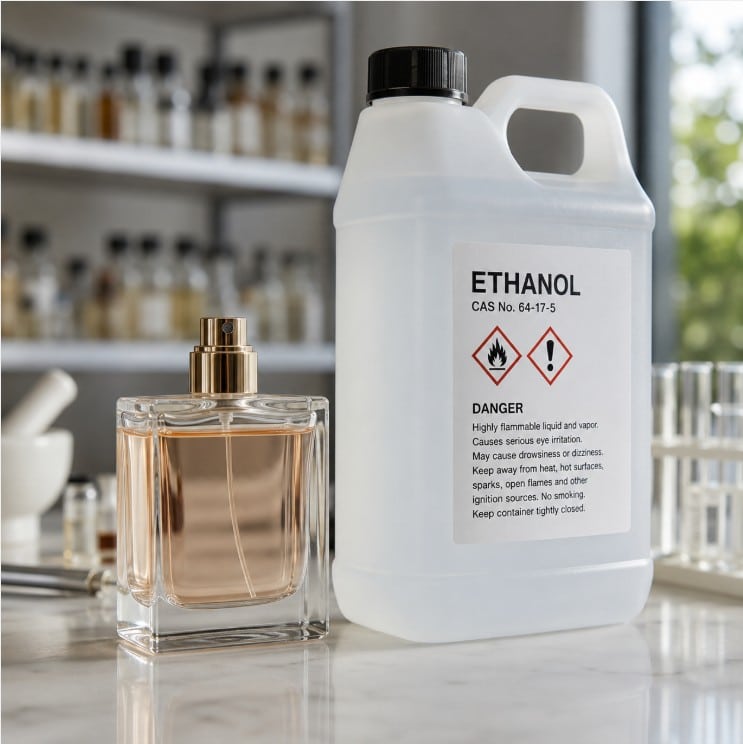
Despite its long history of use, ethanol has recently become the subject of increased regulatory scrutiny in the European Union. Ongoing discussions under chemicals and biocides legislation have drawn significant attention from the cosmetics industry, raising questions about the potential implications for one of the sector’s most widely used ingredients.
While no immediate regulatory changes affect the use of ethanol in cosmetics today, the evolving regulatory landscape is being closely monitored by manufacturers, formulators and regulatory affairs professionals across Europe.
Where Does the Debate Come From?
The current discussion originates primarily from the evaluation of ethanol under European biocides legislation.
As part of the review process for ethanol as an active substance in disinfectant products, European scientific committees have assessed a broad range of toxicological data and considered whether the available evidence could support a harmonised hazard classification under the Classification, Labelling and Packaging (CLP) Regulation.
These discussions have attracted considerable attention because any future harmonised classification could have consequences beyond the biocides sector, potentially affecting a wide range of industries that rely on ethanol, including cosmetics, fragrances, pharmaceuticals and healthcare products.
Importantly, the debate does not mean that ethanol is currently classified as a carcinogenic substance under EU chemicals legislation. Rather, it reflects an ongoing regulatory evaluation process whose final implications remain uncertain.
Why Does This Matter for Cosmetics?
The cosmetics sector is paying close attention because of the way European legislation treats substances classified as carcinogenic, mutagenic or toxic for reproduction (CMR).
Under Article 15 of the EU Cosmetics Regulation, substances classified as CMR are, in principle, prohibited in cosmetic products. However, the legislation also provides specific derogation mechanisms under defined conditions. As a result, a future CMR classification would not automatically determine the regulatory outcome for every cosmetic use of a substance.
This distinction is important. Public discussions sometimes present the issue as a straightforward question of whether ethanol could be “banned” in cosmetics. In reality, European cosmetics legislation includes additional regulatory steps, scientific assessments and decision-making processes that would need to be considered before any regulatory consequences could be determined.
Recent Regulatory Developments
A significant milestone was reached in early 2026 when the European Chemicals Agency’s Biocidal Products Committee adopted a positive opinion supporting the approval of ethanol for certain disinfectant uses under the Biocidal Products Regulation.
This development was welcomed by many stakeholders, as it provided greater regulatory certainty regarding the continued use of ethanol in biocidal products. However, it is important to understand that approval under the Biocidal Products Regulation and classification under the CLP Regulation are separate regulatory processes with different objectives.
Consequently, developments under one framework do not automatically determine the outcome under another. This distinction is particularly relevant for sectors such as cosmetics that may be indirectly affected by future classification decisions.
Why Industry Stakeholders Are Concerned
The interest from the cosmetics industry is largely driven by the functional importance of ethanol in cosmetic formulations.
In fragrances, ethanol is often the primary solvent. It also contributes to product aesthetics, drying time, sensory properties and formulation stability across numerous cosmetic categories. For many applications, identifying technically equivalent alternatives would be challenging and could require significant reformulation efforts.
For this reason, industry organisations have been actively following the regulatory discussions and engaging with authorities throughout the evaluation process. The objective is not only to understand potential future requirements but also to ensure that regulatory decisions are based on robust scientific evidence and a clear understanding of actual use conditions.
Current Regulatory Status
At present, cosmetic manufacturers are not facing any new restrictions on the use of ethanol as a consequence of these ongoing discussions.
Nevertheless, companies should continue monitoring developments related to ethanol’s regulatory status, particularly any future decisions concerning harmonised classification under the CLP Regulation. Regulatory affairs teams may also wish to assess the strategic importance of ethanol within their product portfolios and stay informed about potential future scenarios.
For now, the key message is one of vigilance rather than immediate action. The issue is not whether ethanol is currently prohibited—it is not. Rather, it is about understanding how ongoing regulatory evaluations could influence the future regulatory landscape and preparing for possible developments while avoiding premature conclusions.
