
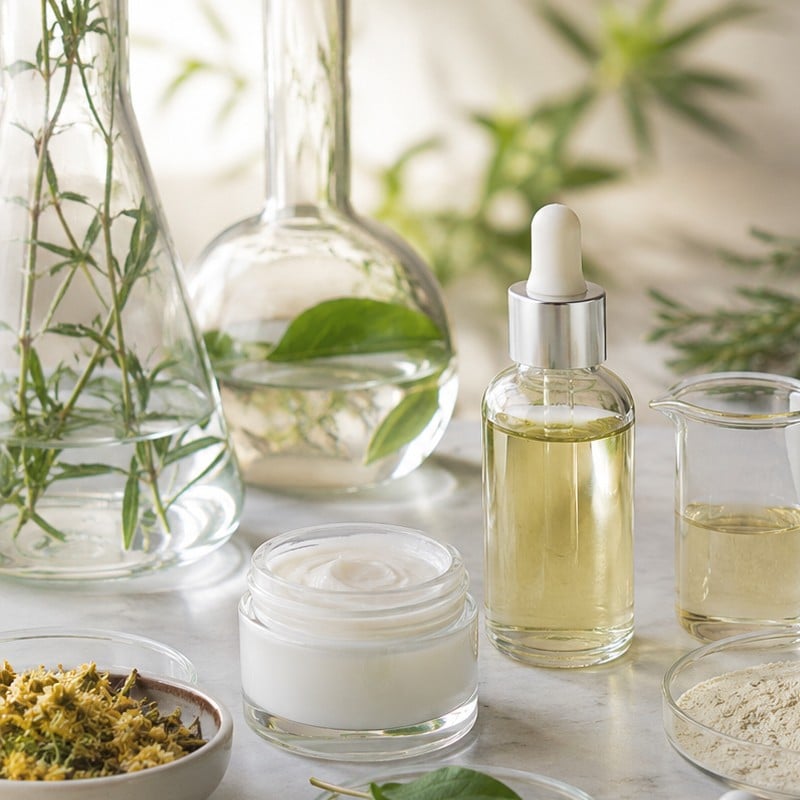

European cosmetic legislation does not create a separate legal category for “natural cosmetics”. Instead, all cosmetic products placed on the EU market must comply with the same legal framework, regardless of ingredient origin.
The central reference is the European Cosmetic Regulation, Regulation (EC) No 1223/2009, which establishes the requirements for product safety, ingredient restrictions, labeling, claims, and market surveillance across all Member States.
Are “Natural Cosmetics” Legally Defined?
One of the most common misunderstandings in the cosmetic sector is the assumption that “natural cosmetic” is a legally protected term in the European Union. In reality, EU legislation does not currently provide an official legal definition for either “natural” or “organic” cosmetics.
This means that a product marketed as natural is still subject to exactly the same safety obligations as any conventional cosmetic formulation. A botanical extract, essential oil, or mineral ingredient is not automatically considered safer simply because it originates from nature.
Instead of defining natural cosmetics through binding legislation, the EU relies on general rules governing cosmetic claims. These rules are established through Regulation (EC) No 1223/2009 and Commission Regulation (EU) No 655/2013. Under these frameworks, any claim such as “natural,” “green,” “clean,” or “organic” must be truthful, substantiated, and not misleading to consumers.
As a result, manufacturers must be particularly careful when communicating the natural character of a product. Marketing language cannot imply superior safety, efficacy, or regulatory approval unless evidence exists to support those statements.
The Safety Principle: Natural Does Not Mean Exempt
European cosmetic legislation is fundamentally risk-based rather than origin-based. The key principle is that every cosmetic product must be safe for human health under normal or reasonably foreseeable conditions of use.
This requirement applies equally to plant extracts, synthetic preservatives, essential oils, laboratory-produced peptides, mineral pigments, biotechnology-derived ingredients, etc.
A natural ingredient can present toxicological concerns just as a synthetic ingredient can. Essential oils, for example, may contain allergens, phototoxic compounds, or sensitizers that require careful concentration limits and labeling obligations.
Likewise, many synthetic ingredients have undergone decades of toxicological evaluation and may offer greater formulation stability, microbiological protection, or consistency than some natural alternatives.
Under EU rules, all cosmetic products require a safety assessment performed by a qualified safety assessor before being placed on the market. This assessment forms part of the Product Information File (PIF), a mandatory compliance document.
Claims and Greenwashing Risks
The growing demand for sustainable and natural cosmetics has also increased regulatory scrutiny around environmental and ethical marketing claims.
European authorities are paying closer attention to potential greenwashing practices, particularly where vague expressions such as “eco-friendly,” “chemical-free,” or “non-toxic” are used without adequate substantiation.
From a scientific and regulatory perspective, the term “chemical-free” is especially problematic because all cosmetic ingredients, including water and plant oils, are chemicals.
Claims must therefore remain accurate, verifiable, and understandable to the average consumer.
Manufacturers should ensure that natural-origin claims are supported by clear criteria and internal documentation. Many companies voluntarily rely on private certification schemes or international standards, such as ISO 16128, to calculate natural origin indexes. However, these standards do not replace legal compliance obligations under EU cosmetic law.
Preservation Challenges in Natural Formulations
Natural cosmetic formulations often present additional technical and regulatory challenges, particularly regarding preservation systems.
Consumers increasingly request products free from certain synthetic preservatives, yet cosmetics must remain microbiologically safe throughout their shelf life and use period.
Inadequate preservation can create serious safety risks, including microbial contamination by bacteria, yeast, or mold. For this reason, formulators working with natural concepts frequently need to balance consumer expectations with microbiological stability, packaging compatibility, product shelf life and regulatory compliance.
This balance is one of the most technically demanding aspects of modern cosmetic formulation.
Towards a More Scientific Consumer Understanding
The opposition between natural and synthetic cosmetics is often oversimplified in public discourse. European cosmetic regulation instead adopts a scientific and evidence-based approach focused on safety, exposure, toxicology, and consumer protection.
For manufacturers, understanding this distinction is essential. Compliance is not determined by marketing terminology or ingredient origin, but by demonstrating that a cosmetic product is safe, properly documented, and honestly presented to consumers.
As the cosmetic industry continues evolving toward sustainability, biotechnology, and greener formulation strategies, regulatory literacy will become increasingly important for both brands and consumers navigating the future of cosmetic innovation.


