
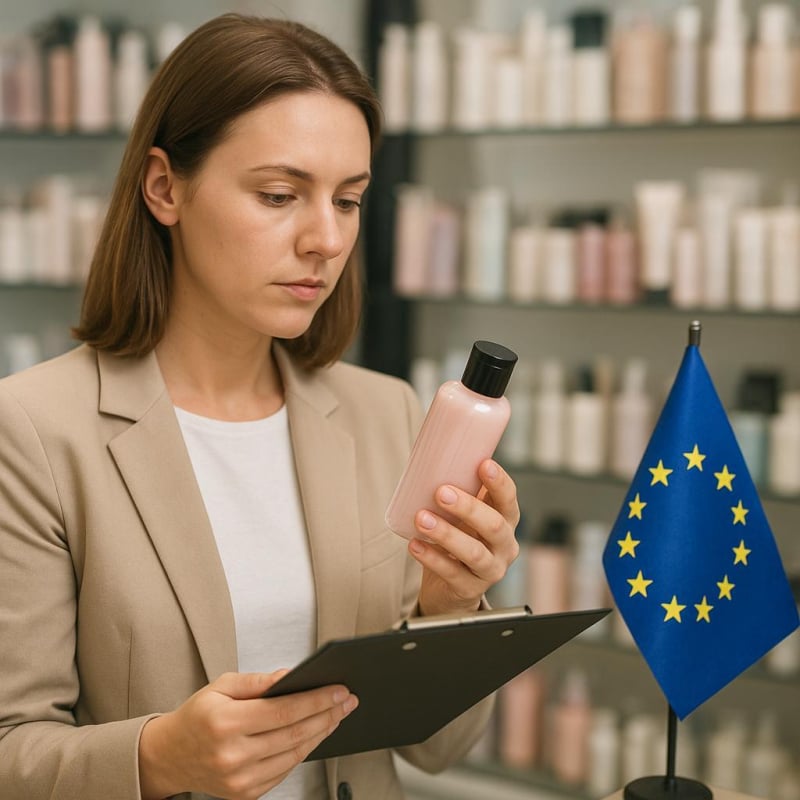
Most peopel ask this because “license” sounds official and scary.The honest answer is simpler. In the European Union you do not get a traditional license to sell cosmetics,but you do have to meet strict pre-market requirements before a product can be placed on the EU market. Think documented safety, labeling, and having a nominated Responsible Person in the EU. If you skip those, your products can be pulled from shelves or customs.
Do you need a license to sell cosmetics in Europe?
Short answer. No classic business license applies to cosmetic products across the EU. Brands do not apply for a pan‑EU permit. You follow the EU Cosmetics Regulation (EC) No 1223/2009, appoint an EU Responsible Person, build a Product Information File with a Cosmetic Product Safety Report, and notify the product on the CPNP before sale.That is your green light.
What “no license” really means
EU law treats cosmetics as low-risk consumer products that need pre-market compliance, not ministerial approvals. Approval is self-declared but backed by evidence. Market surveillance authorities check files,labels,claims,and safety if something looks off or consumers complain.
Who needs what: roles explained
If you plan to sell cosmetics in Europe, your obligations depend on your role. The law is very precise here.
Manufacturer or brand owner
– Based in the EU: you are typically the Responsible Person unless you designate another company in writing.
– Based outside the EU: you must appoint an EU-based Responsible Person. Without one, the product cannot be placed on the EU market.
Importer into the EU
– The importer becomes the Responsible Person by default if the brand does not appoint one.
– Importers must verify labeling, language, and the existence of a complete PIF and CPSR before placing stock on the EU market.
Distributor or retailer
– Distributors check label language,batch numbers,shelf life indicators,and storage conditions.
– If you re-label, translate, or substantially modify a product, you may become the responsible Person.
Marketplace sellers and private label
– White-label products need the same files as any branded item.Your name on the label makes you the Responsible Person unless your contract says or else.
– marketplaces can request your CPNP notification reference and RP details, especially after compliance sweeps.
Core requirements under the EU Cosmetics Regulation
Here is the practical list that replaces the idea of a license.
– Responsible Person in the EU
You must have a single Responsible Person with a name and EU postal address on the label. The RP keeps regulatory files, handles serious adverse effect reporting, and deals with authorities.
– Product Information File
Keep a PIF for each product at the RP address for ten years after the last batch is placed on the market.This is the technical pack inspectors ask for first.
– Cosmetic Product Safety Report
A CPSR signed by a qualified safety assessor sits inside the PIF. It covers toxicology of ingredients, exposure scenarios, margins of safety, microbiological quality, and impurities. no CPSR, no sale.
– CPNP notification
Notify the product on the Cosmetic products Notification portal before first placement on the EU market. You submit the product identity, function, RP details, frame formulation, label art, and photo.
– Good Manufacturing Practise
Manufacture under GMP. In practice, ISO 22716 is used. Keep batch records, traceability, and recall procedures.
– Ingredient rules and annexes
Comply with Annex II banned substances, Annex III restricted substances with conditions, colorants in Annex IV, preservatives in Annex V, and UV filters in Annex VI. Watch SCCS opinions for changes.- Nanomaterials
Declare nanomaterials in the CPNP and label the ingredient with [nano]. Some nanomaterials require a longer notification window.
– Animal testing ban
Finished cosmetic products and cosmetic ingredients cannot be tested on animals for EU cosmetic purposes. REACH may still require certain data for worker safety though. A clean marketing claim must not mislead.
– Labeling requirements
Labels must display: product function, nominal content, date of minimum durability or PAO, batch number, precautions, country of origin if made outside the EU, the Responsible Person name and address, and the ingredient list using INCI. Fragrance allergens above thresholds must be listed. Language must match the consumer’s country.
– Claims and proof
Claims must meet the common criteria regulation. Keep substantiation for “dermatologically tested,” “clinically proven,” “hypoallergenic,” or SPF. Medical claims will reclassify the product into medicine or medical device territory and that is a different world.
– Cosmetovigilance
Record and evaluate adverse events. Report serious adverse effects to authorities through the Responsible Person without delay.
Pre-market checklist you can actually use
Checklist table for EU cosmetic compliance
| Step | What it means | Who | Proof kept |
|---|---|---|---|
| Define RP | Appoint EU Responsible Person and set address on label | Brand or importer | Mandate letter, service contract |
| Safety assess | CPSR by qualified assessor with toxicology and MoS | Safety assessor | Signed CPSR Part A and B |
| Build PIF | Collect formula, specs, stability, microbiology, claims data | RP with manufacturer | PIF index and sections |
| GMP | Make under ISO 22716 style controls | Manufacturer | GMP certificate or SOP set |
| Label review | INCI list, allergens, warnings, PAO/date, country of origin | RP | final artworks, translations |
| CPNP | Notify before sale, upload label and product photo | RP | CPNP reference number |
| Claims proof | Keep test reports and user trials | Brand | reports, protocols |
| Post-market | Track complaints and serious adverse effects | RP | Cosmetovigilance log |
What counts as a cosmetic in Europe
A cosmetic is a substance or mixture intended to be placed in contact with external parts of the human body or teeth and oral mucosa for cleaning, perfuming, changing appearance, protecting, keeping in good condition, or correcting body odours. If you claim to treat a disease or modify physiological functions, you are leaving cosmetic land. That reclassification triggers different laws.
Country and region notes
Europe is not one box. Here is the quick map.
EU and EEA
– EU member states plus EEA countries like Norway, Iceland, and Liechtenstein apply Regulation 1223/2009.
– CPNP notification is valid across all thes markets once you have the right language on the label.
United Kingdom
– Great Britain runs the UK Cosmetics Regulation. Appoint a UK Responsible Person,hold a PIF in the UK,and notify on the UK SCPN portal.- Northern Ireland follows EU rules and uses the CPNP. Products for both GB and NI often need dual RP addresses and dual notifications.
Switzerland
– Swiss rules are aligned with the EU in spirit. A Swiss RP and local notification may be required for sale in Switzerland. Labels need the CH RP address.
Microbrands and artisans
– handmade does not mean exempt. Soap bars, balms, oils, and scrubs still need a CPSR, PIF, CPNP, and proper labeling before you sell at a market or online.
Selling cosmetics online to EU consumers
– If a consumer in the EU can buy your product, that product must be compliant.
– Platforms ask for CPNP proof and RP details during safety checks.
– Ads and website copy count as claims. Keep your words consistent with your evidence.
Typical pitfalls that delay launch
– Using non-INCI names on labels. Switch to INCI and list fragrance allergens when above the threshold.
– Forgetting country of origin for products made outside the EU.
– No RP address on pack or using a PO box not allowed for official mail.
– Stability or microbial testing skipped on water-based products.
– Using a restricted preservative or colorant outside its allowed conditions.
– Claims that push the product into medicine territory.
– CPNP submitted with fuzzy photos or mismatched label files.
Costs and timelines to expect
– CPSR and PIF preparation per SKU can range from modest for simple anhydrous balms to higher for complex emulsions and leave-ons.
– ISO 22716 setup ranges from light-touch documentation for small contract manufacturers to full system audits for bigger plants.
– CPNP timing is fast once your files are ready. The long pole is usually testing and safety assessment.
– Plan 4 to 12 weeks from formula lock to market-ready, depending on stability studies and data you already hold.
Benefits of doing it right
– Faster customs clearance and fewer headaches with marketplaces.
– Stronger consumer trust when your labels look professional and consistent.
– Easier scale into new EU countries since the regulation is harmonized.
– Lower recall risk and better insurance conversations.
Practical tips that save launch time
– Lock your formula before design so the INCI list and allergens do not change mid-artwork.
– Keep a clean archive of all versions of the label with dates. Inspectors ask for “the one on shelf.”
– Ask your safety assessor early about fragrance allergens, leave-on vs rinse-off, and SPF claims.
– Translate mandatory label text early for your first two markets.
– If you switch manufacturer, update the PIF with new GMP evidence and stability data.
Mini case snapshots
– US indie sunscreen. They tried to sell as a cosmetic SPF. Their UV filters were not on the EU positive list. They pivoted to a non-SPF tinted cream for the EU and built a new product line with allowed UV filters later.
– Natural soap maker. Thought “handmade” meant informal. They obtained a group CPSR covering fragrance variations, updated labels to INCI with allergen disclosure, and cleared CPNP. Weekend markets were suddenly compliant and stress-free.
Frequently asked questions
– Do I need a government license to sell cosmetics in Europe
No. you need to meet the EU Cosmetics Regulation requirements, appoint an EU Responsible Person, keep a PIF with a CPSR, and notify on the CPNP.
– Can I sell the same product across all EU countries once notified
Yes, provided the product follows the regulation, and your label is in the right language for each country.
– I manufacture outside the EU.Can I still sell in Europe
Yes. Appoint an EU Responsible Person, follow GMP, complete the CPSR and PIF, and submit a CPNP notification before sale.
– Is animal testing allowed for EU cosmetics
No for cosmetic purposes. Do not market products as tested on animals. Keep marketing claims accurate.- Do I need to notify poison centres
Cosmetics sit outside the CLP mixture notification in many cases, yet some member states have processes. Your RP and safety assessor will flag any special steps.
– Are essential oils a problem
They can be safe in the right dose. You still need toxicology review,allergens on the label if thresholds are reached,and a CPSR that covers the blend.
Conclusion
You do not get a paper license to sell cosmetics in Europe. You prove safety and compliance through the Responsible Person, the Product Information File, the CPSR, GMP, and CPNP notification. That framework is your real permission to trade. Treat it like part of product growth, not an afterthought, and Europe opens up with far fewer roadblocks.
