


Titanium dioxide (TiO₂) is widely used across several industries, including cosmetics, paints, plastics, and food. For a period of time, it had been classified in the European Union as a suspected carcinogen when inhaled in powder form. On 1 August 2025, the Court of Justice of the European Union (CJEU) annulled that classification after nearly...
A cosmetics company introduced two AI-based technologies designed to assess the biodegradability and safety of cosmetic ingredients. These tools manage the collection and analysis of large datasets related to ingredient evaluation. The development forms part of an effort to combine digital transformation with research expertise. The technologies support research processes and address environmental and safety...
The US Food and Drug Administration (FDA) has reinforced requirements related to tamper-proof packaging for certain personal care products. The update focuses on strengthening consumer safety by lowering contamination risks that can happen if cosmetic products are tampered with. The rules already existed, though the agency released updated guidance that clarifies expectations. This guidance aligns...
Sunscreen products in Europe are treated as cosmetic products, so they must follow Regulation (EC) No. 1223/2009 on cosmetic products. This regulation sets the rules for safety, ingredients, labeling, and marketing before a product can be sold in the European Union. The European Commission has also issued recommendations on sunscreen efficacy and claims that manufacturers...

On 10 February 2026, the European Chemicals Agency (ECHA) published the Response to Comments (RCOM) on the proposed classification of sodium fluoride. This document followed a three-month public consultation on France’s proposal to classify sodium fluoride as Repr. 1B under the Classification, Labelling and Packaging (CLP) of Substances and Mixtures Regulation. The proposal and consultation...

Two AI-based technologies have been introduced to assess cosmetic ingredients. One focuses on biodegradability and the other identifies safety information. Cosmetic ingredient evaluation requires collecting and analyzing large datasets, and these tools were created with that in mind. The technologies are intended to support research related to environmental issues and human safety in cosmetics. Key...
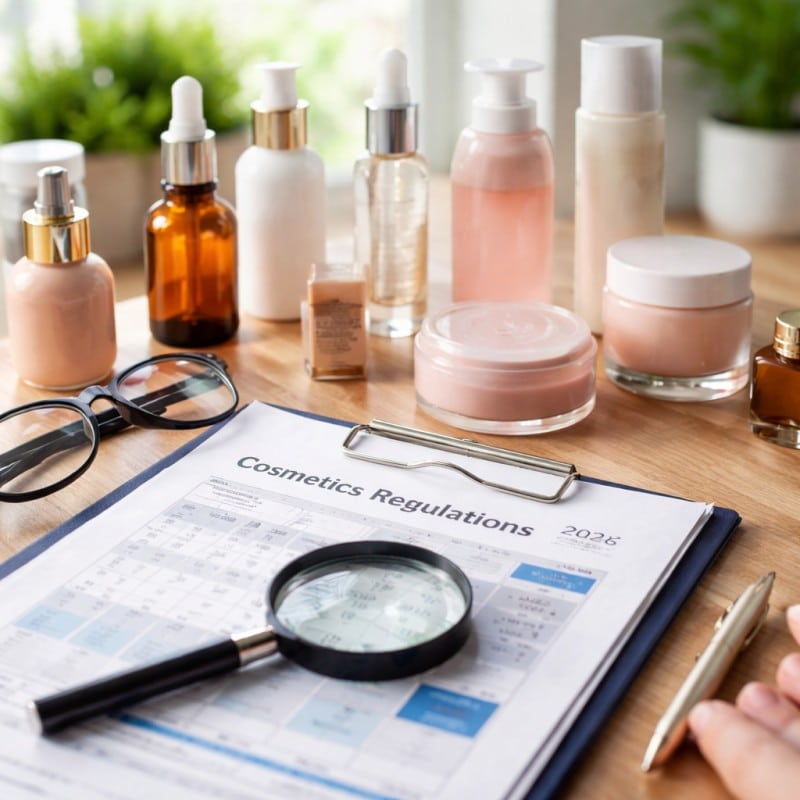
The year 2026 brings quite a few regulatory deadlines that affect cosmetic product labelling across several territories. These include the European Union, United Kingdom, Switzerland, Canada, and the United States. Some of these deadlines influence not only product formulation but labelling compliance as well. Companies placing cosmetic products on these markets should prepare early so...

In January 2026, the Health and Safety Executive (HSE) released its assessment report about talc used in cosmetic products. The technical report looks at the proposed CMR classifications for talc under the GB Classification, Labelling and Packaging Regulation (GB CLP Regulation). According to the UK Agency, the available data are not sufficient to support classification...