
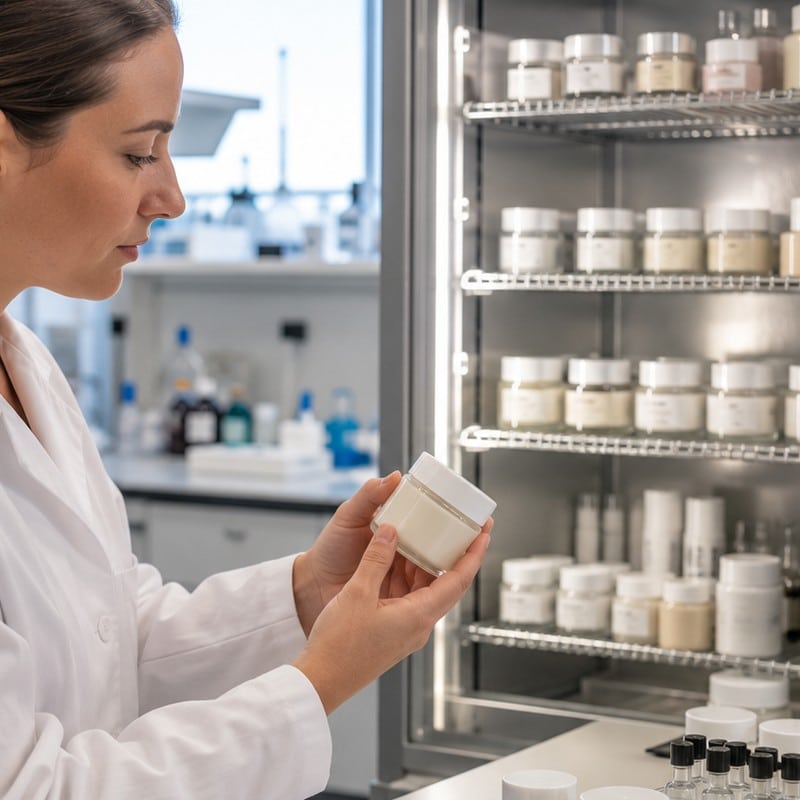
Answering these questions is one of the main objectives of stability testing. Since waiting several years before launching a product is rarely practical, laboratories often use accelerated stability testing to predict how a cosmetic may behave over time.
Although accelerated studies cannot reproduce every aspect of long-term storage, they are widely used throughout the cosmetics industry to support product development, estimate shelf life, and identify potential formulation or packaging issues before products reach consumers.
What is accelerated stability testing?
Accelerated stability testing is a laboratory study in which cosmetic products are stored under conditions that are more demanding than normal storage. The aim is to speed up physical and, to some extent, chemical changes that might occur during the product’s lifetime.
Instead of storing samples only at typical room temperature, laboratories expose them to controlled conditions such as elevated temperatures, humidity or repeated temperature cycles. By increasing the stress placed on the product, potential stability problems can often be detected within a few months rather than after several years.
This approach allows manufacturers to obtain valuable information much earlier in the product development process.
Typical accelerated storage conditions
Although testing protocols vary between laboratories, accelerated studies generally involve storing products under one or more controlled environmental conditions that place additional stress on the formulation.
Elevated temperatures are among the most common conditions because higher temperatures accelerate many physical and chemical processes. Some protocols also include alternating heating and cooling cycles to simulate changing environmental conditions that products may experience during transport or storage.
Depending on the formulation, laboratories may also evaluate the effects of humidity, light exposure or repeated freeze-thaw cycles where appropriate.
The selected conditions should always be scientifically justified and suitable for the specific type of cosmetic being evaluated.
What do laboratories evaluate?
Accelerated stability testing involves much more than simply checking whether a product still looks acceptable.
Throughout the study, laboratories monitor a range of physical and chemical characteristics to detect signs of instability. These commonly include:
- Appearance, colour and odour
- pH (where applicable)
- Viscosity or texture
- Phase separation in emulsions
- Sedimentation or crystallisation
- Container integrity and product-package interactions
The exact parameters depend on the formulation. For example, an emulsion requires different evaluations than an anhydrous oil, while a shampoo presents different stability considerations from a pressed powder.
What types of instability can be detected?
Accelerated studies are designed to reveal problems before products reach the market.
Physical instability may appear as phase separation, changes in viscosity, sediment formation, colour changes or loss of homogeneity.
Chemical instability may involve oxidation, degradation of active ingredients or changes affecting fragrance and appearance.
Packaging-related issues can also become evident during accelerated storage, including deformation of containers, leakage or undesirable interactions between the formulation and the packaging material.
Identifying these problems during development is considerably easier and less expensive than addressing them after commercial launch.
Advantages of accelerated stability testing
One of the main benefits is speed. Manufacturers can obtain meaningful information within a relatively short period, allowing product development to continue without waiting for long-term storage studies.
Accelerated testing also supports formulation optimisation by identifying weaknesses before commercial production. Alternative preservatives, emulsifiers, antioxidants or packaging systems can be evaluated efficiently while the product is still under development.
From a business perspective, early identification of stability problems reduces the likelihood of costly reformulation, product recalls or customer complaints after launch.
Limitations of accelerated studies
Although accelerated testing is extremely valuable, it has important limitations.
Laboratory conditions are intentionally more severe than normal storage, meaning they cannot reproduce every situation that a product may experience during its lifetime. Consumer behaviour, transportation conditions and environmental factors vary considerably and cannot all be simulated.
Certain degradation mechanisms also occur independently of temperature or develop over very long periods, making them difficult to predict using accelerated methods alone.
For these reasons, accelerated stability testing should be considered one component of a broader stability assessment rather than a complete replacement for other available evidence. Manufacturers may combine accelerated studies with packaging compatibility assessments, microbiological evaluations and other laboratory analyses to build a complete picture of product performance. Depending on the product and the available development timeline, additional long-term observations may also contribute to supporting the proposed shelf life.
A well-designed stability programme considers the characteristics of the formulation, its intended packaging and the expected storage conditions throughout the product’s commercial life.


