
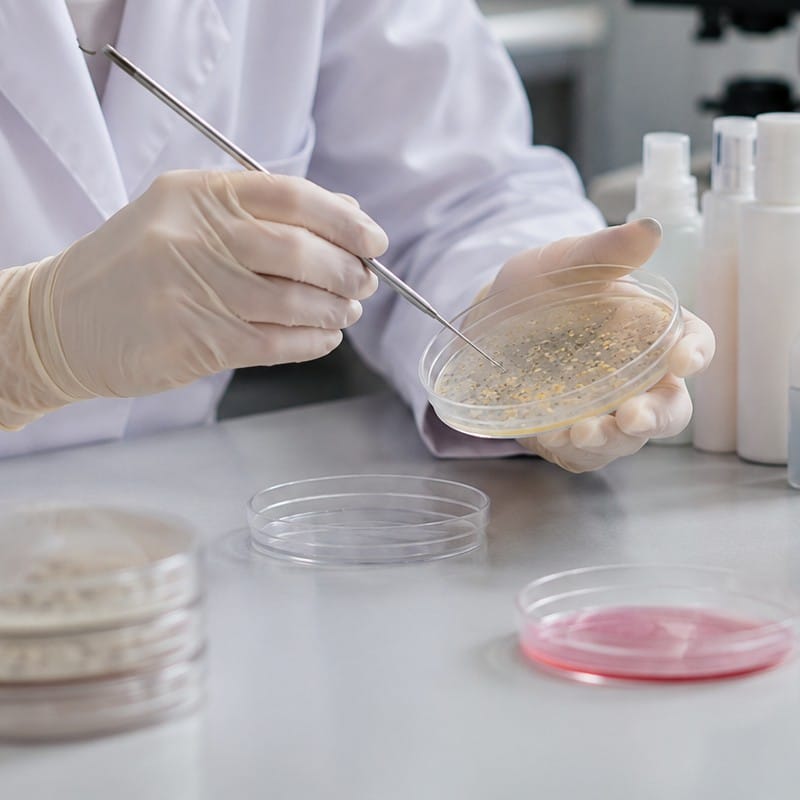
Microbiological testing is therefore a fundamental part of cosmetic safety assessment and quality control. It helps manufacturers verify that products are free from harmful microbial contamination and that preservation systems can adequately protect products during normal use.
What is microbiological quality testing?
Cosmetic products can provide favourable conditions for microbial growth, particularly when they contain water. For this reason, manufacturers must carefully evaluate and control microbiological risks throughout the product lifecycle.
Microbiological quality testing evaluates whether a cosmetic product contains microorganisms and whether those microorganisms are present at acceptable levels.
The objective is not necessarily to achieve complete sterility. Most cosmetics are not sterile products. Instead, the goal is to ensure that microbial contamination remains sufficiently low and that objectionable microorganisms are absent.
Testing typically includes the determination of the total number of viable microorganisms present in a sample, together with the search for specific microorganisms that are considered particularly relevant for cosmetic safety.
The exact testing strategy depends on the product category, formulation, intended users, and method of application.
Specified microorganisms of concern
Certain microorganisms are regarded as particularly important because of their potential to cause infections or indicate inadequate manufacturing hygiene.
Among those commonly monitored in cosmetic products are:
- Pseudomonas aeruginosa
- Staphylococcus aureus
- Candida albicans
- Escherichia coli
Their presence may suggest contamination during manufacturing, handling, or storage and represent an unacceptable risk, especially in products intended for sensitive areas of the body or vulnerable consumer groups.
Which products require microbiological testing?
Virtually all cosmetic products require some degree of microbiological evaluation, although the extent of testing may vary.
Products with a high water content, such as creams, lotions, shampoos, liquid soaps, and gels, typically require comprehensive microbiological assessment because they can support microbial growth.
In contrast, products with very low water activity, such as certain anhydrous oils or powders, may present a lower microbiological risk. Nevertheless, manufacturers must still justify their safety through an appropriate risk assessment.
The final testing strategy should always be based on the specific characteristics of the product rather than applying a single approach to all formulations.
Microbiological testing and Good Manufacturing Practice
Testing alone cannot guarantee product safety. Effective microbiological control begins long before samples reach the laboratory.
European regulations require cosmetic products to be manufactured according to Good Manufacturing Practice (GMP), commonly demonstrated through compliance with ISO 22716.
Good manufacturing practices help minimise contamination risks by controlling factors such as: raw material quality, water systems, equipment hygiene, personnel practices, environmental conditions, and packaging processes.
Microbiological testing therefore acts as a verification tool within a broader quality management system rather than as a substitute for good manufacturing controls.
What do microbiological results tell us?
Microbiological testing provides valuable information about the overall quality and safety of a cosmetic product.
Consistently satisfactory results can indicate that:
- manufacturing processes are under control;
- preservation systems are effective;
- raw materials and packaging are suitable;
- products are likely to remain safe throughout their intended shelf life.
Conversely, unexpected results may reveal formulation weaknesses, preservation issues, hygiene deficiencies, or contamination sources that require investigation.
For manufacturers, these data support both regulatory compliance and continuous product improvement.
The role of accredited laboratories
Microbiological testing should be carried out using validated methods and appropriate quality controls. Accredited laboratories play an important role by providing reliable and reproducible results that support regulatory documentation and product safety assessments.
Laboratory expertise is particularly valuable when interpreting results, designing testing plans, and addressing unexpected microbiological findings during product development or routine quality control.


