

After the public consultation period and review of stakeholder comments, the final opinion was adopted in April 2026.
It is important to remember that the SCCS provides scientific guidance on safety, not regulation. However, since its conclusions may lead to future regulatory restrictions at EU level, it is advisable to anticipate these developments and align with its recommendations early on.
A Growing Ingredient in Cosmetic Formulation
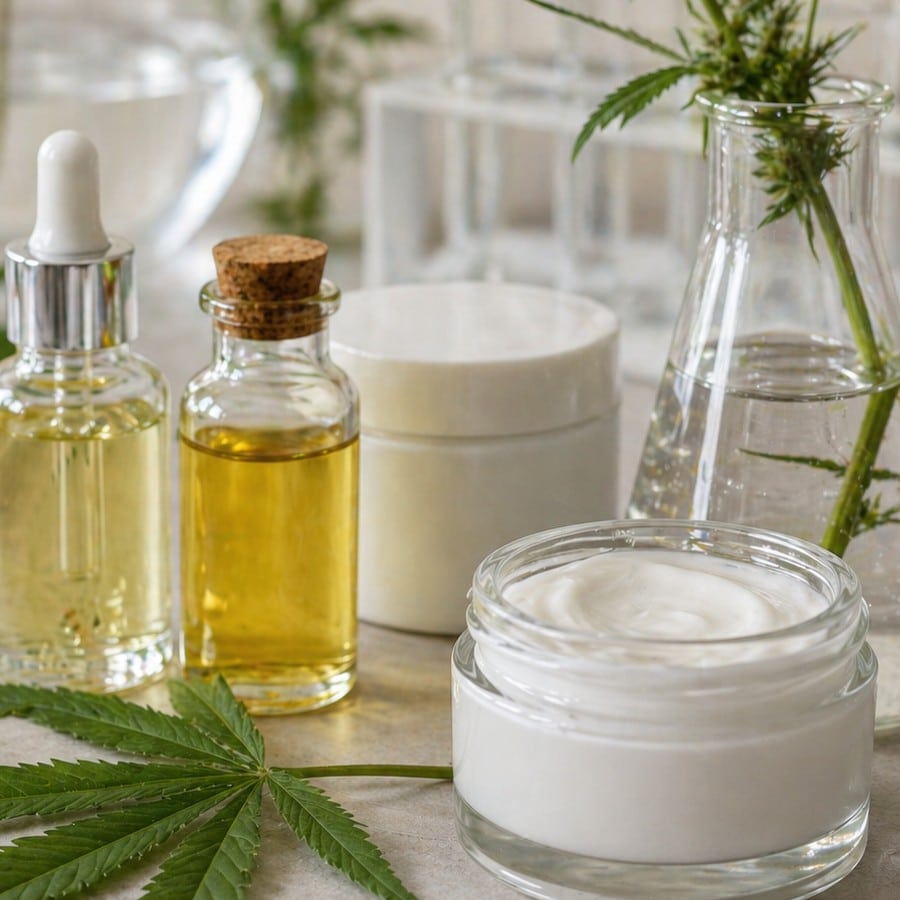
The use of CBD in cosmetics has increased significantly in recent years, becoming a common ingredient in a wide range of formulations.
CBD used in cosmetics may be obtained from parts of Cannabis sativa that are not considered narcotic under EU law (such as seeds and certain extracts of leaves and stems with no THC), or produced synthetically.
Its use is mainly linked to the following cosmetic functions:
- Skin conditioning
- Antioxidant properties
- Sebum-regulating effects
Key Findings from the SCCS Final Opinion
The SCCS assessed CBD considering combined exposure from dermal and oral cosmetic products.
Safe concentration of CBD
According to the SCCS:
- CBD is considered safe up to 0.19%
- This applies to dermal and oral cosmetic products, whether used alone or in combination
THC content as an impurity
The presence of delta-9-tetrahydrocannabinol (THC) as an impurity in CBD was also evaluated. The SCCS concluded that:
- THC is considered safe up to 0.00025%
- This limit applies to dermal and oral cosmetic products, whether used alone or in combination
Regulatory Implications: What to Expect
The SCCS opinion:
- Does not introduce legal obligations
- Does not modify current legislation (Regulation (EC) No 1223/2009)
However, its conclusions may be used by the European Commission to support future regulatory decisions.
This could potentially result in:
- The establishment of concentration limits
- The inclusion of CBD in Annex III (substances allowed with restrictions)
For now, these measures have not been adopted.
Preparing for Possible Changes
Although there are no immediate legal changes, companies using CBD may consider:
- Reviewing raw material specifications, including THC content
- Checking whether formulations comply with the 0.19% level identified as safe
- Following future regulatory developments closely
Final Takeaway
The SCCS final opinion defines clear safety thresholds for CBD and THC in cosmetic products.
While it does not create legal restrictions, it represents an important step that may shape future EU regulation.
For manufacturers, staying informed and prepared will be key to ensuring continued compliance.
