
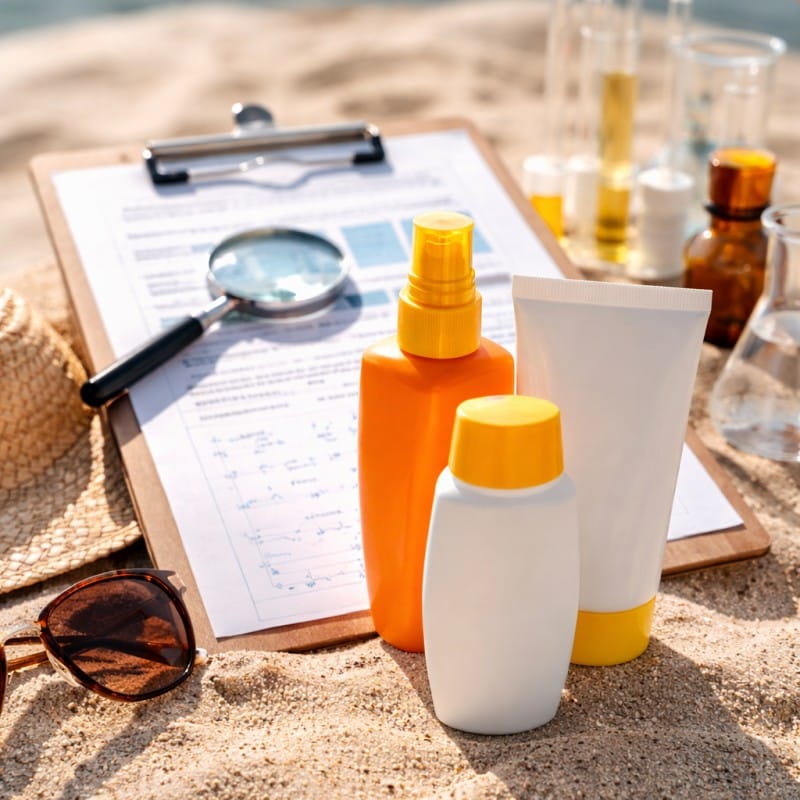
Sunscreen products in Europe are treated as cosmetic products, so they must follow Regulation (EC) No. 1223/2009 on cosmetic products. This regulation sets the rules for safety, ingredients, labeling, and marketing before a product can be sold in the European Union. The European Commission has also issued recommendations on sunscreen efficacy and claims that manufacturers should consider during product development. These recommendations focus mainly on how well sunscreens protect against UV radiation and how this protection is communicated to consumers.
Sunscreen Products Under EU Cosmetic Regulation
In the European Union, sunscreen products are considered cosmetics rather than medicines. That means they must comply with the requirements set out in Regulation (EC) No. 1223/2009.
A sunscreen product is defined as a preparation intended to be placed in contact with the skin to protect it from ultraviolet radiation. This protection can happen by absorbing, scattering, or reflecting UV radiation. Sunscreens may appear in several product formats such as creams, oils, gels, or sprays.
To be marketed in the EU, these products must be safe for human health and comply with the regulatory requirements for cosmetic products.
Minimum Efficacy Requirements
The European Commission established recommendations that define the minimum efficacy sunscreen products must achieve before being marketed in the EU. These recommendations focus on three main elements related to protection against UV radiation.
UVB protection
A sunscreen product must have a Sun Protection Factor (SPF) of at least 6. Products with an SPF below 6 cannot be classified as sunscreen products.
UVA protection
The UVA protection factor must be at least one-third of the SPF value indicated on the label.
Critical wavelength
The minimum critical wavelength required for a sunscreen product is 370 nm.
These criteria help confirm that sunscreen products offer balanced protection against both UVA and UVB radiation.
Testing Methods for Sunscreen Products
To verify the level of protection provided by sunscreen products, specific testing methods must be used. These tests must be standardised, reproducible, and capable of evaluating factors such as photo-degradation.
The most common tests include:
-
SPF testing: Conducted according to the International Sun Protection Factor Test Method ISO-EN-UNE 24444 (in vivo) or other in-vitro methods.
-
UVA protection testing: Determined using the Persistent Pigment Darkening (PPD) method, modified by the French health agency Agence française de sécurité sanitaire des produits de santé (Afssaps) under ISO-EN-UNE 24443, or using in-vitro methods.
-
Critical wavelength testing: Performed according to the ISO-EN-UNE 24443 method.
Results from these tests determine the level of protection that can be claimed on the product label.
Protection Categories for Sunscreen Products
Based on the SPF test results, sunscreen products can be classified into four protection categories:
-
Low protection
-
Medium protection
-
High protection
-
Very high protection
These categories are used on product labels to help consumers understand the level of protection provided.
Claims and Warnings for Sunscreen Products
The European Commission provides guidance on the types of claims that should not be used on sunscreen products. Claims suggesting complete protection from UV radiation are not allowed. Examples include statements such as:
-
“sunblock”
-
“sunblocker”
-
“total protection”
Claims suggesting that sunscreen does not need to be reapplied, such as “all-day prevention,” should also not be used.
Sunscreen labels should include warnings reminding consumers about safe sun exposure. Examples include:
-
“Do not stay too long in the sun, even while using a sunscreen product.”
-
“Keep babies and young children out of direct sunlight.”
-
“Over-exposure to the sun is a serious health threat.”
Manufacturers are encouraged to provide instructions for use on product labeling, including information about applying sunscreen before sun exposure and reapplying it regularly, especially after swimming, perspiring, or towelling.
Conclusion
Sunscreen products marketed in the European Union must comply with EU Cosmetics Regulation (EC) No. 1223/2009 and the European Commission recommendations on sunscreen efficacy and claims. Products must provide protection against both UVA and UVB radiation, meet defined efficacy criteria, and be tested using recognised methods. Clear labeling, appropriate claims, and safety warnings are also required to help consumers understand how to use sunscreen products effectively.


