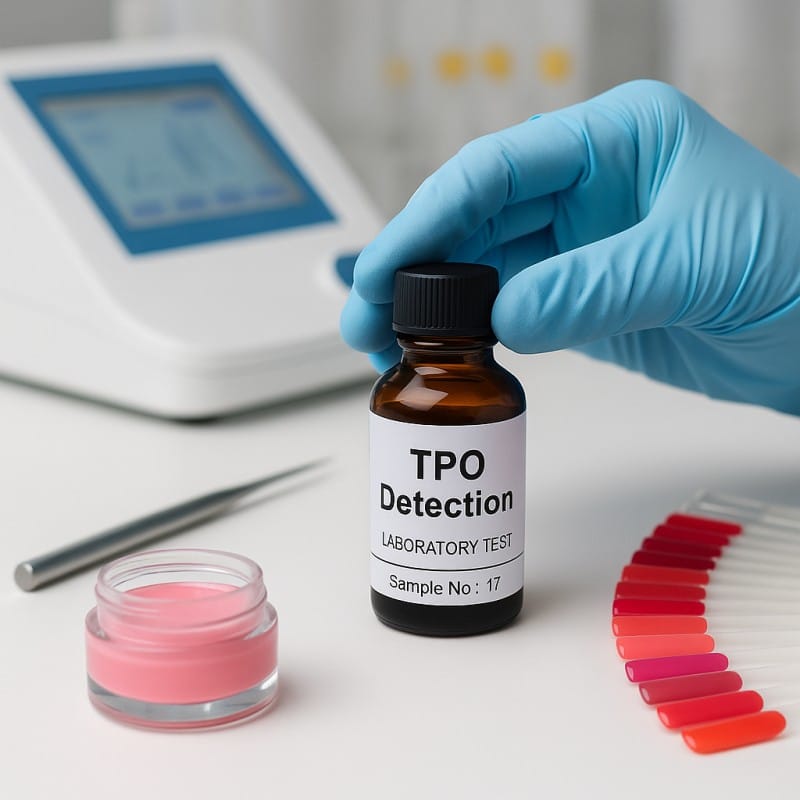
TPO Detection
€250.00
The TPO detection laboratory test for nail products is a specialized analytical procedure used to identify and quantify Trimethylbenzoyl Diphenylphosphine Oxide (TPO) — a photo-initiator that was widely used in UV-curable nail gels and coatings to initiate the polymerization process.
Purpose of the Test
The purpose of this test is to verify whether nail products contain TPO, which is banned for use in cosmetics and nail products within the European Union under Annex II of EU Cosmetic Regulation (EC) No 1223/2009. Despite its previous popularity for its efficiency in UV curing, TPO has been prohibited due to safety concerns, making its detection crucial for regulatory compliance, import screening, and product safety validation.
Why TPO Detection Is Important
-
Regulatory compliance: Since TPO is banned in the EU, the test confirms that cosmetic and nail formulations do not contain any trace of this restricted substance.
-
Safety assurance: TPO has been associated with potential skin sensitization, photoallergic reactions, and toxicological concerns, particularly with repeated exposure during UV curing of gel nails.
-
Market approval: Products found to contain TPO cannot legally be sold or distributed in the EU and EEA markets.
-
Quality and integrity: Detecting and eliminating banned substances like TPO ensures manufacturing transparency and consumer protection.
Methodology
The TPO Detection Test is performed using advanced analytical techniques capable of identifying even trace levels of TPO in finished nail products:
-
High-Performance Liquid Chromatography (HPLC)
-
Gas Chromatography–Mass Spectrometry (GC-MS)
-
Liquid Chromatography–Tandem Mass Spectrometry (LC-MS/MS)
These methods allow laboratories to detect and quantify TPO with high precision, ensuring compliance with EU cosmetic safety standards.
Test Procedure
-
A representative nail product sample (gel polish, top coat, or extension gel) is collected.
-
The sample undergoes solvent extraction to isolate any potential photoinitiators.
-
The extract is analyzed using chromatography and mass spectrometry to identify TPO and related substances.
-
Detected compounds are compared against certified reference standards for confirmation.
-
The final report includes the measured concentration (if any) and a clear compliance statement.
Results & Reporting
Laboratory reports typically include:
-
Detection of TPO and related photoinitiators (e.g., BAPO, HEMA photoinitiators).
-
Concentration data expressed in mg/kg or % w/w.
-
Method detection limits and analytical accuracy.
-
Compliance status according to EU Regulation (EC) No 1223/2009, confirming whether the product is free from banned photoinitiators.
Typical Applications
-
UV/LED nail gels and top coats
-
Hybrid gel polishes
-
Nail builder and extension gels
-
Nail primer and bonding agents
-
Ingredient verification for raw material suppliers
Why This Test Matters
Since TPO is explicitly banned in the European Union, manufacturers, distributors, and importers must ensure their nail products are completely free of TPO to legally place them on the market. The TPO Detection Laboratory Test provides reliable, science-based proof of compliance and helps prevent costly product recalls, customs detentions, and consumer safety issues.
Testing for banned substances like TPO is an essential part of cosmetic safety assessment, PIF (Product Information File) documentation, and Regulatory Compliance Verification under EU law. It demonstrates due diligence and commitment to safety — ensuring that nail products meet the highest European regulatory standards.